

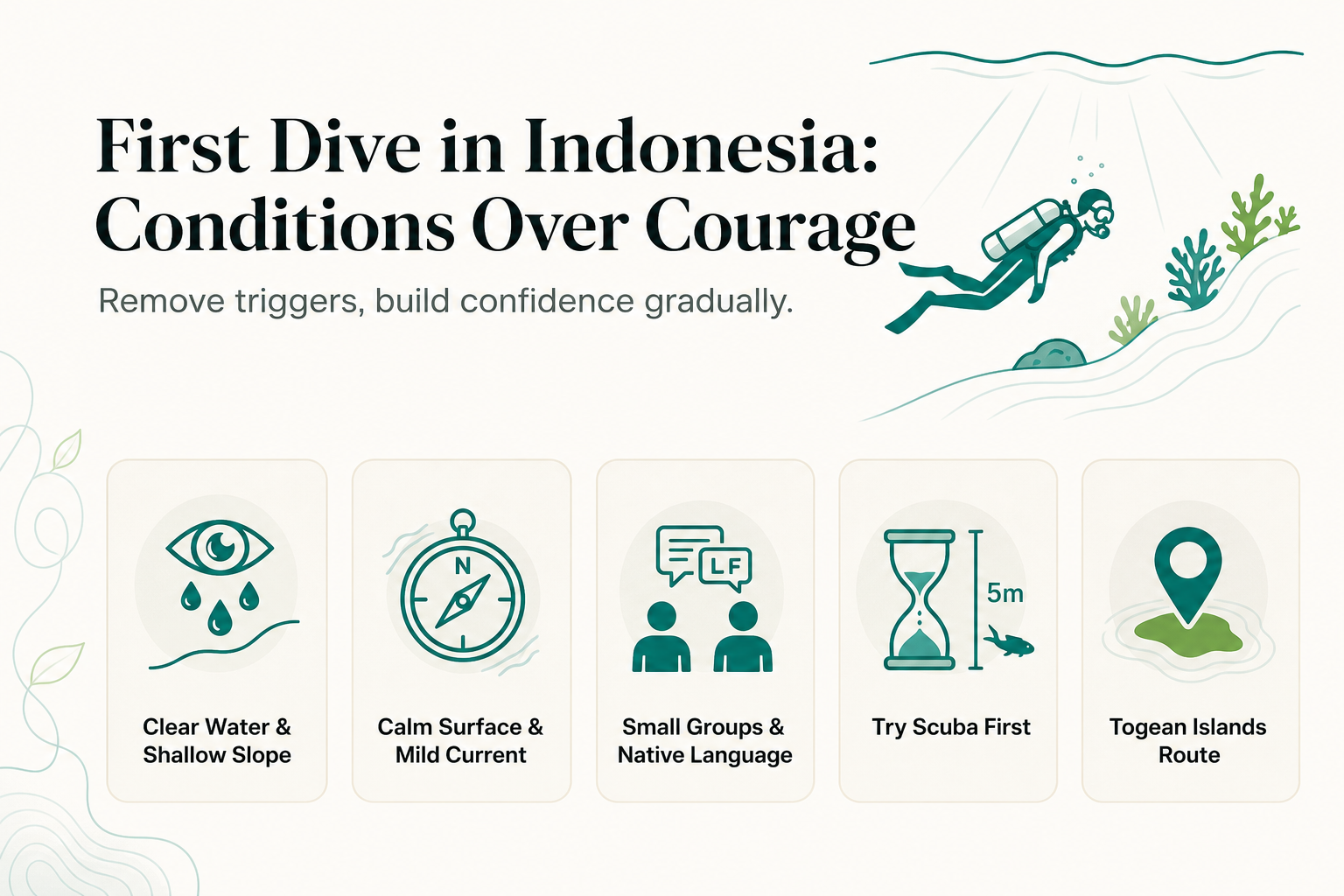
Many beginners do well in the pool, then freeze when the bottom disappears. The solution is to choose water that removes the triggers: a calm surface, clear visibility, mild current and small groups.
At Reconnect's SSI dive center in Indonesia's Togean Islands, we teach first-timers in those conditions.
TL;DR
- Fear of open water usually comes from specific, fixable triggers. Choose a destination for its conditions, not its reputation.
- Do a half-day Try Scuba (confined water, maximum 5 meters) before you pay for a full course.
- When choosing between SSI and PADI, the instructor, group size and teaching language matter more than the agency.
What causes fear of open water, and what reduces it?
Open-water anxiety is mostly a reaction to losing your reference points. That is why the destination does half the work.
In a pool, the walls and floor tell your brain exactly where you are. In deep or cloudy water those cues vanish, and the brain fills the blank with threat.
Think of driving in fog. The road has not changed, but losing sight of what lies ahead is enough to raise your pulse.
Clear water restores those cues.
| Trigger | What reduces it |
|---|---|
| No visible bottom or reef | Clear water, shallow sloping sites |
| Current pulling you off course | Mild-current sites, dives timed to the tides |
| Waves at the surface | Calm seas, short boat rides |
| Feeling rushed in a big group | Few divers per guide |
| Instructions in a second language | Teaching in your own language |
Where in Indonesia should a nervous beginner learn to dive?
Option 1: Bali, the Gili Islands or North Sulawesi (easiest to reach)
These are the areas most often recommended for beginners. In North Sulawesi, the usual pick is Bunaken near Manado. Their flight connections suit a short trip.
Option 2: The Togean Islands, Central Sulawesi (calm conditions, longer trip)
The Togeans are known for calm water and mild currents over fringing reef slopes, walls and volcanic pinnacles. UNESCO's 2019 biosphere reserve announcement counts 596 coral reef fish species in Togean Islands National Park ([unesco.org]).
The tradeoff is the route. The main access is a flight to Luwuk, usually via Makassar, then a five-hour drive to Ampana and a boat to the islands.
Option 3: Komodo (save it for later)
Komodo is known for strong currents. It rewards divers with logged experience and is a poor place to manage first-dive nerves.
Is scuba diving safe for a nervous first-timer?
Calm conditions lower the anxiety. Rules lower the actual risk, and recreational diving keeps beginners inside a narrow margin with a few fixed rules:
- Always dive with a buddy.
- Run a pre-dive equipment check every time.
- Never hold your breath.
- Stay within your certification's depth limit.
- Dive in daylight, in calm water with good visibility and little current.
On Buka Buka, our team follows SSI training standards, keeps emergency oxygen on site and includes first-aid certified staff. We cap groups at 4 divers per guide.
We confirm dive times each evening based on the weather, the tides and the planned sites, so you go to sleep knowing tomorrow's plan. We recommend DAN dive insurance, and travel insurance is mandatory.
How should you plan your first time scuba diving in Indonesia?
Pacing matters as much as conditions.
Step 1: Try Scuba
Try Scuba costs IDR 1,000,000 (about €50). If it feels wrong, you have lost a morning, not a course fee.
Step 2: The SSI Open Water course
- Duration: 3-4 days, including 4 open water dives
- Open water certification cost: IDR 6,900,000 (about €345)
- Depth limit once certified: 18 meters
- Where: reef sites around Buka Buka Island, a short boat ride out
- Language: English, French or Indonesian, small groups only
Learning in your first language matters more than it sounds. A nervous brain has little spare capacity for translating instructions underwater.
Step 3: Book rest days into the plan
Reconnect is an eco-resort with an on-site dive center. Full board covers meals, house-reef snorkeling, kayaking and paddleboarding. Courses are paid separately.
A snorkeling day off rebuilds confidence at no extra cost.
Frequently Asked Questions
Do I need to be a strong swimmer?
SSI lists the Open Water Diver prerequisite as being fit to swim, with no prior certification needed ([divessi.com]). Tell your instructor about your nerves beforehand so they can pace the session.
What is the minimum age for a first dive?
SSI sets the minimum age for core open water programs at 10. Our Try Scuba uses the same minimum.
Should I bring my own equipment?
A mask you already trust removes a common trigger: leaks. Bringing your own equipment earns a 5% discount.
Is there a calmer time of year to learn?
The dry season brings calm seas. The rainy season has short showers and rougher boat crossings, but the reefs stay diveable.
SSI vs PADI: does the agency matter?
The main difference you will notice is the course names:
| Stage | SSI | PADI |
|---|---|---|
| Introductory dive | Try Scuba | Discover Scuba Diving |
| First certification | Open Water Diver | Open Water Diver |
| Five-dive next course | Advanced Adventurer | Advanced Open Water Diver |
In SSI, Advanced Open Water Diver is a rating awarded automatically at 4 specialties and 24 logged dives. It is not a course you book.
About Reconnect
Reconnect is a Private Island Resort founded by Thomas Despin. To plan your first dives, message us on WhatsApp or visit reconnect.id.