


Yes. A newly certified SSI Open Water Diver can legally reach the Togean B-24, because the wreck sits right at the edge of what that certification allows. Whether it should be your next dive is a separate question.
We run SSI Open Water and Advanced Adventurer courses at our dive center on Buka Buka Island. Our advice: arrive at this wreck with a few deeper dives behind you. Do not make it the deepest dive of your life.
TL;DR
- SSI's open water max depth is 18 meters, so an Open Water Diver at the sand is exactly at their limit.
- The real challenge is air, bottom time and buoyancy hitting you all at once. Overshooting depth is not the main risk.
- SSI Advanced Adventurer, with a deep adventure dive, certifies you to 30 meters and gives the margin we recommend.
- Look and photograph, but never enter the fuselage.
Why is 18 meters harder on a wreck than on a reef?
On a reef slope, depth is a choice you keep making. Drift up a few meters and every number improves.
On the B-24, the sand stops you from sinking deeper. But the features you came to see sit close to it, so you spend most of the dive at your deepest point. At 18 meters the pressure is 2.8 bar, and three things follow:
- Air. Each breath uses 2.8 times the air it would at the surface, so a standard 12-liter tank empties much faster than on a shallow reef.
- Bottom time. Nitrogen loads faster, so your computer allows far less no-decompression time than at 10 meters.
- Buoyancy. Gas in your wetsuit and BCD compresses to roughly a third of its surface volume.
Buoyancy is where new divers struggle. Compressing neoprene behaves like a car rolling downhill with no brakes: the deeper you sink, the less buoyant you become, so you sink faster still.
Divers who land hard on the sand kick up silt and lose the visibility they came for.
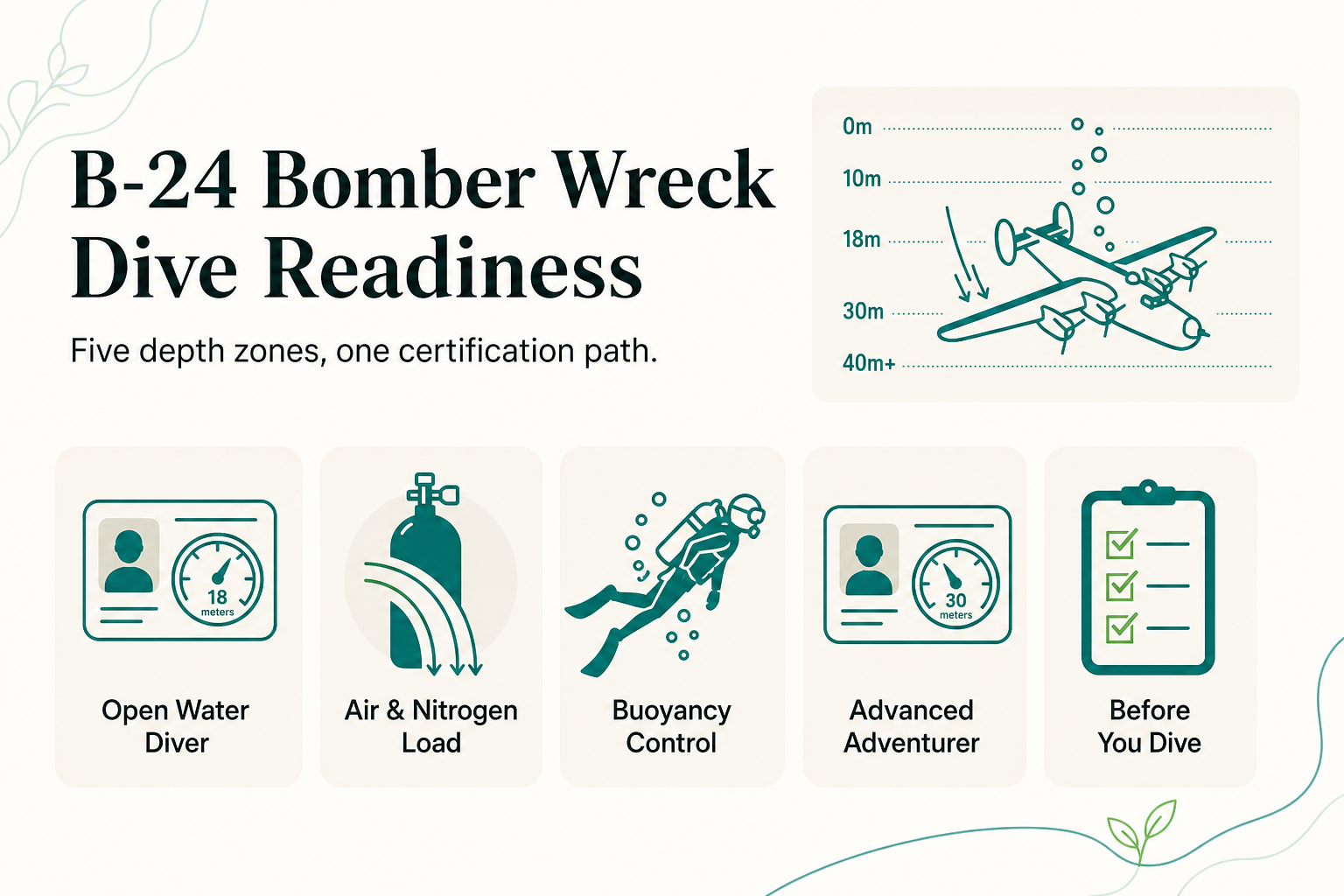
Which dive certification levels fit the B-24?
The right certification is the one that has already made those three skills routine before you descend.
| Level | What it adds | Depth rating | Fit for the B-24 |
|---|---|---|---|
| SSI Open Water Diver | 4 open water training dives | 18 m | Within limit, zero margin |
| SSI Advanced Adventurer | 5 adventure dives, including a deep dive | 30 m | Comfortable margin |
| SSI Deep Diving specialty | Full deep-diving training | 40 m | Wide margin, suits deeper wrecks |
For most divers, Advanced Adventurer is the useful step. It puts 12 meters of margin below the sand and gives you one supervised deep dive before the wreck itself.
Indonesia's WWII wrecks vary in depth, and advanced certification is generally recommended for wreck sections around 30 meters. If those deeper wrecks are on your list, the deep diving specialty is the logical next course.
How should an Open Water diver prepare for the B-24?
Three steps close the gap between a fresh certification card and a relaxed wreck dive. The first two can happen around Buka Buka.
Step 1: Rebuild your buoyancy
If your last dive was months ago, start with a refresher dive (IDR 900,000 at our dive center). Then log fun dives where you practice hovering motionless at 15 to 18 meters.
Step 2: Take SSI Advanced Adventurer
- At Reconnect: IDR 6,000,000, 2 to 3 days, 5 adventure dives. Ask for deep, navigation and buoyancy dives.
- Starting from zero? Open Water is IDR 6,900,000 over 3 to 4 days.
- Courses are paid separately from the all-inclusive stay.
- Training dives take place at reef sites around Buka Buka, a short boat ride out. The Wall (15-40m+) and the Pinnacles (20-35m) suit the deep dive.
- We teach in English, French or Indonesian, with a maximum of 4 divers per guide.
Step 3: Plan the wreck dive itself
- Descend along a line or a visual reference, and settle your buoyancy above the wreck before you reach the sand.
- Agree on a turn pressure with your buddy before you enter the water.
- Wear your own computer and follow it, not a published depth.
- Finish with a 3-minute safety stop at 5 meters.
What should you know before diving the B-24?
Near the bottom the colors fade to blue, and the bomber's outline appears as you swim its length.
A B-24 had a 110-foot wingspan, about 33 meters, which is wider than the average Togean visibility of about 30 meters. This scale matters when you navigate the wreck.
- Do not enter the fuselage or touch the instruments.
- Keep your fins off the airframe. Its clean profile is the reason it is worth seeing.
- Hover rather than kneel on the sand.
Frequently Asked Questions
Can I see the wreck on a Try Scuba dive?
No. Try Scuba is a supervised introduction in shallow water, and an 18-meter wreck falls outside it. It is a good way to decide whether you want to take the Open Water course.
Do I need my own dive computer?
For a dive this deep, yes, strongly. Bring one if you own it, as personal computers are not provided.
Does Reconnect dive the B-24?
We are an eco-resort with an on-site dive center, and the B-24 is not one of the 20+ sites we dive around Buka Buka. National Park dives are not included in the Dive-cation package. Message us for current options before planning around the wreck.
When is visibility best in the Togeans?
The dry season, roughly May to October, brings calmer seas and the clearest water. The rainy season brings short showers. Around Buka Buka we dive year-round. Rainy-season crossings are rougher, but conditions stay diveable.
About Reconnect
Reconnect is a Private Island Resort on Buka Buka Island in the Togean archipelago. We run 93% on solar power, make our own desalinated water, and offer all-inclusive full board from EUR 60 per night. Our dive center is Blue Oceans certified. Ask us about your next course at https://reconnect.id.