


Most coral damage from visitors happens in seconds and without intent: a knee planted while fixing a mask, a fin swung over a coral head, a film of sunscreen rinsing off a shoulder.
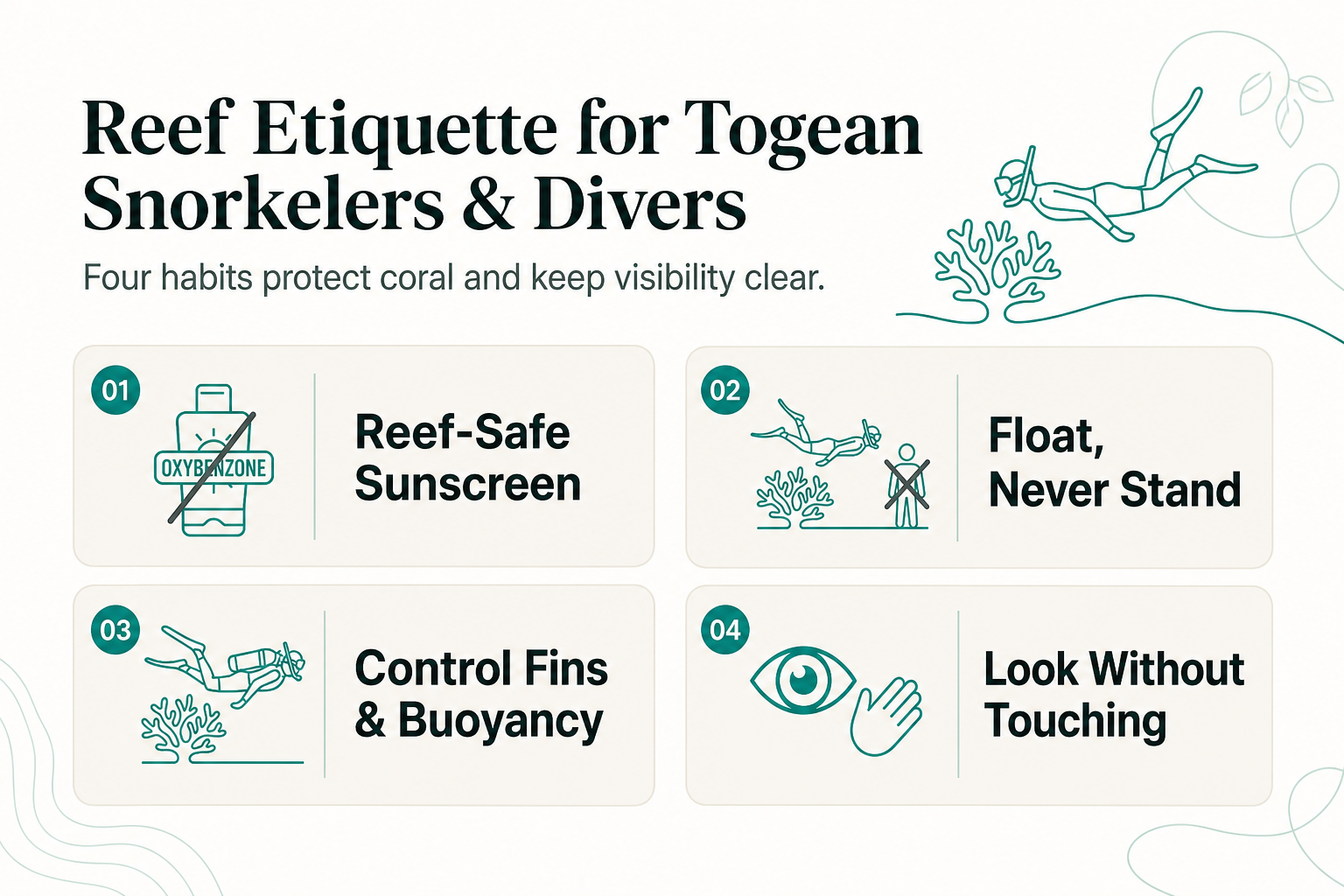
Knowing how to protect coral comes down to three habits: keep chemical sunscreen out of the water, keep your body off the reef, and control your fins and buoyancy. None of them costs you a sighting. Calm swimmers see more fish, in clearer water.
We write this from the water. Reconnect is an eco-resort on Buka Buka Island, in the Togean Islands, with an on-site SSI dive center that holds Blue Oceans certification.
About half our guests dive or take their first certification with us. The rest snorkel, kayak and paddleboard over the same reefs. This guide is the briefing we would give all of them.
TL;DR
- Choose an oxybenzone-free mineral sunscreen, bring it from home, and let clothing cover most of your skin.
- Snorkelers: treat coral tops as out of bounds.
- Divers: correct weighting and clipped-in gear prevent more contact than any rule list.
- Look without touching, feeding or chasing. Animals you leave alone stay in view longer.
- Some Togean coral grows nowhere else, so a single broken colony costs more here.
Why does reef etiquette matter more in the Togean Islands?
Each habit carries more weight here because some of the coral you will float over grows nowhere else.
Reconnect sits in the Togean Islands, a gateway to Togean Islands National Park. The park and surrounding seascape are protected on paper. UNESCO lists the area as the Togean Tojo Una-Una Biosphere Reserve, in the centre of the world's coral reef triangle [unesco.org].
Paper does not stop a fin. Kicks and hand contact scrape coral tissue, break skeleton and leave colonies more open to disease.
What counts as reef safe sunscreen, and where do you buy it?
Sunscreen is the one reef impact that starts on land. Reef safe sunscreen means a formula without oxybenzone, usually a mineral product based on zinc oxide or titanium dioxide.
The reason is chemical, not cosmetic.
We run the resort on a zero single-use plastic policy. Sunscreen is still the one product we cannot swap out for you, so the choice is yours:
- Read the ingredients, not the front label. A "reef" claim on the bottle is no substitute for checking for oxybenzone.
- Bring a full supply from home. Do not count on finding reef safe sunscreen in Indonesia along the route.
- Apply it on land, well before swimming, so less rinses off when you enter the water.
- Cover up. Water stays 27-30°C year-round, so a long-sleeve rash guard or a 3mm wetsuit is comfortable. Either one replaces sunscreen on most of your body and puts a layer between your skin and the coral.
How do you protect coral while house reef snorkeling?
At Reconnect, house reef snorkeling is complimentary, with masks, fins and snorkels provided. The reef wall sits 200 meters from the beach. Shallow water like this is where standing, kneeling and fin strikes happen.
The Togeans are quieter than Raja Ampat [togean.com], and Reconnect is effectively the only resort on Buka Buka.
- Step 1: Gear up over sand. Fit your mask and fins in knee-deep water over sand. Never stop to adjust anything above coral.
- Step 2: Float, never stand. If you need a rest, roll onto your back or swim back to sand. Coral that looks like rock is living tissue.
- Step 3: Kick gently, high in the water. Keep your fins below the surface but well clear of the reef. Over the shallowest tops, stop kicking and drift.
- Step 4: Give the slope room. On guided boat trips to Tanjung Pasir, the slope runs from 0 to 10 meters. The shallow end needs the most care.
Sand kicked off the bottom behaves like flour shaken into a glass of water. It hangs for minutes and blocks the light coral needs to feed the algae living in its tissue. Then it settles onto the polyps.
Visibility around Buka Buka averages about 30 meters. One careless kick clouds it for everyone behind you.
How do divers protect coral around Buka Buka Island?
For divers, coral reef protection is mostly a buoyancy problem. A diver who sinks or rises unexpectedly corrects with hands and fins, and the reef absorbs the contact.
| Site | Depth | What to watch |
|---|---|---|
| Coral Gardens | 8-15m | Hard coral close below you for the whole dive |
| The Wall | 15-40m+ | Depth creep along the face. Stay off it and check your gauge |
| Pinnacles | 20-35m | Holding position near the rock without grabbing it |
- Check your weighting on the first dive. Overweighted divers swim head-up and fins-down, which sweeps the reef.
- Clip in your octopus and gauges. A dangling second stage or console drags across coral without you feeling it.
- Frog kick near coral. Flutter kicks drive water straight down onto the reef.
- Stay close to your guide. We cap groups at 4 divers per guide, so you have room to hold position without bumping a neighbour.
We offer SSI Open Water and SSI Advanced Adventurer courses, each booked and paid for separately from your stay.
These Training dives take place at reef sites around Buka Buka, a short boat ride out, with instruction available in English, French or Indonesian.
Frequently Asked Questions
Can I feed fish or collect shells?
Empty shells left in place become homes for hermit crabs.
Should I wear gloves?
In warm water like this, no. Gloves make it easy to grab coral without feeling it, so going without them keeps your hands to yourself.
Can I snorkel on my own?
Pair up. A buddy can tell you when you drift too close to the reef and offers safety in deeper water.
What if I touch coral by accident?
Do not push off it. Back away with small, slow fin movements. Rinse any scrape and tell the team, since first-aid certified staff are on-site.
Do the same rules apply in Togean Islands National Park?
Yes. Park reefs are visited on our Togean Day Trip, which is a paid excursion. Park entry fees are charged where applicable.
About Reconnect
Reconnect has 20 rooms and full board from EUR 60 per night. We run on 93% solar power, and guests rate us 4.9 on TripAdvisor, 4.8 on Google and 9.2 on Booking.com. For a reef briefing before you arrive, or help planning your stay, visit https://reconnect.id.