


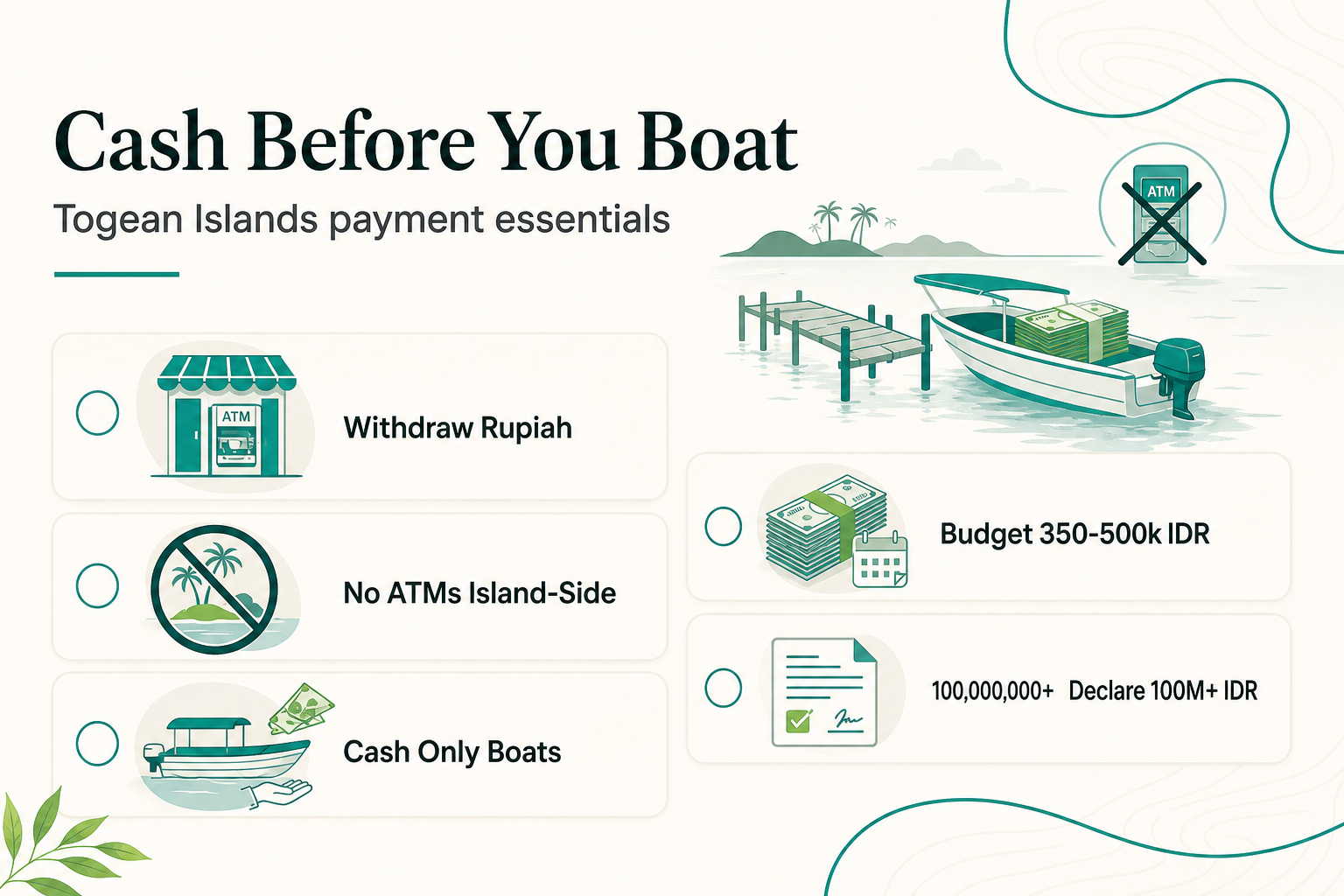
There are no ATMs anywhere in the Togean Islands, and no banking services once you leave the Sulawesi mainland. Every rupiah you'll need for boats, meals, souvenirs, and incidentals has to be withdrawn or exchanged before you reach Luwuk, Ampana, or Gorontalo. Get this wrong and you're not facing an inconvenience, you're facing a multi-day supply problem in a place where the nearest bank is a boat ride and a car ride away.
TL;DR
- No ATMs or banking services exist in the Togean Islands; withdraw all cash on the Sulawesi mainland first [togean.com].
- The Indonesian Rupiah (IDR) is the only currency accepted locally: roughly 17,578 IDR to 1 USD, 20,404 IDR to 1 EUR, and 23,783 IDR to 1 GBP.
- Boats, ferries, and local transport in the Togeans are cash-only; cards work at airports and larger mainland businesses.
- Basic full-board accommodation in the Togeans runs 350,000 to 500,000 IDR per person per night, a useful benchmark for budgeting cash.
- Declare any cash equivalent to 100 million IDR or more when entering or leaving Indonesia.
About the Author: Reconnect operates an eco-resort on Buka Buka Island in the Togean Islands and coordinates every guest transfer from Luwuk Airport onward, which means cash logistics and mainland banking stops are something we walk travelers through daily, not theory from a guidebook.
What Currency Do You Need in the Togean Islands?
The Indonesian Rupiah (IDR) is the only currency that functions in the Togeans. No resort, boat operator, or warung takes US dollars, euros, or any other foreign note directly.
Current indicative rates put the indonesian rupiah exchange rate at approximately 17,578 IDR per USD, 20,404 IDR per EUR, and 23,783 IDR per GBP. These move daily like any floating currency, so check a live rate within a day or two of your trip rather than relying on a number from months earlier. When people compare indonesia rupiah vs dollar for budgeting purposes, the practical takeaway is simple: work in round numbers (100,000 IDR is roughly 5.7 USD) rather than trying to convert every small purchase precisely.
Some Togean businesses quote prices informally in USD or EUR for foreign guests, but settlement still happens in rupiah at the till. Confirm the conversion before handing over cash, not after.
Why Are There No ATMs in the Togean Islands?
The Togeans are a scattered archipelago of small islands with limited permanent population centers, no bank branches, and no reliable grid infrastructure to run ATM networks. Banking services simply stop once you leave the Sulawesi mainland [togean.com].
This isn't a gap that's closing. There's no indication of ATM infrastructure being planned for the islands, and several independent travel guides covering the region as recently as 2026 confirm the same zero-ATM reality [togean.com][timetravelbee.com]. Some resorts can process a Wise or Revolut transfer if you've arranged it in advance, but this depends entirely on that specific property having internet reliable enough to confirm the transaction, and it should never be your primary plan [brunetteatsunset.com].
The practical implication: whatever cash you carry onto a boat toward the Togeans is what you have for the rest of the trip.
Where Should You Withdraw Cash Before Arrival?
This is the single most important logistics decision in Togean trip planning, and it happens on the mainland, before you ever see the water.
Step 1: Withdraw at Your Gateway City
Luwuk, Ampana, and Gorontalo are your practical points to access ATMs and bank branches. Luwuk in particular functions as the main reliable gateway into the Togeans, so it's also usually where travelers make their last significant withdrawal.
Step 2: Calculate for the Full Trip, Not Just the First Few Days
Underestimating is the common mistake. Once you're on an island, there is no fallback withdrawal point, no card machine to bail you out, and no bank branch to visit if you run short [beyondthebucketlist.co][pinkplankton.com].
Step 3: Build in a Buffer
Add 15-20% beyond your calculated need for the trip. Boat operators, snorkeling gear rentals, small purchases at a village market, or an extra night if weather delays your return all draw on cash you didn't plan for [timetravelbee.com][billandjo.com].
What Can You Actually Pay for With Cash Versus Card?
Cards work where there's reliable power, internet, and a bank relationship to process transactions. That combination doesn't exist in most of the Togeans.
| Location/Service | Typical Payment Method |
|---|---|
| International flights, major mainland hotels | Card, online payment |
| Domestic flights to Luwuk/Gorontalo | Card or cash |
| Car transfer, Luwuk to Ampana | Usually pre-paid/coordinated, cash if not |
| Local boats and ferries within the Togeans | Cash only [discoveryourindonesia.com] |
| Village warungs, small vendors | Cash only |
| Resort full-board rates (where booked in advance) | Often pre-paid by bank transfer before travel |
| On-site incidentals, tips, extras | Cash |
Major airlines and mainland transport accept standard card and online payment methods, but local boats, ferries, and transport within the Togeans are almost exclusively cash-based. This split explains why the mainland withdrawal step matters so much: it's your only real opportunity to fund the cash-only leg of the trip.
At Reconnect, full-board stays, dive packages, and transfer coordination from Luwuk Airport can typically be arranged and paid in advance by bank transfer, which removes one layer of on-island cash pressure. Day-to-day extras once you're on Buka Buka Island, souvenirs from a village visit, or a tip for your boat driver, still work best in cash.
How Much Should You Budget, and What Are the Customs Rules?
Basic full-board accommodation in the Togeans typically runs 350,000 to 500,000 IDR per person per night, a useful floor for estimating daily costs beyond your resort package. Add cash for:
- Village market purchases and handicrafts
- Boat driver and guide tips
- Snorkeling or dive gear rental at independent operators
- Snacks and drinks outside your accommodation's meal plan
- A buffer for delayed departures (boat schedules shift with weather)
On the regulatory side, Indonesian customs require declaration of cash or payment instruments valued at 100 million IDR or more (roughly 5,690 USD at current rates) when entering or leaving the country. Most leisure travelers carrying trip cash for a Togean visit fall well under this threshold, but it matters if you're arriving with a large sum for an extended stay or a group booking.
No current government travel advisory for Central Sulawesi, including those from the US and UK, raises currency or payment-specific concerns. The advisories that exist relate to broader regional security, not cash logistics.
Frequently Asked Questions
Can I use a credit card anywhere in the Togean Islands?
Not reliably. A handful of larger resorts may process a pre-arranged bank transfer, but day-to-day spending, boats, warungs, and local vendors, is cash-only.
Should I exchange money before leaving my home country or wait until Sulawesi?
Either works, but confirm your mainland gateway city (Luwuk, Ampana, or Gorontalo) has an open bank or money changer on the day you arrive, since hours can be limited outside major towns.
What denominations of rupiah are most useful?
Smaller notes (20,000 to 100,000 IDR) are easier to use for boat fares, tips, and village purchases where vendors may not hold change for larger bills.
Is it safe to carry several days' worth of cash on a boat transfer?
Standard precautions apply, split cash across bags, use a money belt or dry bag given the boat crossing, and avoid displaying large amounts publicly.
Do dive courses or excursions require separate cash payment?
Dive courses are booked and paid for separately from your accommodation package, and if arranged on-site rather than pre-paid, expect this to be settled in rupiah.
About Reconnect
Reconnect is a private island eco-resort on Buka Buka Island in the Togean Islands, built by founder Thomas Despin around an off-grid model: 93% solar power, on-site desalinated water, and zero single-use plastics. The resort runs an SSI-certified dive center alongside all-inclusive full-board stays from EUR 60 per night, and coordinates every transfer from Luwuk Airport through to the island. Rated 4.9 on TripAdvisor and 9.2 on Booking.com, it's built for travelers who want a remote, uncrowded island experience without giving up modern comforts.
Planning a Togean Islands trip and want the cash logistics handled for you. Visit Reconnect to see how our transfer coordination and pre-arranged full-board packages simplify arrival.
References
- Togean Islands FAQ: Common Questions Answered (2026) | Togean.com (togean.com)
- Togean Islands Travel Guide: Where to stay and best diving - Brunette at Sunset (brunetteatsunset.com)
- Your Complete Togian Islands Guide: Sulawesi's Hidden ... (beyondthebucketlist.co)
- Indonesia’s Togean Islands: An Undiscovered Paradise | Pink Plankton (pinkplankton.com)
- Togean National Park - Responsible travel guide to Togean Islands | Time Travel Bee | Responsible Travel Blog (timetravelbee.com)
- 7 Fun and Adventurous Things to Do in the Togean Islands (discoveryourindonesia.com)
- Togean Islands Trip Guide — Bill and Jo (billandjo.com)