

Most divers choose an Indonesian destination by its name, then discover what actually lives there. Flip the order.
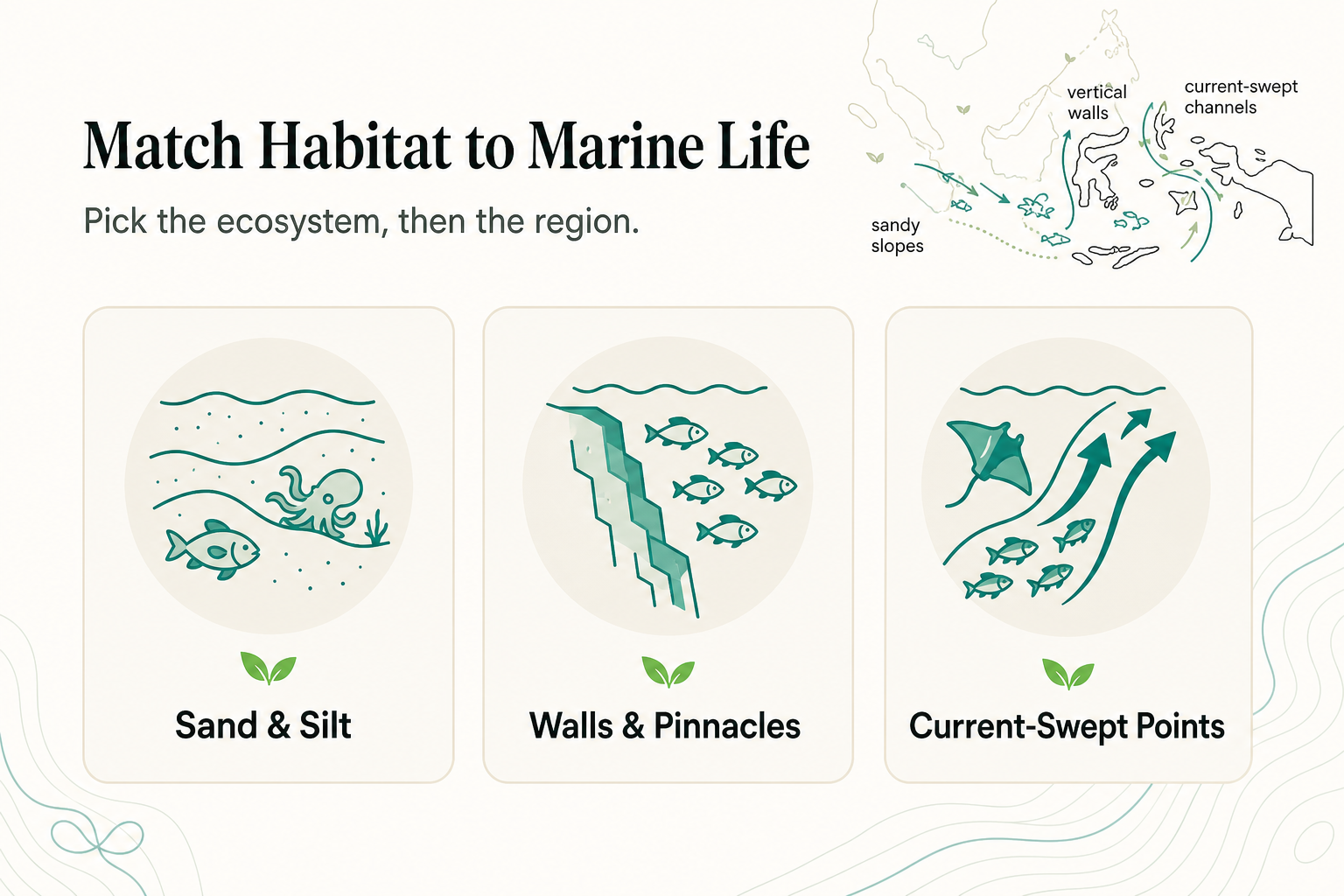
Pick the habitat first: dark volcanic sand for macro, steep reef for walls and hard coral, current-swept channels and plankton-rich bays for pelagics and whale sharks. Each sits in a different part of the archipelago.
We run an on-site SSI dive center on Buka Buka Island in the Togean Islands. Roughly half our guests are divers or doing their first certification. That vantage point lets us be specific about what our waters offer, and what they don't.
TL;DR
- Macro and critters: Lembeh Strait in North Sulawesi is the benchmark, with Ambon as the main alternative.
- Walls and hard coral: Bunaken in North Sulawesi, and the Togean Islands in Central Sulawesi.
- Pelagics and big current: Raja Ampat for dense fish life, Komodo for strong current and mantas.
- Whale sharks: Cenderawasih Bay in West Papua, and Gorontalo.
- The pattern: Sulawesi diving covers macro, walls and whale sharks. For the strongest pelagic action, most divers head east or south.
Why does habitat matter more than the destination name?
Search "where to dive Indonesia" and you get rankings. Rankings are the wrong tool, because marine life sorts itself by bottom type and current far more than by region.
Indonesia sits inside the Coral Triangle, a 6-million-km² area shared by six countries [asiapacific.panda.org] and one of the world's richest marine ecosystems [wwf.org.au]. Its Indonesian portion spans the central and eastern seas, including the Gulf of Tomini that encloses the Togeans.
Within that area, three habitats drive what you see:
- Sand and silt slopes: little coral cover, so animals hide through camouflage. You search slowly, close to the bottom.
- Walls and pinnacles: vertical reef structure and reef fish, often in calmer water.
- Current-swept points and channels: nutrient-rich water rises, and the food chain follows.
Think of wind hitting a mountain range. The air has nowhere to go but up. Current meeting an underwater slope does the same, lifting plankton toward the surface, and the plankton feeders and their hunters gather there.
Where should you go for macro and muck diving in Indonesia?
Macro is where the habitat-first rule matters most, because the best critter sites look like nothing from the surface.
Lembeh Strait muck diving happens on dark sand and silt between mainland North Sulawesi and Lembeh Island, reached through Manado. With no coral to shelter in, animals survive by mimicry: frogfish, mimic octopus, ghost pipefish.
You find them through your guide's eyes, not your own. Ambon, in Maluku, is the main alternative for the same style of critter hunting.
What to check before booking a muck trip:
- Guide ratio: critters are tiny, and a crowd around one frogfish ruins the dive for everyone.
- Dive profile: long, shallow dives suit photographers best.
- Briefings by species: good guides tell you what they expect to find, not just the site name.
- Realistic visibility: silt bottoms mean lower visibility than reef sites. That is part of the habitat.
Where should you go for walls, pinnacles and hard coral?
Bunaken, a boat ride from Manado, has steep walls close to shore, which is why many divers pair it with Lembeh on one North Sulawesi trip.
The Togean Islands lie in the sheltered Gulf of Tomini. Reconnect sits on Buka Buka Island, where visibility averages about 30 meters and each guide takes a maximum of 4 divers:
| Site | Depth | Best suited to |
|---|---|---|
| House Reef | 5-18 m | Snorkeling from the beach, relaxed dives |
| Coral Gardens | 8-15 m | Hard coral, newer divers |
| The Wall | 15-40 m+ | Vertical reef, experienced divers |
| Pinnacles | 20-35 m | Advanced divers |
Coral Gardens, The Wall and Pinnacles are a short boat ride from Buka Buka, not a long transfer.
The walls and pinnacles here are what draw divers to Buka Buka. Manta and whale shark sightings are rare in our waters. Macro is not Lembeh.
Buka Buka is a gateway to Togean Islands National Park, which guests visit on a paid Togean Day Trip.
Where should you go for pelagics and whale sharks?
Pelagics follow the current mechanism described above, so the strongest action moves to channels with powerful tidal flow, mostly east and south of Sulawesi.
Option 1: Raja Ampat vs Komodo
The Raja Ampat vs Komodo choice usually comes down to how much current you want to handle.
| Raja Ampat | Komodo | |
|---|---|---|
| Gateway | Sorong, Southwest Papua | Labuan Bajo, Flores |
| Main draw | Dense reef fish life, manta sites | Strong current, mantas, big fish action |
| Water | Warm | Warm in the north, cooler and greener at southern sites |
| Current | Gentle to strong, depending on site | Often strong, reef hooks common |
| Best suited to | Groups with mixed experience | Divers confident with drift diving |
Our view: if you have never used a reef hook, Komodo is the harder first trip. Raja Ampat diving offers more gentle sites while still putting big animals within reach.
Option 2: Indonesia whale shark diving
Indonesia whale shark diving centres on places where the sharks gather around human activity rather than passing at random.
- Cenderawasih Bay, West Papua: whale sharks gather under bagan, the traditional fishing platforms.
- Gorontalo: sightings near Botubarani village, close to shore, tied to local shrimp processing.
Both encounters depend on human food sources. Ask any operator how it manages feeding, touching and crowding.
Luwuk is the main reliable route into the Togeans. Gorontalo is the only other reliable route. That makes whale sharks and Togean walls a workable single trip.
Frequently Asked Questions
When is the best time to dive the Togean Islands?
Peak conditions run through the dry season, April to November. Water stays 27-30°C year-round, so a 3mm wetsuit is enough.
What certification do I need for walls and pinnacles?
The deeper wall and pinnacle sites go beyond what an Open Water rating covers. In SSI, the next bookable step is Advanced Adventurer: five adventure dives over 2-3 days. It is sold separately from your stay, and our Advanced signature sites are Survival and Space X.
Is there a recompression chamber near the Togeans?
We keep emergency oxygen on-site, and our staff are first-aid certified. The nearest chamber is RS Bhayangkara in Palu, with emergency transport available. Travel insurance is mandatory for every stay and must cover evacuation.
Is the Coral Triangle protected?
Can non-divers enjoy a wall destination?
Yes, if the wall starts shallow. At Buka Buka, the house reef wall sits 200m from the beach, and snorkeling gear is free for guests. Guided snorkel trips also visit Tanjung Pasir, a 0-10m slope.
About Reconnect
Reconnect is a 20-room island eco-resort. Founded by Thomas Despin, it runs 93% on solar power, offers full-board stays from EUR 60 per night, and holds a 4.9 TripAdvisor rating. Learn more at https://reconnect.id.
References
- Coral Triangle | WWF Asiapacific (asiapacific.panda.org)
- Resource By Subject | Coral Triangle Initiative on Coral Reefs, Fisheries, and Food Security (new.coraltriangleinitiative.org)
- How the Coral Triangle Set the Standard for Effective and Equitable Conservation? | IUCN World Conservation Congress (iucncongress2025.org)
- Coral Triangle: Protecting a Global Marine Biodiversity Hotspot | WWF-Australia (wwf.org.au)
- New ADB Coral Reef Project Eyes Sustainable Management of Indonesia's MPAs | CTI-CFF (coraltriangleinitiative.org)