


Most disappointing shore snorkels in Indonesia have nothing to do with the reef. The coral is fine. The water over it is wrong, usually too shallow or moving too fast, because the swim was timed to breakfast instead of the tide.
The fix is a short check before you get wet: tide, then current, then a planned entry and exit. Around Buka Buka Island, our guests snorkel the house reef and our boats run to more than 20 dive sites.
TL;DR
- Reconnect is a private island eco-resort with an on-site SSI dive center on Buka Buka Island in Indonesia's Togean Islands.
- The best tide for snorkeling from the beach runs from mid-tide on the rise to just after high water.
- Skip the hours around low water on shallow reef flats.
- Togean currents are mild on average, but points and channels run faster. Read the water before entering.
- Plan your entry and your exit before you get in.
What is the best tide for snorkeling from the beach?
Tide decides two things before you even look at the reef.
Depth is the obvious one. A reef flat you float over at high water can be ankle-deep six hours later.
Water clarity is the one people miss. A rising tide pushes clearer water in from offshore. A falling tide drains beaches, mangroves and stream mouths back over the reef, carrying sediment with it.
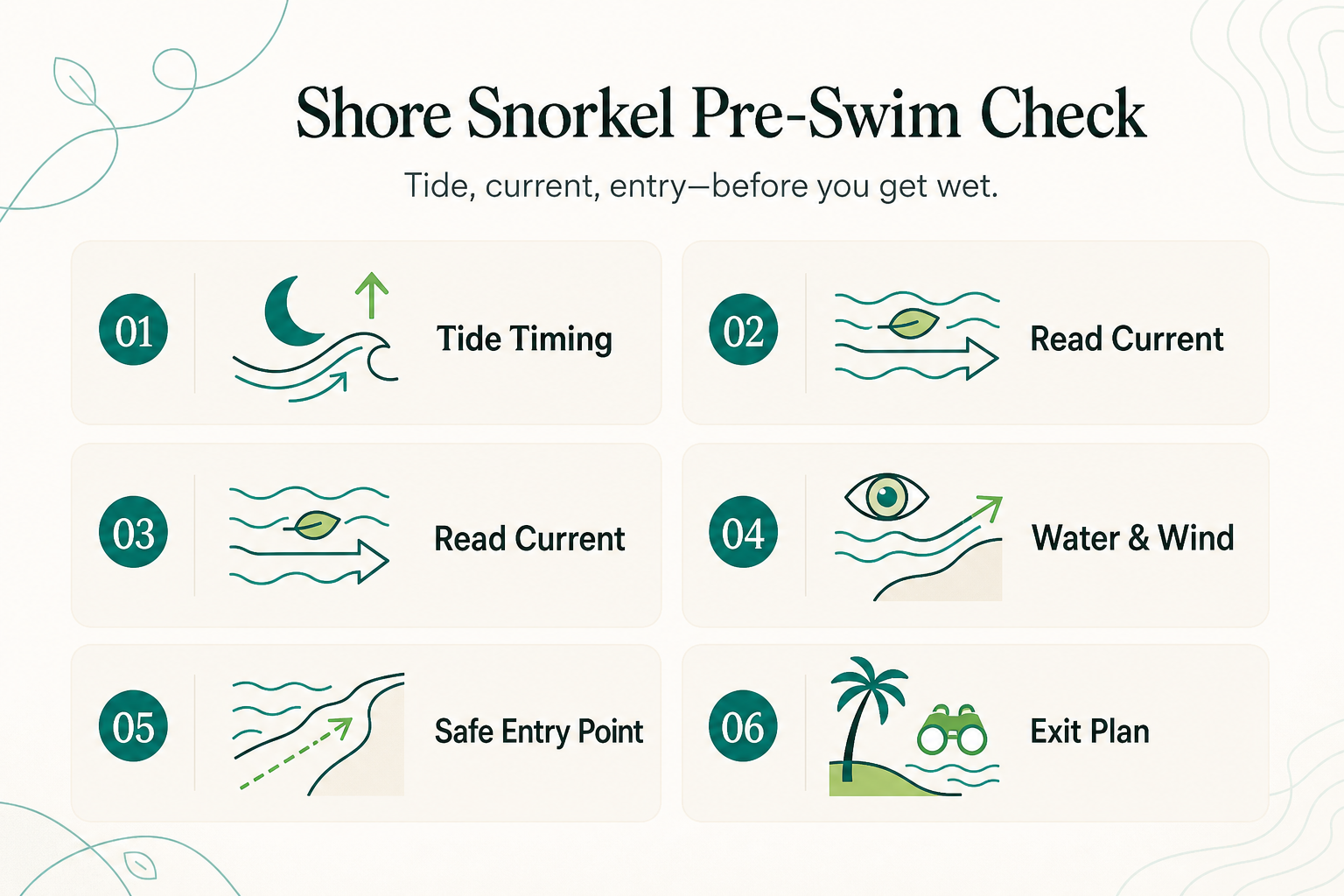
Timing it in three steps:
- Find the right tide table. Indonesian tide predictions typically come from the Geospatial Information Agency (BIG). Use the nearest station and ask staff how their reef runs against it.
- Count the hours, not just the high. Over a roughly six-hour tide, the middle two hours move half the water (the sailors' rule of twelfths). Depth changes fastest and current runs hardest then.
- Re-check daily. High water arrives about 50 minutes later each day. A tide that suited a 9:00 swim on Monday suits a late-morning swim by Thursday.
How do you read the current before getting in?
Current is the tide in motion, and it decides whether the swim home is easy or a fight.
The Togeans start with an advantage.
Averages hide the spots that matter.
Tidal water forced between a headland and the next island speeds up the way a garden hose jets when you pinch the end: the same volume through a narrower gap must move faster.
Points, channels and reef corners are where a gentle day stops being gentle.
Before and during the swim:
- Watch the surface for five minutes. Floating leaves and foam lines drift downstream. A moored boat's bow points into the stronger of wind or current.
- Swim up-current first. You return with the water when you are most tired.
- Cross a pull, do not fight it. Angle across the flow toward shore or a second exit downstream, rather than swimming straight back against it.
- Leave a plan on shore. Tell someone your entry point and expected return time.
How do you choose a safe entry and exit point?
The shallow first and last stretch of a shore swim is where both reefs and snorkelers get hurt. Fringing reefs, common in the Togeans alongside barrier, patch and atoll reefs, grow right up to the beach.
Option 1 (best): a sand channel or natural gap
Pale sand running out to darker blue water marks a clear lane. Float as soon as it is waist-deep and put your fins on there.
Option 2 (good): a jetty or ladder
It is clean on the reef, but jetties are where boats come and go. Check traffic and mooring ropes first.
Option 3 (last resort): walking across the reef flat
It breaks coral and puts your feet among urchins and stonefish. If there is no other way, go at higher water in reef shoes, stepping only on sand.
Pick an exit landmark you can recognise from the water, like a leaning palm or a roof. Every beach looks the same once you lift your head.
What should your house reef snorkeling check look like on the day?
Tide and current are only part of a daily check. Add these before you walk in:
| Check | Go | Wait or rethink |
|---|---|---|
| Wind | Calm, or blowing off the beach | Onshore wind building chop at the entry |
| Recent rain | Dry overnight | Heavy rain, brown water near stream mouths |
| Water at the entry | Bottom clearly visible in the shallows | Milky or stirred-up water |
| Boats | Nothing arriving or leaving near your lane | Shuttle or dive boats moving at the jetty |
| Sun | Rash guard on, hat for the walk back | Bare back at midday |
On a wall reef, the drop-off stays deep at any tide, so the question is mostly the approach. Our house reef on Buka Buka is a wall, and the team will tell you where to enter on the day.
House reef snorkeling is complimentary, with masks, fins and snorkels provided. Visibility around the island averages about 30 meters. When the house reef is not right, we run guided snorkel boat trips to sites such as Tanjung Pasir and Tanjung Gurita.
Choosing a private island resort in Indonesia for its reef? Before booking, ask which tide suits the house reef, where the entry is, and who checks conditions each morning.
Frequently Asked Questions
Can weak swimmers snorkel from the shore?
Yes, with a snorkel vest or float and a buddy alongside. Flotation lets you rest on the surface instead of standing on coral, which protects the reef and your feet.
Is morning or afternoon better for snorkeling?
Pick by tide first. Between two good tides, choose the one with the sun higher in the sky. Overhead light reaches into the reef and brings out colour that low-angle light leaves flat.
What should I do if I tire or cramp on the reef?
Roll onto your back and float. Stretch a calf cramp by pulling your fin tip toward you, then signal shore by waving one arm overhead.
Do I need to dive to see more than the house reef?
No, but diving opens up the deeper reef. Try Scuba is open from age 10, taught in English, French or Indonesian, and booked separately from your stay. All our dives are boat dives, with the house reef dive site about 5 minutes out by boat.
Should I bring my own snorkel gear?
Bring a mask if you own one that fits well or has prescription lenses. Fit matters most, because a leaking mask cuts more swims short than people expect.
About Reconnect
We run the resort on 93% solar power, with our own desalinated water and no single-use plastics.
Full-board stays start from IDR 1,500,000 per night for two, varying by date. Some of our 20 rooms have air conditioning, which is rare in the Togeans.
We arrange your transfer from Luwuk Airport. Ask about tomorrow's tide at hi@reconnect.id or https://reconnect.id.