


Most divers plan a Togean trip around daytime walls and pinnacles, then wonder whether the reef is worth a second visit after sunset. It is, for one specific reason: much of the reef life here is small and well camouflaged, and a torch beam is the best tool for finding it.
We run night dives on request around Buka Buka Island.
TL;DR
- Reconnect is a private island eco-resort with an on-site SSI dive center on Buka Buka Island in Indonesia's Togean Islands.
- Yes, the Togeans suit night diving, but as a macro dive. Expect small, cryptic animals, not big predators.
- Night dives at Reconnect must be requested the day before and are paid on top of the full-board room rate.
- If you have never dived at night, the SSI Night Diving and Limited Visibility specialty gives you a structured way in.
Is the Togean Islands good for night diving?
Yes, if you come for small animals. The Togeans sit in the Coral Triangle, and their reefs hold life in nearly every crack and ledge.
Daytime visibility averages about 30 meters around Buka Buka Island. At night that number barely matters. Your view shrinks to the width of a torch beam.
What counts instead is sheltered water you can move through slowly, and a reef with enough life that every sweep of light turns something up.
The honest tradeoff: a night dive here rewards slow, close looking. Divers who want big animals usually get more from our daytime walls and pinnacles.
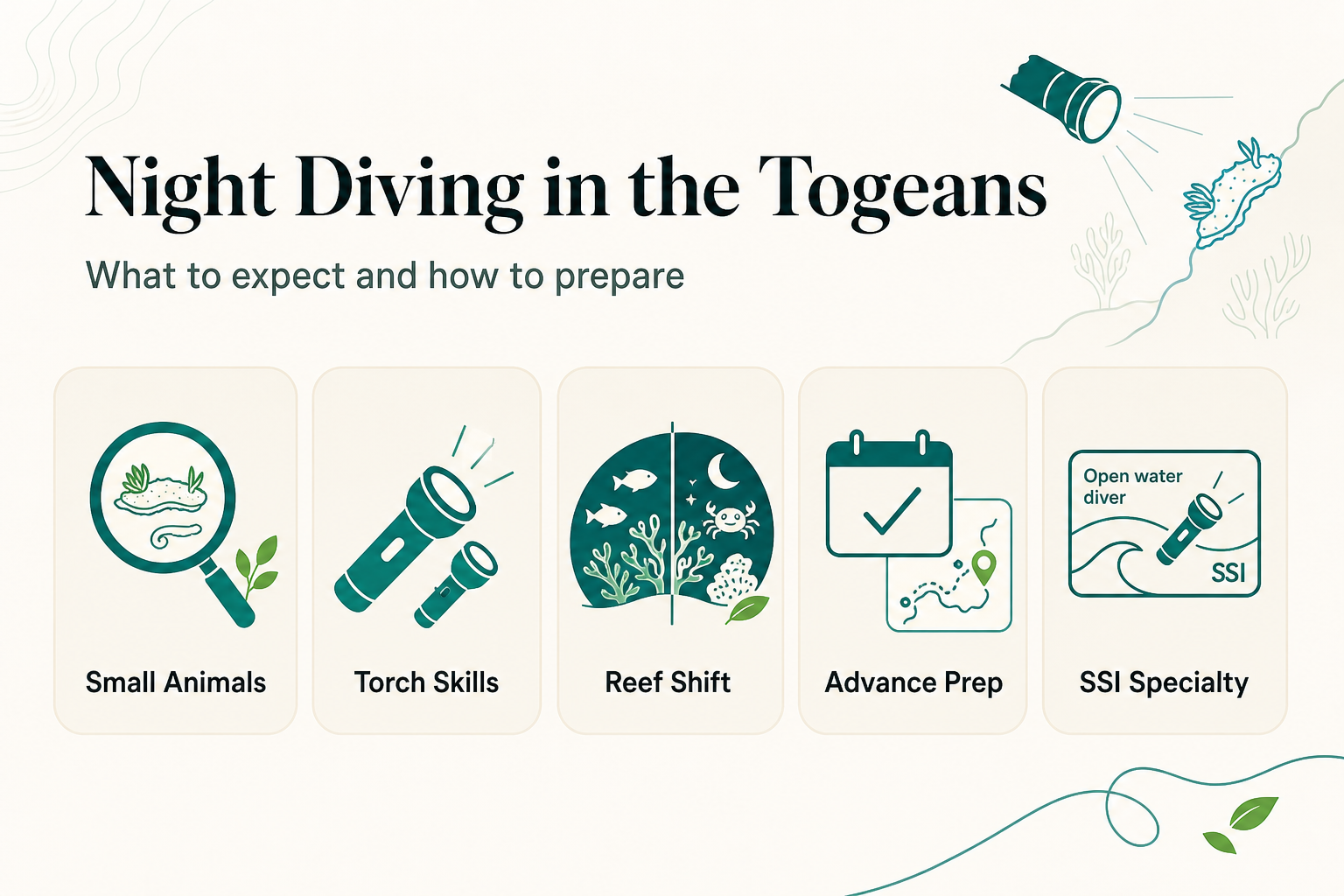
What marine life comes out on a Togean night dive?
A reef works like a hospital with two shifts. As light fades, daytime grazers and plankton feeders wedge into crevices to sleep.
Animals that hunt by ambush, touch or smell take over the same space. That handover is why a familiar site looks like a different reef at night.
| Animal | What it does after dark | Where to look |
|---|---|---|
| Nudibranchs | Graze openly across rock and sponge | Walls and coral heads, close up |
| Pipefish | Pick tiny crustaceans off the bottom | Rubble and sheltered patches |
| Crocodilefish | Lie flat and still, waiting to ambush | Sand and rubble |
| Leaffish | Rock gently on a perch like a dead leaf | Coral ledges |
| Frogfish | Sit motionless, waiting for prey | Sponges and rocks |
A torch works like a stage spotlight: it blacks out the background, so a two-centimeter animal becomes the only contrast in your field of view. Camouflage built for a busy daytime reef loses much of its cover.
Switch your light off for a few seconds and the dark closes in, warm and total.
How do night dives work at Reconnect?
The dive team confirms night-dive times each evening, once weather, tides and planned sites are known.
- Group size: a maximum of 4 divers per guide.
- Safety on site: SSI training standards, emergency oxygen and first-aid certified staff.
- Language: instruction in English, French and Indonesian.
Book your night dive early in your stay. If weather rules out the first evening, you still have days left to reschedule.
Ask whether you can dive the site in daylight first. Knowing the layout removes most of the disorientation of a first night dive.
What should you prepare before your first night dive?
Most night-dive problems come from lights and communication rather than the reef itself. Sort out both on the boat before you descend.
Step 1: Carry three lights
- Primary torch: your main light for seeing.
- Backup light: clipped on or pocketed, for when the primary fails.
- Tank marker light: lets your buddy and guide see you from behind.
Step 2: Agree on light signals
Light replaces hand signals at night.
- A slow circle with the beam means OK.
- Rapid side-to-side sweeps mean attention or a problem.
- Light your own hand to signal. Never shine a torch into your buddy's eyes.
Stay within arm's reach of your buddy. Know a compass heading back to the boat.
Step 3: Consider the specialty
SSI's Night Diving and Limited Visibility specialty requires Open Water Diver certification, online academic learning and 2 open water training dives with dive lights. Ask our dive center whether it can be scheduled during your stay. Courses are booked and paid separately from your stay.
Frequently Asked Questions
Do I need a night diving certification to join a guided night dive?
Generally not, if you are already a certified diver, but each operator sets its own experience rules. When you request the dive, tell us how many dives you have logged and when you last dived.
If it has been a while, we offer a refresher dive for €45.
How much does a night dive cost at Reconnect?
A night dive is €50 per person, with equipment included. Daytime fun dives cost €30 to €40 per dive, depending on how many you book.
Do I need a thick wetsuit for night diving in the Togeans?
The water stays at 27-30°C all year, so heavy thermal protection is unnecessary. A thin full-length suit is still useful: it protects your skin, and a slow hour in the water can feel cooler than the temperature suggests.
Do I need dive insurance for a Togean trip?
Travel insurance is mandatory for stays at Reconnect, and we recommend DAN dive insurance on top of it. There is no pharmacy on Buka Buka, so bring any personal medication with you, including ear drops.
Get in Touch
To plan a night dive or learn more, write to hi@reconnect.id or visit reconnect.id.