


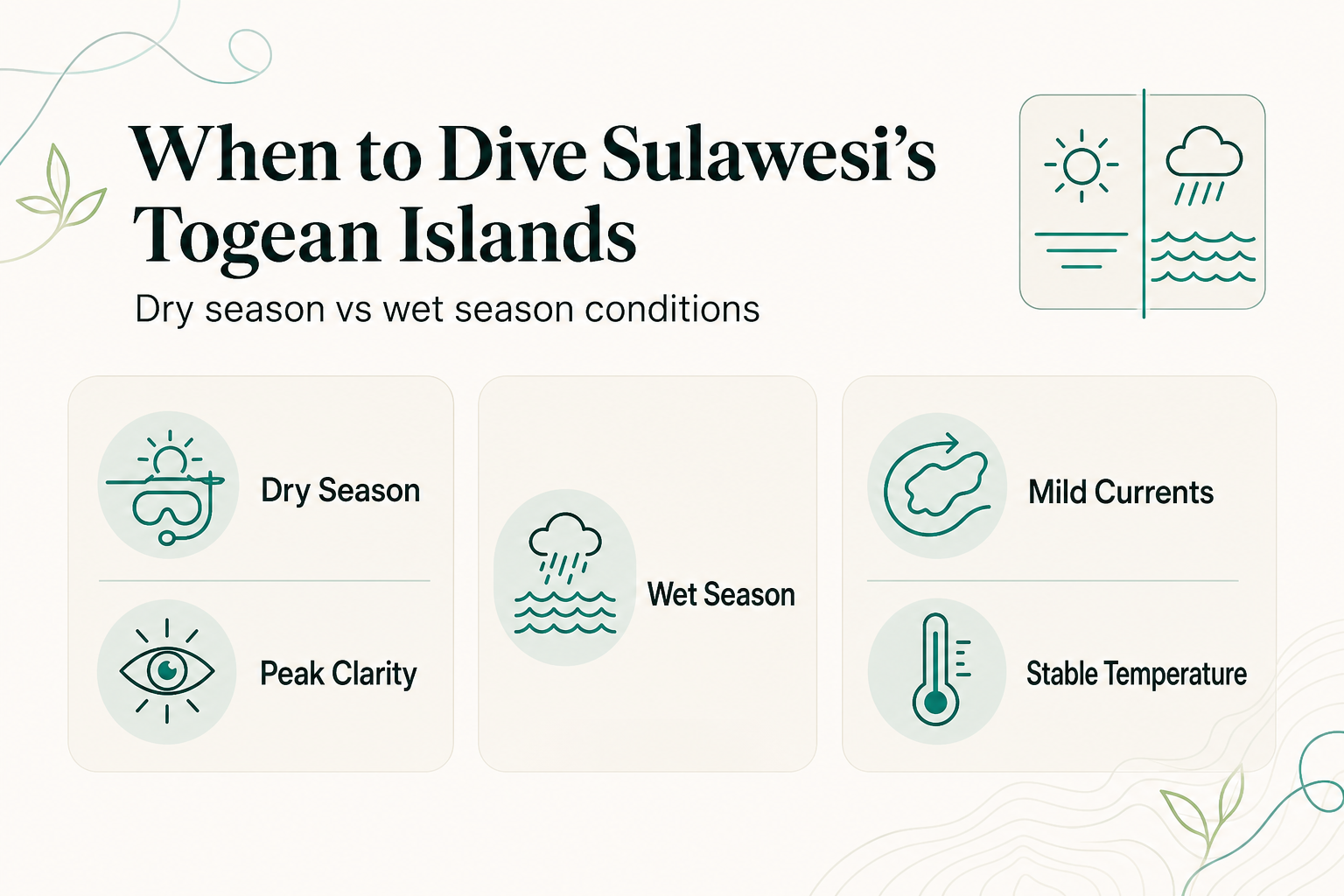
The best diving conditions in Central Sulawesi's Togean Islands run from April to November, when visibility averages about 30 meters and seas stay calm inside Tomini Bay. December through March brings heavier rainfall, more surface chop, and visibility that drops as runoff clouds the water near shore. The exact month you pick should depend on what you're diving for: flattest seas, clearest water, or a specific animal encounter.
TL;DR
- Dry season (April to November) delivers the most consistent visibility and the calmest surface conditions in the Togean Islands.
- August to October is the driest stretch of the year in Central Sulawesi, with sea temperatures of 27 to 30 degrees Celsius.
- Wet season (December to March) brings southwest winds that can exceed 25 knots and waves up to 1.5 meters, plus reduced visibility from rain runoff.
- Currents around the Togeans are mild year-round because Tomini Bay is sheltered, unlike more current-driven sites elsewhere in Indonesia.
- Whale sharks and turtles follow their own regional patterns elsewhere in Sulawesi and shouldn't be the sole reason to time a Togean trip.
What Makes a Month "Good" for Diving in the Togean Islands?
Three factors decide whether a given month is worth booking around: water clarity, sea state, and temperature. None of them move independently. Rainfall drives runoff into the bay, runoff clouds visibility, and wind on top of that stirs up chop that makes boat rides and surface intervals rougher.
The Togean Islands sit inside Tomini Bay, which shelters them from the open-ocean swell that hits more exposed dive destinations. That's why currents here stay generally mild and gentle year-round, calmest from April to November. It also means the wet season penalty here is less about dangerous currents and more about reduced clarity and choppier crossings.
Sea temperature barely changes across the year. Central Sulawesi holds a fairly narrow band of 27 to 30 degrees Celsius year-round, so a 3mm wetsuit works in January the same as it does in September. Air temperature runs 24 to 28 degrees Celsius. Temperature is not the variable that should drive your travel dates here. Visibility and sea state are.
Month-by-Month: What to Expect
Dry Season (April to November)
This is the reliable window. Surface conditions stay calm, and boat transfers between dive sites are smooth. August to October is the driest stretch of the year, which tends to produce the clearest water of the whole season.
| Period | Visibility | Sea State | Notes |
|---|---|---|---|
| April to July | Averages about 30 meters | Calm, mild currents | Transition into dry season, reliable diving begins |
| August to October | Often at the upper end of the 30-meter average | Calmest of the year | Driest months in Central Sulawesi |
| November | Consistent about 30 meters | Still calm, early transition signs | Last reliable month before wet season |
Wet Season (December to March)
December to February is when the monsoon brings southwest winds that can exceed 25 knots and wave heights up to 1.5 meters. Rainfall peaks in this window too, and the runoff that follows heavy rain is the main reason visibility drops during these months. It's not that diving stops. It's that conditions become less predictable, surface intervals get choppier, and some days are better spent on a house reef than a boat.
- December to February: Heaviest rainfall, strongest winds, most variable visibility.
- March: Transitional. Rain tapers off but conditions haven't fully stabilized yet.
How Do Currents Compare to Other Sulawesi Dive Regions?
This is where the Togean Islands differ structurally from Sulawesi's other well-known dive regions, and it's worth understanding why. Bunaken and Lembeh Strait in North Sulawesi sit on open channels where tidal exchange drives strong, sometimes technical currents that experienced divers seek out deliberately. The Togeans, by contrast, sit inside an enclosed bay.
Tomini Bay shelters the Togeans like a large lake with one narrow opening to the ocean rather than a channel with water flowing through both ends. Less water movement in and out means less current at any given site. Togean diving suits a broader range of experience levels than current-driven sites elsewhere in the region.
This matters for course planning too. SSI certification progresses from Open Water Diver through specialty courses toward the Advanced Adventurer rating, and calmer conditions make early training dives more comfortable for divers still building buoyancy control and skill confidence. Reconnect's training dives happen at reef sites around Buka Buka Island, a short boat ride from the resort, with instruction available in English, French, and Indonesian.
Does Marine Life Timing Change the Best Month to Visit?
Whale sharks are sighted year-round in Gorontalo, several hours from the Togeans. Turtles are seen year-round around Bunaken, in North Sulawesi. Sperm whales pass through certain areas on a seasonal migration. Manta rays, unlike in Komodo or Raja Ampat, are rarely the headline draw in Sulawesi waters generally.
None of these patterns are specific to the Togean Islands themselves. If a particular species is the main reason for your trip, base that decision on the specific region you're diving, not the general Sulawesi dry-season calendar. For divers coming to the Togeans for reef diving, wall diving, and pinnacle sites rather than a single target species, the visibility and sea-state calendar above is the more useful planning tool.
Where to Stay for Togean Islands Diving
Togean Islands accommodation options range from long-established eco-resorts on islands like Kadidiri and Malenge to smaller properties elsewhere in the archipelago. Sanctum Una Una and Pristine Paradise both operate on Una Una island, The Cliff Malenge sits on Malenge island, Kadidiri Paradise is established on Kadidiri island, and Araya Resort operates in the Bomba area.
Reconnect is a private island eco-resort on Buka Buka Island with an on-site SSI dive center, running full board from EUR 60 per night with three meals daily included. The resort is fully off-grid, drawing 93% of its power from solar with on-site desalinated water, and it's one of the few properties in the Togean Islands offering air-conditioned rooms, though not every room type has AC. Dive sites around Buka Buka Island are a short boat ride away rather than a long transfer, which matters more in wet-season months when longer crossings mean more time in chop.
Frequently Asked Questions
Is it possible to dive in the Togean Islands during the wet season?
Yes. Diving continues year-round, but December to February brings the heaviest rainfall and strongest winds, so expect more variable visibility and choppier surface conditions than the April to November window.
Do I need a different wetsuit thickness depending on the month?
No. Sea temperature stays within a narrow 27 to 30 degree Celsius range all year, so wetsuit choice doesn't need to change by season.
Are the Togean Islands suitable for beginner divers?
Yes, largely because currents are mild and gentle year-round thanks to the sheltered position inside Tomini Bay.
Should I plan my trip around whale sharks or mantas?
Not if you're diving specifically in the Togeans. Whale sharks are a Gorontalo pattern, turtles a Bunaken pattern, and manta sightings are not a primary Sulawesi draw compared to regions like Raja Ampat.
About Reconnect
Reconnect is a private island eco-resort on Buka Buka Island in the Togean Islands, with an on-site SSI dive center offering guided dives and courses on reefs a short boat ride from shore. All stays are full board from EUR 60 per night. Get in touch at reconnect.id.