


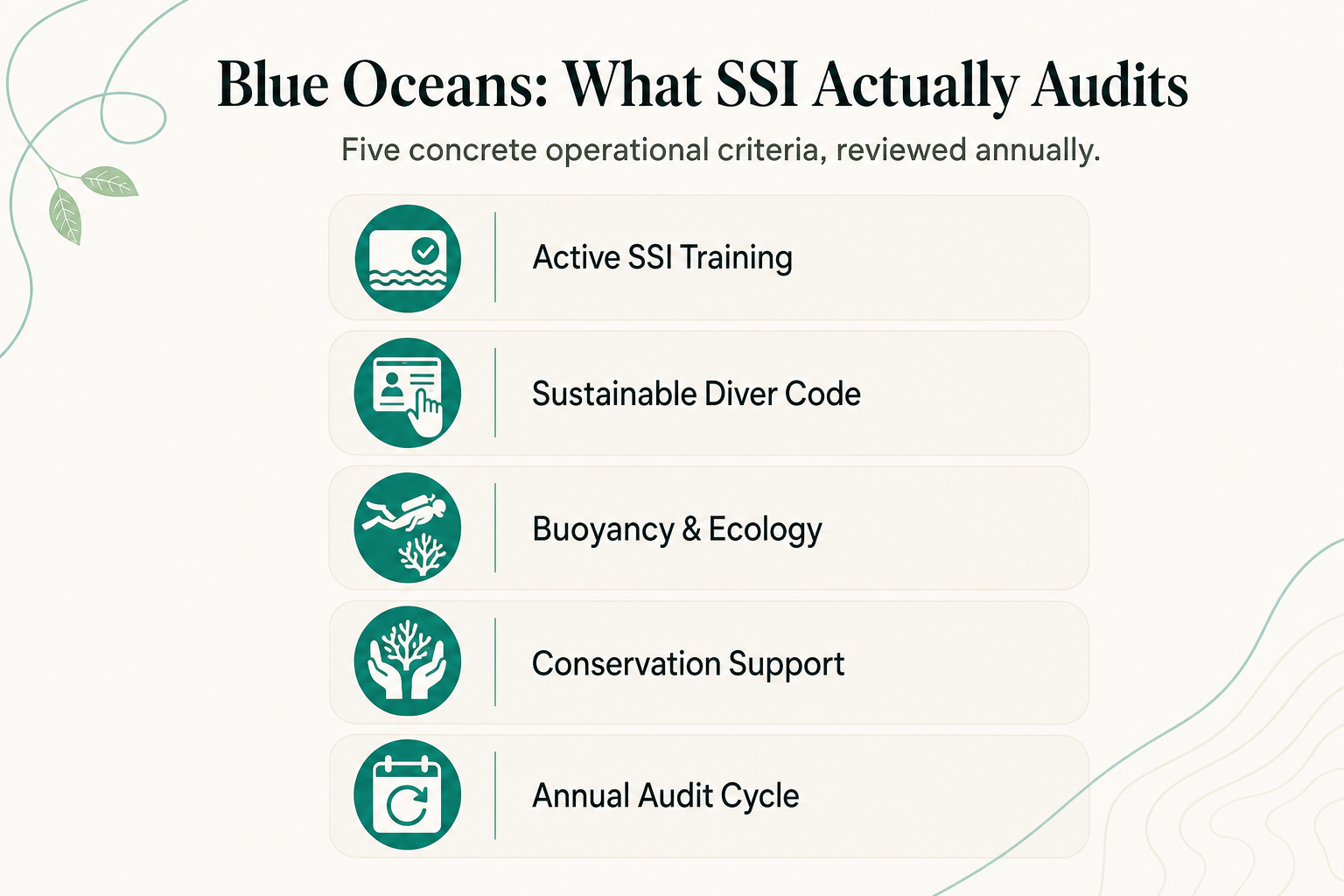
Blue Oceans certification is SSI's sustainability standard for dive centers. It audits five concrete things: active SSI training status, promotion of the Sustainable Diver Code, delivery of buoyancy and ecology-focused courses, ongoing conservation support, and regular clean-up events. It is reviewed annually through an application checked by an SSI Sales Representative and confirmed by the SSI Service Center, with compliance monitored on an ongoing basis.
TL;DR
- Blue Oceans is issued by Scuba Schools International (SSI), the same global agency behind Open Water and Advanced Adventurer certifications.
- It audits operational behavior, not just paperwork: buoyancy teaching standards, no-touch diving practice, conservation project support, and clean-up frequency.
- Certification is reviewed annually, not granted once and forgotten.
- It says nothing about a center's water, power, or waste systems. Those are separate sustainability claims a resort has to prove on its own.
- Reconnect's on-site dive center on Buka Buka Island in the Togean Islands holds Blue Oceans status alongside its own off-grid infrastructure (93% solar, on-site desalination, zero single-use plastics).
What Is Blue Oceans Certification, Exactly?
Blue Oceans is a status awarded by SSI to dive centers that meet specific sustainability operating criteria. SSI itself is a globally recognized training agency for recreational scuba diving, freediving, and professional instruction, aligned with WRSTC and ISO standards and covering certification levels from entry-level Open Water Diver through advanced specialties and instructor ratings.
Blue Oceans sits on top of that training framework as a conduct standard. A center cannot apply for it unless it is already an active SSI Training Center. From there, the certification checks how that center actually operates day to day, not just what courses it sells.
Two things make this different from a generic "eco-friendly" claim printed on a website. First, it requires the center to already run SSI training programs, so it is anchored to a real instructional infrastructure. Second, it gets re-reviewed every year, so it cannot be earned once and left to lapse silently.
What Does the Audit Actually Check?
The audit looks at five specific requirements, each tied to something a diver or auditor can observe.
- Active SSI Training Center status. The center must currently run SSI courses, not have run them at some point in the past.
- Promotion of the Sustainable Diver Code. The center has to actively teach and display this code to guests, not just link to it somewhere.
- Perfect Buoyancy and Ecology program delivery. These specific SSI programs must be offered, not optional add-ons mentioned in passing.
- Eco-friendly operational practices. This covers day-to-day behavior: low-impact diving techniques, proper buoyancy control, and no-touch policies on reefs.
- Conservation project support and clean-up events. The center must show it supports marine conservation organizations and organizes clean-ups on a recurring basis, not as a one-off photo opportunity.
The review process runs through an application, checked by an SSI Sales Representative, then verified by the SSI Service Center. Compliance is monitored afterward, which is what separates Blue Oceans from a certificate a center could frame and forget.
Why Does the "Annual" Part Matter More Than the Badge Itself?
A one-time certification measures intent. An annual one measures behavior over time. That is the mechanism worth understanding here.
Think of it the way you'd think about a food safety inspection for a restaurant versus a chef's diploma. The diploma proves someone learned to cook properly once. The inspection checks whether the kitchen is still being run properly today, this month, this year. Blue Oceans functions like the inspection, not the diploma.
That has a practical consequence for divers choosing a center. A center that let its clean-up events lapse, or stopped reinforcing no-touch buoyancy in its courses, would not keep the certification through the next review cycle. The badge only stays current if the practice stays current.
Does Blue Oceans Cover a Resort's Broader Sustainability, or Just the Dive Operation?
This is the distinction most guests miss, and it matters. Blue Oceans audits the dive center's conduct: how courses are taught, how divers behave underwater, how often clean-ups happen. It says nothing about how a resort generates its electricity, sources its water, or handles waste on land.
Those are separate claims, and a resort has to substantiate them independently. At Reconnect, that means:
| Sustainability layer | What it covers | Certified by |
|---|---|---|
| Dive operation conduct | Buoyancy standards, no-touch diving, clean-up events, conservation support | SSI Blue Oceans |
| Power generation | 93% solar, generator as backup only, never primary | Reconnect's own infrastructure |
| Water supply | On-site desalinated water, no municipal or bottled water needed | Reconnect's own infrastructure |
| Waste | Zero single-use plastics resort-wide | Reconnect's own policy |
A center can be Blue Oceans certified and still run on a diesel generator around the clock. The certification does not touch that layer at all. If a resort tells you Blue Oceans covers its power or water systems, that is a claim worth questioning, not accepting.
What Should a Diver Actually Look For When Comparing Centers?
Since the certification audits specific, observable practices, you can ask a center direct questions rather than taking the logo at face value.
Step 1: Ask about the Sustainable Diver Code. A genuinely compliant center should be able to explain it to you in a sentence or two before your first dive briefing, not hand you a laminated card and move on.
Step 2: Ask when the last clean-up event happened. "Regularly" is the standard's own word. If the honest answer is "over a year ago," the center is likely coasting on an old certification.
Step 3: Watch the buoyancy instruction during a course. Sustainable diving standards emphasize resource conservation and waste minimization, alongside skill enhancement like buoyancy control. If instructors are correcting trim and finning technique on every dive, that is the certification showing up in practice, not just on paper.
The Togean Islands, an archipelago of 56 islands in the Gulf of Tomini within the Coral Triangle, give this extra weight. Visibility here averages about 30 meters, most consistent in the April-to-November dry season, and the reefs are fragile enough that buoyancy discipline is not a formality.
Frequently Asked Questions
Is Blue Oceans the same as Green Fins?
No. They are separate programs run by different organizations with different audit criteria. This article covers SSI's Blue Oceans standard specifically.
Do all SSI dive centers automatically hold Blue Oceans status?
No. A center must already be an active SSI Training Center to apply, but Blue Oceans is a separate, additional certification with its own criteria and annual review.
Can a Blue Oceans center still use a diesel generator for power?
Yes. The certification audits dive operation conduct, not a resort's energy infrastructure. Power source is a separate claim a property makes on its own.
How often is Blue Oceans status reviewed?
Annually, through an application process checked by an SSI Sales Representative and verified by the SSI Service Center, with ongoing compliance monitoring.
Reconnect is an eco-resort with an on-site SSI-certified dive center on Buka Buka Island in the Togean Islands. Built by Thomas Despin, it runs on 93% solar power with on-site desalinated water and zero single-use plastics. All-inclusive full-board stays start from EUR 60/night. For more information, visit reconnect.id.