


Food allergies and intolerances do not disappear on vacation, and a shared kitchen serving one set menu to every guest is where most risk gets introduced. At Reconnect, every stay is all-inclusive full-board, which means our kitchen team already prepares three meals a day for every guest on the island, and building dietary accommodation into that same process rather than bolting it on afterward is what makes it manageable. This article explains exactly how that works, what to tell us before you arrive, and what questions to ask any all-inclusive resort, in Indonesia or elsewhere, before you book with a restriction that matters.
TL;DR
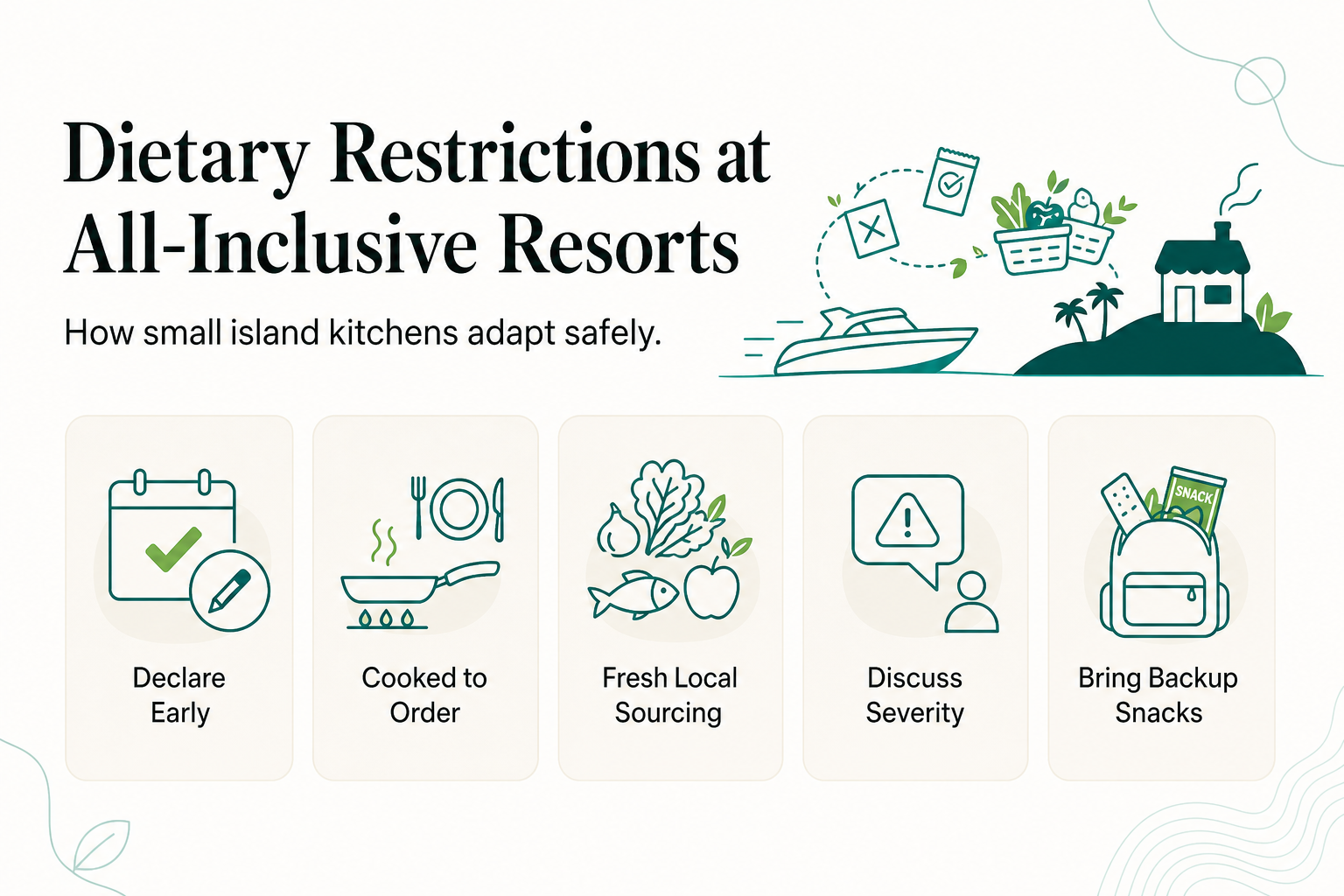
- Tell us your allergy, intolerance, or preference (vegan, celiac, shellfish, nut-free) when you book, not on arrival, so the kitchen can plan ingredient sourcing around it.
- Our kitchen cooks to order rather than running an open buffet, which limits cross-contact compared to self-serve stations.
- Vegan, vegetarian, and celiac-conscious meals are prepared on request as part of the standard all-inclusive rate, at no extra charge.
- Being a small, 20-room resort supplied through local village partnerships means our kitchen sources and adapts fresh, not from a large frozen inventory built for volume.
- Remote-island logistics mean rare or highly specific packaged products may not be available. Bring backup snacks for very restrictive diets.
Why Does Dietary Accommodation Work Differently at a Remote Island Resort?
A resort connected to a mainland supply chain can restock a specific gluten-free brand or a substitute ingredient within a day or two. We cannot. Everything reaching Buka Buka Island travels by the same route guests do: a private car from Luwuk Airport to Ampana, then a 30-45 minute speedboat crossing. That distance changes how a kitchen has to plan.
Rather than stocking a wide range of packaged alternatives, our approach is built on fresh, adaptable ingredients sourced through supplier partnerships with neighboring villages. Fish, vegetables, and fruit arrive fresh and get prepared per dish, per guest, rather than pulled from a pre-made batch. That is closer to home cooking than resort catering, and it is precisely what makes flexible substitution realistic here: a cook adjusting a fresh dish is simple, while a cook reformulating a packaged, pre-mixed product is not.
The tradeoff is availability. If your diet depends on one specific certified product, such as a particular commercial gluten-free flour blend, plan around it rather than assume it will be on the island.
How Do You Tell Reconnect About an Allergy Before You Arrive?
Industry guidance is consistent on this point: formal allergen intake before arrival, not after, is what actually prevents incidents at all-inclusive properties. Many allergy-conscious kitchens keep a written record of each guest's restrictions on file so every staff member on shift is aware. We follow the same principle.
Step 1: Declare it at booking
Be specific about the allergen or condition when you reserve. "No shellfish" and "severe shellfish allergy, anaphylaxis risk" require different kitchen protocols.
Step 2: Confirm again on arrival
Restate the restriction with our team when you check in, which closes the gap between what was booked online and who is actually cooking that week.
Step 3: Flag severity, not just the food
A gluten preference and celiac disease call for different handling in the kitchen. Say plainly if a reaction would require medical attention. That single detail changes whether a dish gets its own pan, its own cutting board, and its own prep window.
Can a Small Island Kitchen Really Handle Celiac Disease or Severe Allergies?
Celiac disease is the harder case for any all-inclusive resort, ours included, because cross-contact from shared cutting boards, fryers, or serving spoons can trigger a reaction even when the ingredient itself is gluten-free. Independent reviews of all-inclusive dining note this directly: buffets, shared kitchens, and unclear procedures are where celiac risk actually comes from, not the absence of gluten-free food on the menu [celiac.com].
This is where our meal format helps. Reconnect serves full-board meals prepared to order rather than through an open buffet line, which is where most cross-contact happens at resorts running self-serve stations [celiac.com]. A cooked-to-order kitchen can dedicate a clean pan and a fresh set of tools to one dish. A buffet cannot guarantee that once a hundred guests have moved through it with shared serving spoons.
We are transparent about our limits:
- We do not operate a certified gluten-free prep line with a dedicated kitchen zone.
- We reduce cross-contact through cooked-to-order meals and advance notice, but complete separation is not something a 20-room island resort operates.
- Guests with severe celiac disease or anaphylaxis-level allergies should discuss specifics with us directly before booking, and consider bringing shelf-stable backup food as a precaution, which is standard advice for any remote destination [cntraveler.com].
What About Vegan, Vegetarian, or Other Preference-Based Diets?
Preference-based diets are more straightforward than allergies because there is no cross-contact risk to manage, only ingredient substitution. Reconnect prepares vegan and vegetarian meals on request at no extra cost, drawn from the same fresh produce, rice, and legume base already used across the kitchen. Guests searching for a vegan all-inclusive resort in Indonesia should know that plant-based meals here are a standard accommodation, not a specialty add-on with a surcharge.
The Coral Triangle location also means fresh fish and seafood dominate the standard menu, so guests avoiding seafood for preference rather than allergy simply get a swapped protein, most often chicken, egg, or a legume-based dish.
How Should You Compare All-Inclusive Resorts Before Booking With a Restriction?
Not every all-inclusive resort handles dietary accommodation the same way, and the honest advice from allergy and food-safety specialists is to call ahead and ask specific questions before booking rather than assuming "all-inclusive" implies flexible catering [foodallergy.org].
| Question to ask | Why it matters |
|---|---|
| Buffet or cooked-to-order? | Buffets carry higher cross-contact risk for allergies [celiac.com] |
| Is dietary accommodation free or a surcharge? | Some resorts charge extra for allergy-specific meals |
| Can the kitchen source substitute ingredients locally? | Remote resorts may have longer restock cycles |
| Is there a written allergen record kept per guest? | Prevents the restriction getting lost between shifts |
| What happens if a specific product isn't available? | Matters most for celiac or highly restrictive diets |
This applies whether you are comparing a family-friendly all-inclusive resort in the Caribbean, a scuba diving vacation package in Southeast Asia, or a private island resort in Indonesia like Reconnect. The dive center, the room type, and the setting matter, but for a guest with a real allergy, the kitchen's process is the deciding factor.
Frequently Asked Questions
Does Reconnect charge extra for allergy or dietary accommodation?
No. Vegan, vegetarian, celiac-conscious, and allergen-adjusted meals are prepared on request as part of the standard all-inclusive full-board rate already included in every room type.
Can Reconnect guarantee a completely gluten-free kitchen for celiac guests?
No. We reduce cross-contact through cooked-to-order meals rather than buffet service, but we do not operate a separate certified gluten-free prep line. Guests with celiac disease should discuss severity with us directly before booking [celiac.com].
About Reconnect
Reconnect is an island eco-resort on Buka Buka Island in the Togean Islands with an on-site SSI dive center. To plan a stay with a specific dietary need, get in touch at https://reconnect.id.