


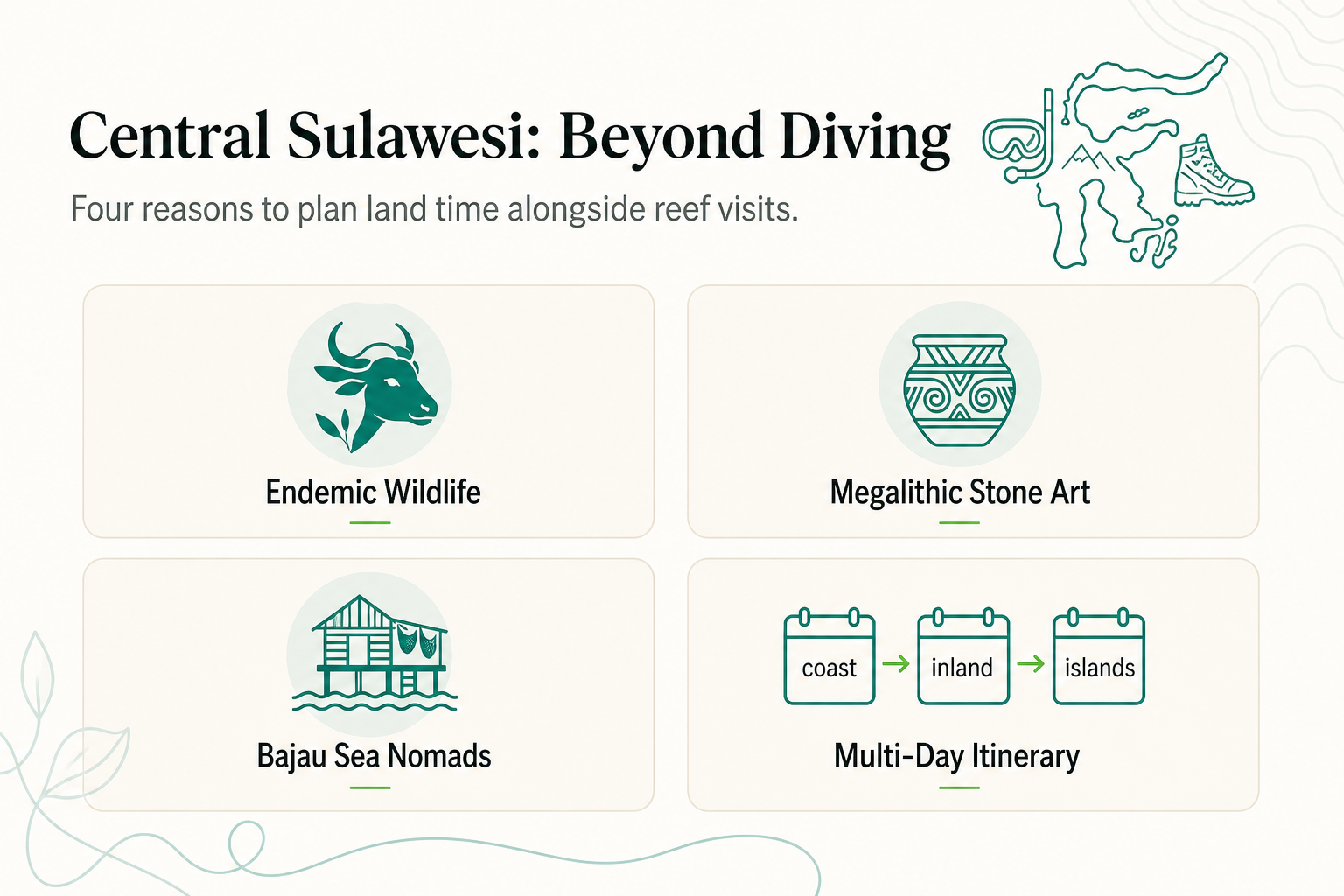
Most travelers researching Central Sulawesi focus entirely on reef conditions and dive sites, then arrive to discover the region holds a National Park with megalithic stone vessels, endemic wildlife found nowhere else on earth, and Bajau sea nomad communities living exactly as their ancestors did. Central Sulawesi rewards travelers who plan a few land-based days alongside the diving: Lore Lindu National Park's ancient stone carvings, the endangered anoa and babirusa, Tonkean macaques, and Bajau stilt villages are all reachable without cutting into your dive schedule if you build the itinerary correctly.
TL;DR
- Central Sulawesi hosts endemic species found nowhere else, including the anoa (dwarf buffalo), babirusa, and Tonkean macaque.
- Lore Lindu National Park contains megalithic stone vessels predating written records in the region.
- Bajau sea nomad villages near the Togean Islands offer a genuine, respectful cultural excursion, not a staged performance.
- Land excursions pair naturally with a Togean Islands dive or snorkel stay: mornings underwater, afternoons on a village visit or park trip.
- Plan land excursions before booking flights, since some sites (Lore Lindu in particular) require a multi-day detour from the coast.
What Wildlife Can You Actually See in Central Sulawesi?
Central Sulawesi sits within Wallacea, the biogeographic zone between Asia and Australia where species evolved in isolation.
The anoa is a dwarf buffalo standing about knee-to-thigh height on an adult human, found only in Sulawesi's forests. The babirusa, a wild pig with upward-curving tusks that grow through its own snout, is listed as endangered and specifically documented in the Togean Islands. The Tonkean macaque, pygmy tarsier, spectral tarsier, bear cuscus, dwarf cuscus, and maleo birds (which bury their eggs in warm volcanic or beach sand rather than incubating them) round out a checklist that rivals better-known wildlife destinations, minus the crowds.
| Species | Where Found | Notable Trait |
|---|---|---|
| Anoa | Lowland/mountain forests | Smallest wild buffalo species |
| Babirusa | Togean Islands, Sulawesi forests | Tusks curve back through the snout |
| Tonkean macaque | Central Sulawesi forests | Endemic primate, complex social groups |
| Maleo bird | Volcanic/coastal sand | Buries eggs for geothermal incubation |
| Spectral & pygmy tarsier | Forest interior | Among the smallest primates on earth |
None of these are guaranteed sightings on a short visit. Wildlife spotting in Sulawesi's interior forests works more like Borneo than an African safari: patience and a local guide matter more than luck.
Is Lore Lindu National Park Worth the Detour From the Coast?
Lore Lindu National Park is one of several protected areas in Central Sulawesi, and the one most travelers research for its megalithic stone vessels, human-shaped and animal-shaped carvings scattered across the Bada, Besoa, and Napu valleys, some estimated to predate written historical records in the region.
The park sits inland, a multi-hour road trip from the coast, which is why it belongs in the planning phase rather than a spontaneous add-on. If a Sulawesi itinerary is built around Togean Islands diving, Lore Lindu is not a same-trip detour. It is a separate leg, usually requiring its own overnight stay near Bada Valley.
Who should prioritize it:
- Travelers with 10+ days who can split time between coastal diving and inland archaeology.
- Those specifically interested in megalithic history alongside Sulawesi's broader appeal for diving, snorkeling, hiking, and wildlife spotting [indietraveller.co].
- Photographers and researchers who want the stone vessels themselves, not just a wildlife checklist.
Who should skip it:
- Short-stay divers with under a week total in Sulawesi.
- Travelers whose primary goal is reef time; the detour eats two to three days that could otherwise be spent diving or snorkeling.
Who Are the Bajau Sea Nomads, and How Should You Visit Them?
The Bajau are an ethnic group historically known as sea nomads, traditionally living aboard boats or in stilt houses built directly over shallow reef flats rather than on land. In Central Sulawesi they live alongside over a dozen indigenous groups including the Kaili, Pamona, and Banggai, plus Bugis immigrant communities, giving the region a genuinely layered cultural mix rather than a single dominant tradition.
A village visit near the Togean Islands puts you in a stilt community built on poles above the water, where fishing remains the primary livelihood. This works as a respectful excursion, not a staged show, when it is arranged through direct relationships with the village rather than a generic tour operator.
Three things worth knowing before a Bajau village visit:
- These are working communities, not attractions. Boats, nets, and daily routines continue during your visit. You are a guest observing real life, not an audience at a performance.
- Photography etiquette matters. Ask before photographing individuals, especially children, and follow your guide's lead on what is appropriate.
- Supplier relationships benefit the village directly. Where resorts source food, labor, or crafts from neighboring Bajau and coastal communities, the visit connects to an ongoing economic relationship rather than a one-off transaction.
A guided trip from Buka Buka Island to a nearby Bajau community can be built on these same local supplier relationships, so the excursion supports an existing partnership with the village.
How Do Sulawesi's National Parks Compare for a Multi-Stop Trip?
Sulawesi national parks each protect a different ecosystem, and conflating them is the most common planning mistake. Lore Lindu protects highland forest and megalithic sites. Togean Islands National Park protects a marine ecosystem: coral atolls, reef walls, and the calm, warm waters of the Gulf of Tomini. Further north, Bunaken and Lembeh are separate marine parks entirely, often paired with a Minahasa Highlands land extension for volcano hikes and wildlife viewing [bluewaterdivetravel.com].
A realistic multi-park itinerary looks like this:
- Option 1: Marine-focused. Togean Islands only. Diving, snorkeling, and a paid Togean Day Trip into the National Park, plus a Bajau village visit. No inland travel required.
- Option 2: Marine plus culture. Add Lore Lindu as a dedicated inland leg before or after the Togeans, budgeting two to three extra days for road travel and the stone vessel sites.
- Option 3: North-south combination. Pair Togean or Bunaken diving with a Minahasa Highlands extension for Tangkoko wildlife spotting and volcano hikes [bluewaterdivetravel.com], turning the trip into genuine Indonesia island hopping across two very different ecosystems.
Sulawesi's shape, an orchid with four sprawling peninsulas, means overland travel between regions takes real time. Build the itinerary around two or three focal areas, not a full-island circuit, unless you have three weeks or more.
Where Does Togean Islands Accommodation Fit Into This Plan?
Understanding the Togean Islands map helps here: the archipelago sits in the Gulf of Tomini, reached via Luwuk Airport followed by a road transfer to Ampana and a speedboat crossing to the islands themselves. This is the gateway for anyone combining reef time with the land excursions above.
Togean Islands accommodation ranges from basic guesthouses to small dedicated properties. Reconnect is an island eco-resort with an on-site SSI dive center on Buka Buka Island, with 20 rooms across 8 accommodation types and all-inclusive full-board rates starting from EUR 60 per night. The resort coordinates the Luwuk-Ampana-island transfer directly and arranges a paid Togean Day Trip excursion into the National Park plus a Bajau village visit, so land-and-culture time slots in alongside diving without separate logistics.
Diving conditions here run calm and warm, 28 to 30 degrees Celsius with mild currents and visibility averaging about 30 meters, sheltered inside the Gulf of Tomini, with schooling hammerhead sharks, black-tail barracuda, eagle rays, and rare dugongs among the marine life divers encounter. That reef quality is why most itineraries lead with diving. The wildlife and cultural detail above is why the smarter ones don't stop there.
Frequently Asked Questions
Is Lore Lindu National Park accessible from the Togean Islands?
Not directly. It requires a separate inland trip, typically several hours by road from the coast, so plan it as its own leg rather than a day trip from a Togean base.
What is the best time of year for both diving and land excursions in Central Sulawesi?
The dry season, March to November, gives the calmest seas and clearest water for diving. It also makes overland travel to inland parks more predictable, since the December to February monsoon brings stronger winds and rain.
Can you see the anoa or babirusa in the wild, or only in reserves?
Both are wild, free-ranging species, but sightings are not guaranteed. A local guide familiar with feeding and movement patterns significantly improves your odds.
About Reconnect
Reconnect is an island eco-resort with an on-site SSI dive center on Buka Buka Island, in the Togean Islands. All-inclusive full-board stays start at EUR 60 per night, with complete transfer coordination from Luwuk Airport. Get in touch at reconnect.id to plan your stay.
References
- Sulawesi Travel Guide: Your Journey in Indonesia's Wild Side (indietraveller.co)
- Discover Minahasa Highlands - North Sulawesi Land Extension (bluewaterdivetravel.com)