


A dive plan must match your certification level. The Togeans combine warm, calm water with site-specific currents and occasional thermoclines-which means the right plan looks different for a first-time Open Water diver than for an Advanced Adventurer. Match your maximum depth to your certification limit, check the site's current profile before you book, and build in a buffer for seasonal shifts.
TL;DR
- SSI certification depth limits: Try Scuba stays within 5 meters, Open Water to 18 meters, Advanced Adventurer to 30 meters.
- Togean currents are generally mild April-to-November and more variable December-March, but current strength is always site-specific.
- Average visibility around Buka Buka Island is 30 meters.
- Thermoclines in this region are usually mild temperature shifts, but they still affect buoyancy and should factor into your plan.
- A dive plan should be written before you get on the boat: depth cap, turnaround air pressure, and current contingency, agreed with your guide.
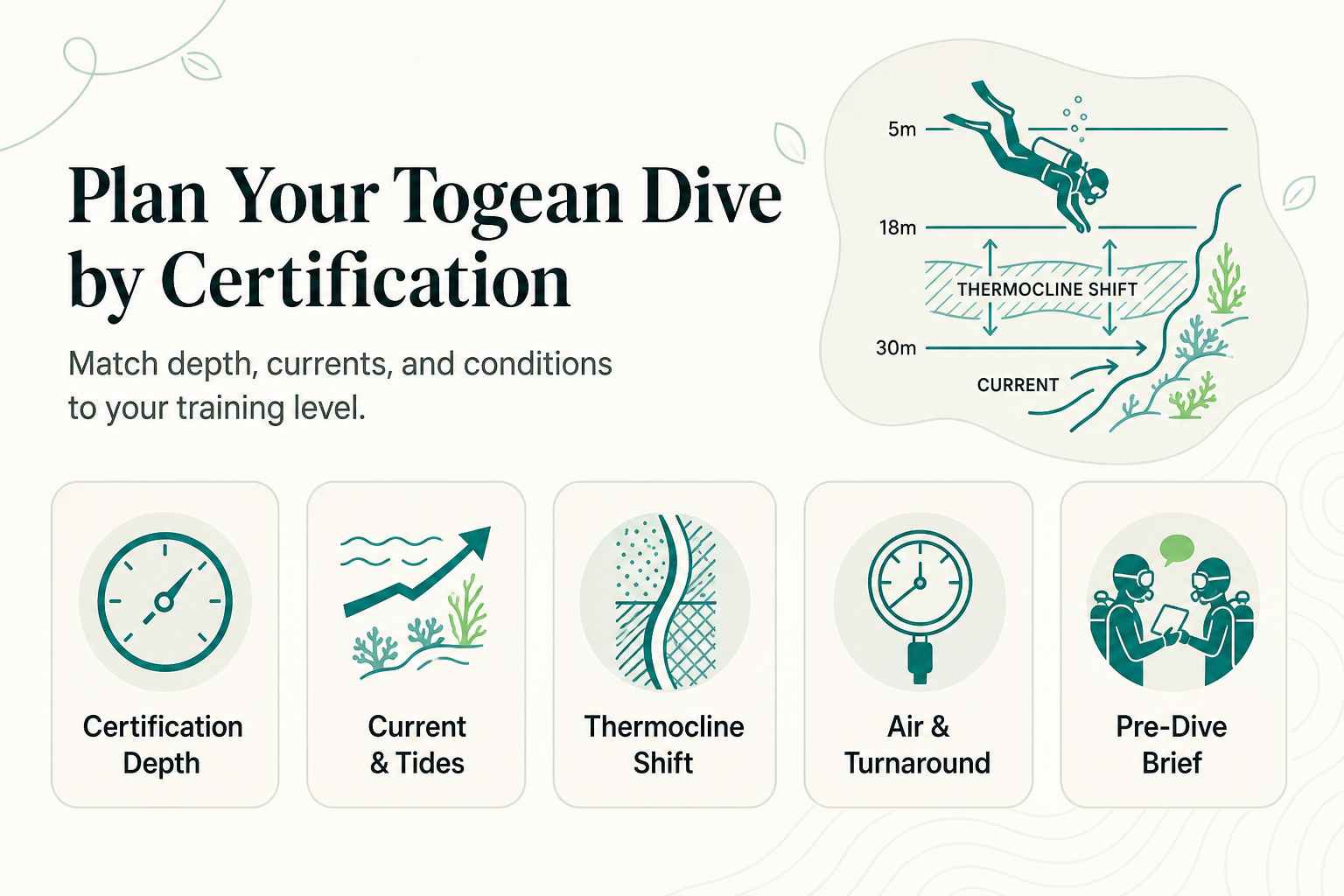
What Do Certification Levels Actually Limit You To?
A certification level is not a suggestion-it is a depth ceiling tied to the training you have actually completed. SSI's Try Scuba program requires no prior certification. You stay at 5 meters or shallower, always with an instructor. For an open-water introduction down to 12 meters, SSI's Basic Diver program is the equivalent option.
Open Water Diver certification extends that limit to 18 meters. It involves full classroom, pool, and open-water training. Advanced Adventurer, bookable once you hold Open Water certification, takes you to 30 meters over five dives covering navigation, deep diving, and other specialties you choose.
This is different from SSI's Advanced Open Water Diver rating, which is not a course you book. It is a recognition awarded automatically once you have logged four specialty certifications and 24 dives. If a dive operator offers to "sell" you Advanced Open Water Diver as a standalone product, that is a red flag.
| Certification | Who it's for | Max depth |
|---|---|---|
| Try Scuba | No prior certification needed | 5 m |
| Basic Diver | No prior certification needed, open water introduction | 12 m |
| Open Water Diver | First full certification | 18 m |
| Advanced Adventurer | Open Water certified divers | 30 m |
The Togeans have real depth range on offer. Walls and pinnacles drop well past recreational limits, so the temptation to go deeper than your training exists on almost every site. The limit exists because nitrogen narcosis risk, air consumption rate, and decompression obligation all increase with depth. Training time teaches you to manage those variables rather than just experience them.
How Should Currents Change Your Dive Plan?
Current strength in the Togeans is site-specific, not a blanket seasonal fact. From April to November, the dry season, seas are generally calm. From December to March, the northwest monsoon brings choppier surface conditions.
Underwater current itself stays highly localized depending on the specific reef, channel, or pinnacle. This means a newly certified Open Water diver and an Advanced Adventurer diver should not default to the same site list, even in the same week.
- Beginners (Open Water, under 50 logged dives): stick to sheltered reef slopes and house-reef-adjacent sites where current is negligible most of the year.
- Intermediate divers (Advanced Adventurer, 50-150 dives): can handle mild-to-moderate drift sites with a briefed entry and exit plan, ideally with a surface marker buoy.
- Experienced divers (150+ dives, multiple specialties): are better matched to channel and pinnacle sites where current can run moderate to strong depending on tide.
A good dive guide will brief current direction and strength before you enter the water, every time. If a briefing skips this, ask.
What Are Thermoclines and Do They Matter Here?
A thermocline is a layer where water temperature drops sharply over a short depth change. Cooler, denser water sits beneath a warmer surface layer heated by the sun. In temperate destinations this can mean a 10-degree Celsius swing in a few meters.
In the Togeans, thermoclines are typically mild-a few degrees at most-since the whole water column stays warm by comparison. The practical effect is still worth planning for. A temperature shift changes water density slightly, which affects buoyancy control. Even a mild cold shock response can affect breathing rate and air consumption.
For beginners doing their first dives past 15 meters, an unexpected thermocline can be startling enough to disrupt trim and buoyancy for a few seconds. That is not dangerous on its own, but it is one more reason a slower, controlled descent matters more as depth increases.
How Do Visibility Conditions Interact With Depth and Experience?
Visibility shapes how much margin you have to react to a current shift, a buddy separation, or a depth drift. Average visibility around Buka Buka Island is 30 meters.
At 30 meters of visibility, a diver at 18 meters depth can often still see the surface shimmer and maintain visual reference to their buddy and guide without difficulty. That margin shrinks fast if you combine lower visibility with deeper diving, which is why Advanced Adventurer training pairs deep diving practice with navigation skills.
Depth and orientation compound each other. Good visibility buys you time to correct a mistake before it becomes a real problem.
How Should You Actually Build a Dive Plan Around Your Level?
Step 1: Confirm your certification ceiling before you book a site
Ask your dive center for the maximum depth of each site on offer and cross-reference it against your own certification limit.
Step 2: Check the current and tidal window for your dive date
Currents shift with tide state even within a single dry-season week. A site rated calm on a neap tide can run moderately on a spring tide.
Step 3: Plan your air management around the rule of thirds
Many divers use roughly a third of their air going out, a third returning, and keep the final third as reserve for an unplanned decompression stop or surface delay.
Step 4: Build in a thermocline and buoyancy check at depth
If you are diving past 15 meters for the first time in the region, do a controlled pause at your working depth to recheck trim before continuing.
Step 5: Debrief every dive with your guide
Depth reached, current experienced, and air used at turnaround all feed into whether your next planned dive should go deeper, shallower, or stay the same.
Frequently Asked Questions
Is scuba diving for beginners safe in a remote destination like the Togeans?
Beginner diving here follows the same SSI depth and supervision standards used worldwide. Remoteness affects logistics and emergency response time, not the in-water teaching standard itself.
How does dive instruction language work for international guests?
At Reconnect, SSI instruction is available in English, French, and Indonesian, which covers most international and local guest groups without language barriers during training dives.
Reconnect is a Private Island Resort on Buka Buka Island in the Togean Islands with an on-site SSI-certified, Blue Oceans-approved dive center. We run instruction from Try Scuba through Advanced Adventurer in English, French, and Indonesian, alongside all-inclusive full-board stays from EUR 60 per night. Transfers from Luwuk Airport are coordinated with every booking.
Ready to plan a dive trip matched to your certification level in the Togean Islands? Get in touch with Reconnect at https://reconnect.id.