


Full disconnection sounds romantic until one partner needs to confirm a flight change or a family emergency call cannot get through. That anxiety is precisely why a growing number of couples now choose curated, low-bandwidth connectivity over cutting the cord entirely on trips that matter. The middle path, sometimes called Starlink-only connectivity, keeps a thin line open for safety and logistics while removing the endless scroll that erodes actual conversation.
TL;DR
- The average adult spends 4.4 hours a day on their phone, roughly 1.5 hours more than they spend talking to their partner, and 70 percent of couples say technology interferes with their relationship.
- Searches for tech-free retreats have grown by 17 percent recently, and over a quarter of travelers now say they want to reduce social media use during their holidays.
- Starlink-only connectivity delivers 40 to 220 Mbps download and 10 to 25 Mbps upload with latency under 99 milliseconds, enough for essentials without enabling all-day scrolling.
- Research links reduced technoference to better communication, lower conflict, and stronger emotional intimacy between partners.
- A destination with a genuinely limited digital footprint, like a remote island, does more of the detox work than any app-blocking setting.
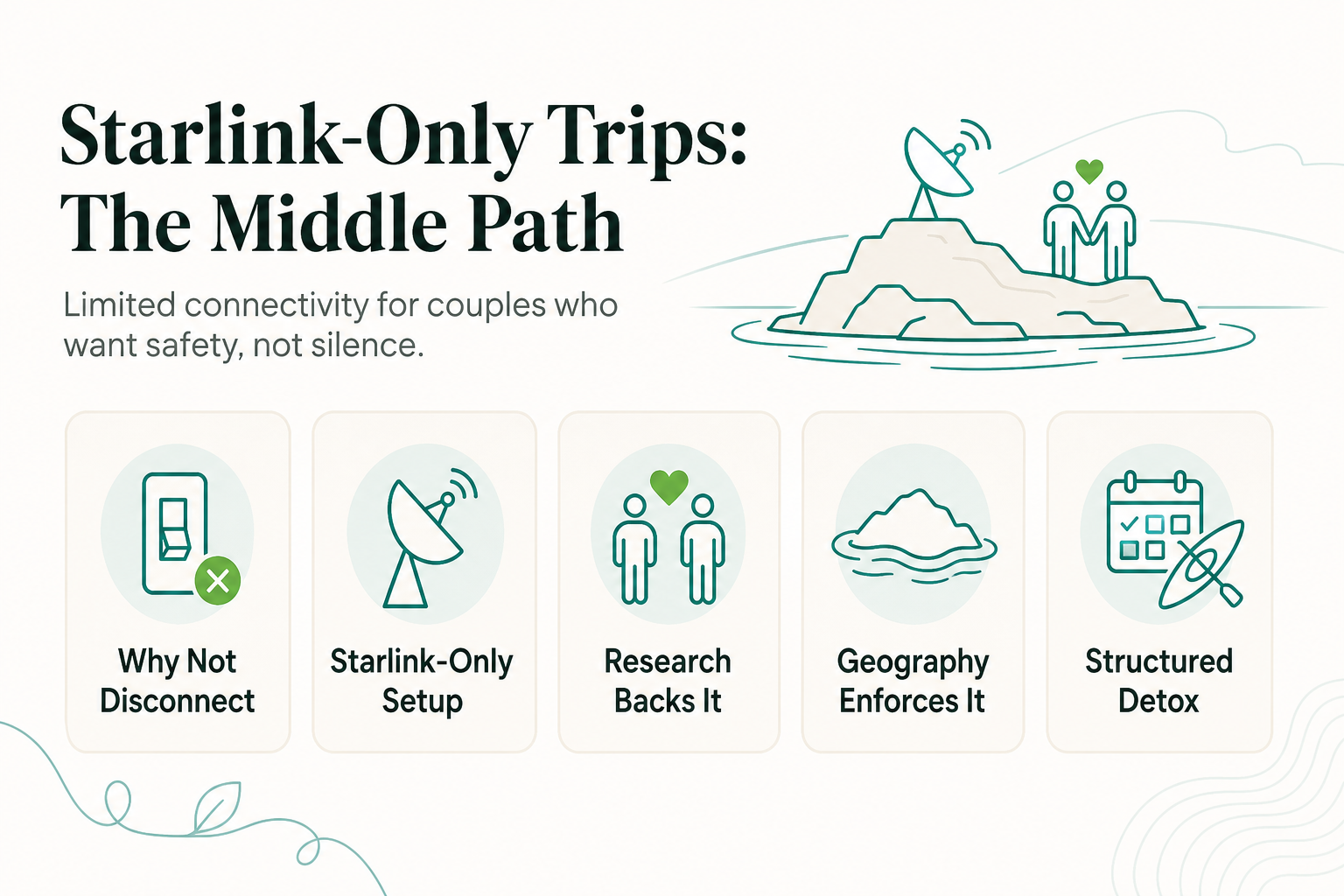
What Does "Starlink-Only Connectivity" Actually Mean for a Couple's Trip?
Starlink-only connectivity means the destination offers satellite internet as the single connection option, with no cell towers, no cable broadband, and no fallback network to switch to. There is one pipe, and it is a modest one by home broadband standards.
That constraint changes behavior in ways a settings menu cannot. Couples cannot toggle between apps looking for a faster connection because there is no alternative to hop to.
- Download speeds run 40 to 220 Mbps, upload 10 to 25 Mbps, latency typically under 99 milliseconds.
- In tropical locations, heavy rainfall can cause rain fade, cutting speeds by 30 to 60 percent or triggering brief outages that recover once the downpour eases.
- The connection supports messaging, maps, and a video call home, but it discourages the kind of high-bandwidth binge-scrolling that fills idle hours at a typical hotel.
The bandwidth is real but finite. That finiteness is the feature, not a flaw.
Why Not Just Disconnect Completely?
Full disconnection sounds cleaner in theory, but most couples do not actually want zero connectivity for a full trip. They want a circuit breaker on habit, not a communications blackout.
A useful analogy: a dimmer switch works better than a light switch for a room you still need to move around in occasionally. Cutting power outright leaves you fumbling in the dark for something urgent, like a delayed flight confirmation or a call from an aging parent. A dimmer lets you keep just enough light to function while removing the option to flood the room with brightness out of habit. Starlink-only connectivity is the dimmer. It permits the necessary and starves the compulsive.
There are real reasons couples still want a thread back to the outside world:
- Confirming return flights or transfer arrangements.
- Reaching family in a genuine emergency.
- Sharing a handful of photos rather than none at all.
- Avoiding the low-grade anxiety that a total blackout can itself create, which undercuts the relaxation a detox is supposed to deliver.
Digital detox research backs the instinct to limit rather than eliminate. Studies on partaking in structured social media breaks show measurable benefits even when some connectivity remains, because the goal is reducing technoference, not achieving total silence [pmc.ncbi.nlm.nih.gov]. A two-week digital detox study found meaningful shifts in mood and social behavior without requiring participants to go fully offline [pmc.ncbi.nlm.nih.gov].
What Does the Research Say About Screens and Relationship Quality?
The evidence on phones and relationship strain is specific and consistent. The average adult spends 4.4 hours daily on their phone, about 1.5 hours more than they spend talking to their partner, and 70 percent of couples report that technology interferes with their relationship.
Technoference, the habit of checking a device mid-conversation or during shared time, correlates with increased conflict and lower life satisfaction for couples. Reducing screen time and minimizing technoference significantly improves relationship satisfaction, communication, and emotional intimacy. Digital detoxes help restore emotional connection, decrease stress, and improve mental well-being more broadly [uclahealth.org].
This is not a fringe wellness trend. Searches for tech-free retreats have grown by 17 percent recently, and over a quarter of travelers now say they want to cut back on social media use while on holiday. Couples-focused detox literature points to the same mechanism repeatedly: removing the device does not just remove a distraction, it reopens the mental space where noticing your partner happens [marriagefamilyservices.com][belovedhotels.com].
How Does a Remote Destination Do More of the Work Than an App Setting?
Screen-time limits and app blockers require willpower that erodes by day two of a trip. A destination with genuinely restricted bandwidth removes the decision entirely, because there is nothing faster to switch to.
This is where geography matters more than settings. A resort built around a single satellite connection, on an island reached by boat rather than road, creates friction that a phone's built-in "Downtime" feature cannot replicate. The couple is not choosing to disconnect moment to moment. The environment has already made that choice easier by limiting what is possible.
Reconnect's setup illustrates the mechanism. The 20-room eco-resort sits on Buka Buka Island in the Togean Islands, reached by private car from Luwuk Airport to Ampana and a 30 to 45 minute speedboat crossing, and it runs on Starlink as its only connectivity layer, backed by 93 percent solar power with a generator held strictly in reserve. There is no cell signal to fall back on, no cable line, and no second network to check when Starlink slows during a rain squall. Days fill with house-reef snorkeling, kayaking, and SSI dives around the island's reefs and pinnacles at 30 meters visibility, rather than the alternative of scrolling on a lounge chair.
Couples booking a Private Island Resort in Indonesia specifically for this kind of trip are not choosing a spa package with better Wi-Fi. They are choosing an environment where the default activity is each other, and connectivity is a safety net rather than the main event.
What Should Couples Actually Do With Starlink-Only Access, Not Just Have It?
Step 1: Agree on connectivity windows before arrival, not during it
Decide together, before the trip starts, on one or two check-in windows a day rather than negotiating it in the moment when a notification pings.
Step 2: Separate "necessary" from "habitual" use explicitly
Necessary use is a flight confirmation or a call home. Habitual use is opening the same app for the fifth time in an hour out of reflex. Naming the difference out loud makes it easier to catch in the moment.
Step 3: Let the environment do the enforcing
Choose a destination where slow or limited bandwidth is structural, not a promise you have to keep to yourself. A rain-faded satellite connection is a better deterrent than a self-imposed rule.
Step 4: Plan device-free activities that fill the actual hours
Kayaking, snorkeling, or a guided dive occupies the exact hours that would otherwise default to a phone. Structured activity, not willpower, is what makes the detox stick for a full trip rather than a single afternoon.
Frequently Asked Questions
Is Starlink-only connectivity reliable enough for a genuine emergency?
Yes for messaging and voice calls, though heavy tropical rain can cause temporary rain fade, cutting speeds by 30 to 60 percent for the duration of the downpour before recovering.
Will a slow connection ruin video calls home?
Video calls work but can degrade during rain fade; text and voice remain more reliable throughout a stay.
How is this different from a resort that simply has "no Wi-Fi in rooms" as a gimmick?
A gimmick still has fast Wi-Fi in a lobby nearby. Genuine Starlink-only connectivity means there is no faster alternative anywhere on the property, which is what removes the temptation entirely.
Does limiting connectivity actually change measurable relationship outcomes, or is it just anecdotal?
Research on technoference shows a measurable link between reduced device interference and improved communication and emotional intimacy for couples, not just a subjective impression.
Should couples tell family and friends about the limited connectivity in advance?
Yes. Setting expectations before departure removes the pressure to respond instantly and is part of what makes the limited window feel restful rather than stressful.
About Reconnect
Reconnect is a 20-room eco-resort with an on-site SSI dive center on Buka Buka Island in the Togean Islands, all-inclusive full-board from EUR 60 per night, running on 93 percent solar power with Starlink as its sole connectivity layer. Founded by Thomas Despin. Get in touch at reconnect.id.
References
- The Effects of Partaking in a Two-Week Social Media Digital ... (pmc.ncbi.nlm.nih.gov)
- Considering a digital detox? Why it's a good idea and what to know | UCLA Health (uclahealth.org)
- Digital Detox for Couples: Reconnect Without Screens (marriagefamilyservices.com)
- Should you do a digital detox with a technology free retreat ... (belovedhotels.com)