


Bali gets the search volume, but the reefs that keep divers talking for years sit further north and east, within the Coral Triangle around Central Sulawesi. The Togean Islands, an archipelago of 56 islands and islets in the Gulf of Tomini, offer diverse reef types from atolls to barrier reefs, an active volcano dive site at Una Una, a WWII wreck, and a stingless jellyfish lake, a combination no single Bali dive destination matches [solitude.world]. If you want fewer boats on the same site and reef systems still building their reputation rather than newer diving destinations, Central Sulawesi deserves a real look before you book Bali again.
TL;DR
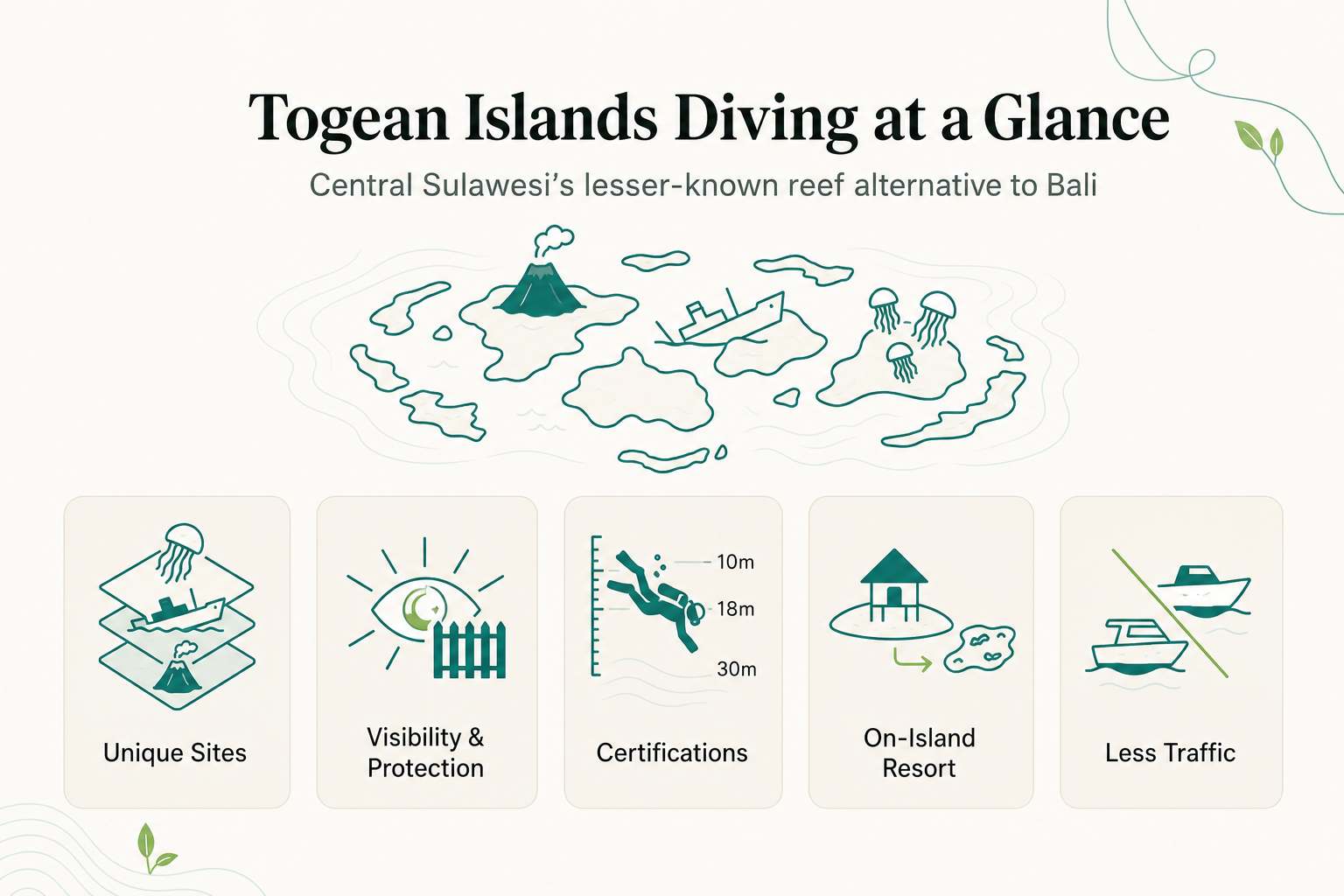
- The Togean Islands sit within the Coral Triangle with 56 islands, an active underwater volcano, a wartime wreck, and a jellyfish lake in one archipelago.
- Recreational certifications cap Open Water divers at 18 meters and Advanced divers at 30 meters, with 40 meters as the absolute recreational limit.
- Visibility in the Togean Islands averages about 30 meters.
- Protection here is substantial: Kepulauan Togean National Park alone covers over 360,000 hectares of marine and terrestrial habitat.
- Reconnect is a Private Island Resort on Buka Buka Island with an on-site SSI dive center, direct reef access, and all-inclusive full board from EUR 60/night.
What Makes Central Sulawesi Different From Bali for Scuba Diving?
Bali's diving is concentrated around a handful of well-known sites: Tulamben, Nusa Penida, Menjangan. All solid options, all heavily dived. Central Sulawesi offers a different proposition entirely.
The Togean Islands sit within the Coral Triangle, the global center of marine biodiversity referenced across best-of lists for diving in Indonesia [bluewaterdivetravel.com][blog.padi.com]. The region stands apart for geological and ecological variety packed into one archipelago:
- An active volcano at Una Una with a dive site formed by its underwater slopes
- A WWII wreck accessible to certified divers
- A stingless jellyfish lake, a rare phenomenon found in only a few places worldwide
- Atolls and barrier reefs within the same cluster of islands, rather than one dominant reef type
Central Sulawesi sits in that same tradition as Sulawesi's broader diving landscape, but with markedly less boat traffic than the more established circuits further north and southeast [worldadventuredivers.com][solitude.world].
How Does Visibility and Reef Health Compare Across Central Sulawesi?
Visibility is not uniform across the region. Coastal areas of Central Sulawesi typically see 10 to 15 meters of visibility, shaped by river runoff and coastal currents. The Togean Islands and Tomini Bay run clearer, with visibility averaging about 30 meters.
At Reconnect's dive sites around Buka Buka Island specifically, visibility averages about 30 meters, reflecting the site's distance from mainland sediment sources and its position within the cleaner Togean waters.
Reef health follows a similar pattern. Protection status matters here more than in most Indonesian diving regions:
| Protected Area | Coverage | What It Protects |
|---|---|---|
| Kepulauan Togean National Park | 360,000+ hectares | Marine and terrestrial habitat across the archipelago |
| Banggai Dalaka Marine Protected Area network | 850,000+ hectares | Reef systems and connected marine corridors |
| Pulau Pasoso Game Reserve | Localized | Turtle nesting sites and coral reefs |
That level of formal protection, layered across three separate designations, is one reason reef condition in this part of Sulawesi has held up better than in more heavily trafficked dive destinations.
What Certification Do You Need, and What Can You Actually Dive?
Your certification level determines your depth limit, not your enthusiasm.
Step 1: If You've Never Dived Before
Start with a Discover Scuba Diving course, an introductory, non-certifying experience that lets you breathe underwater under direct instructor supervision, usually in shallow, controlled conditions. It's the standard entry point offered at dive centers across Sulawesi and Bali alike, and it tells you honestly whether open-water diving suits you before you commit to a multi-day course.
Step 2: Getting Certified
SSI's Open Water Diver certification requires basic swimming ability and a minimum age of 10, with no prior diving experience needed. It qualifies you to dive to 18 meters, which covers the majority of Togean reef sites, including most coral gardens and shallow wall sections.
Step 3: Going Deeper
The Advanced Adventurer course is a five-dive program bookable after Open Water, extending your depth limit to 30 meters and adding skills like navigation and deep diving. Recreational diving tops out at 40 meters under any certification, a limit governed by no-decompression rules that let you ascend directly to the surface without mandatory stops.
Reconnect runs Discover Scuba Diving through Advanced Adventurer and specialty courses on-site, in English, French, and Indonesian, with small groups. Training dives happen at reef sites around Buka Buka Island, reached by a short boat ride. Courses are booked and paid for separately from your room rate; they are not bundled into the all-inclusive stay.
Where Should You Stay for Scuba Diving in Central Sulawesi?
Logistics matter as much as reef quality. Long boat transfers to the dive site each morning eat into your time and patience.
This is the practical argument for basing yourself on a small island directly adjacent to the reefs, rather than commuting to them from the mainland. Reconnect is a Private Island Resort on Buka Buka Island in the Togean Islands, built around short reef access: guided dives launch from an on-site SSI dive center with direct reef access, meaning short boat rides rather than long transfers to reach the day's sites.
For non-divers or rest days, the resort's house reef snorkeling is complimentary for every guest, with mask, fins, and snorkel provided free of charge, no separate booking needed.
Room and rate snapshot:
| Accommodation | From (EUR/night) | Notes |
|---|---|---|
| Beachfront Glamping Hut | 60 | Entry-level, full board included |
| Pyramid | 60 | Entry-level, full board included |
| Sunrise / Sunset Villa | 80 | Standard villa |
| Maison Coco | 110 | Standard villa |
| Beachfront Villa with AC | 110 | One of the few air-conditioned options in the Togeans |
| Le Cabanon | 150 | Sleeps up to 4 |
| Villa Athena | 175 | Sleeps up to 4 |
All rates include three meals daily, afternoon tea, and unlimited coffee, tea, and water. Air conditioning is not standard across every room type; Reconnect is one of the few Togean Islands accommodation options offering it at all, in the Beachfront Villa. Divers who want a structured multi-day dive block can book the Dive-cation package, which bundles 8 guided dives with full board over 5 days, separate from any course fees.
The resort runs fully off-grid: 93% solar-powered, with on-site desalinated water and a zero single-use plastic policy, and a backup generator that only activates when solar reserves run low, never as the primary source. Getting there means flying into Luwuk, then a coordinated private car to Ampana (roughly 5 hours) and a speedboat crossing to the island (30-45 minutes), all arranged by the resort rather than pieced together by the guest.
Frequently Asked Questions
Is Central Sulawesi good for beginner divers?
Yes. Open Water certification requires no prior experience, and many Togean reef sites sit within the 18-meter limit that certification allows, with calm conditions well suited to first certifications.
How does the diving in Central Sulawesi compare to Wakatobi or Bunaken?
All three sit within Sulawesi's broader Coral Triangle diving region, but the Togeans see markedly less dive traffic than the more established circuits further north and southeast [worldadventuredivers.com][solitude.world].
Do I need my own gear?
No standard resort dive center requires you to bring your own equipment; rental gear is standard, though serious divers often prefer their own mask and regulator.
What's the best time of year to dive Central Sulawesi?
Conditions and visibility vary seasonally across the region; check with your dive center directly for current-season specifics before booking.
About Reconnect
Reconnect is a Private Island Resort with an on-site SSI-affiliated, Blue Oceans certified dive center on Buka Buka Island in Indonesia's Togean Islands. Learn more and book at reconnect.id.
References
- The Sulawesi diaries: diving, nature & culture from Manado to Makassar (worldadventuredivers.com)
- Best Diving in Indonesia - Top 10 (bluewaterdivetravel.com)
- Indonesia: A Scuba Diver's Paradise (blog.padi.com)
- Sulawesi Diving Guide: Top Spots, Seasons & Resorts (solitude.world)
- Learn Scuba Diving in Sulawesi | Ocean Earth Travels Indonesia (oceanearthtravels.com)