


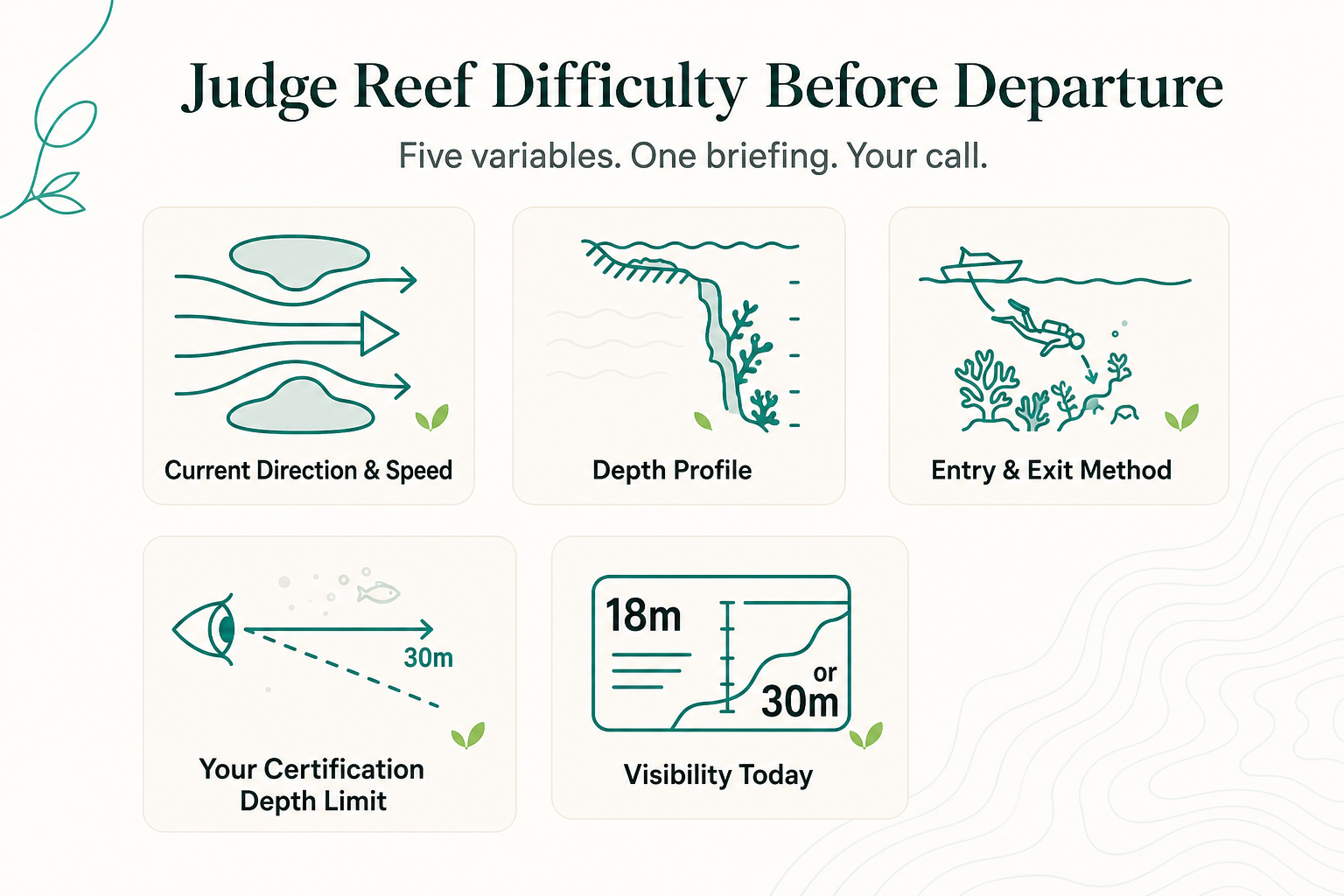
Getting to Sulawesi's reef sites is one thing; knowing whether the dive itself matches your training and comfort is another. Difficulty on a reef dive is a function of four measurable variables: current strength, depth profile, entry style, and visibility on the day. Sulawesi's dive sites range from gentle sloping reefs suited to a fresh Open Water diver to vertical walls dropping hundreds of meters where current and depth control separate a good dive from a dangerous one. The site briefing, the boat crew's plan, and your own certification limits are the three inputs that tell you which category you're facing, and all three are available before departure.
TL;DR
- Check four variables before boarding: current, depth profile, entry/exit style, and visibility (approximately 30 meters average in the Togean Islands, clearest April-November).
- Open Water certification caps you at 18 meters; Sulawesi's wall dives drop far past that, so depth-gauge discipline matters more here than in flat reef destinations.
- A proper pre-dive briefing should cover current direction, descent/ascent method, and a lost-boat contingency plan; if it doesn't, ask before the boat leaves.
- Advanced Adventurer (five dives, built on Open Water) is the next SSI step for divers who want deeper and drift-capable certification, not "Advanced Open Water" (that's a different agency's naming).
What Actually Makes a Sulawesi Reef "Difficult"?
Difficulty on a reef dive is a function of four measurable variables, not a vague feeling: current speed, maximum depth of the planned profile, how you enter and exit the water, and visibility on the day. Each one is knowable before the boat untethers from the dock.
Current is the single biggest variable in Sulawesi. Channels between islands and passages near seamounts can push water fast enough to turn a leisurely reef swim into a drift dive requiring active current management.
Depth profile matters just as much, because Sulawesi is known for near-vertical walls. A site can start at 5 meters and drop past 60 meters within a few fin kicks of the reef crest. Depth control matters more than swimming strength here.
How Do You Read a Pre-Dive Briefing for Difficulty Clues?
A proper pre-dive briefing is a difficulty report if you know what to listen for. The divemaster or boat crew should cover the entry method, current direction and expected strength, maximum planned depth, and what to do if you get separated from the group.
Listen specifically for these three signals:
- Entry style named outright. "Negative entry" or "giant stride with immediate descent" signals the crew expects current at the surface, a harder entry than a standard back-roll into calm water.
- Live-boat or drift language. If the crew says the boat will follow your bubbles rather than anchor, that's a drift dive; you'll be expected to stay grouped and let the current carry you rather than swim against it.
- A stated lost-diver protocol. Surfacing away from the boat is a known scenario with a known procedure: wait at the surface, inflate your safety sausage, and the boat comes to you. A briefing that includes this shows the operator has actually planned for the site's current conditions.
If a briefing skips current direction or maximum depth, ask directly. Every certified diver has the right to review the dive plan and decline before entry if something doesn't match their training or comfort level.
Which Certification Level Matches Which Reef Profile?
Your certification card is a depth and skill ceiling, not a suggestion. SSI's Open Water Diver, the entry-level recreational certification, caps recreational divers at 18 meters (60 feet) of maximum depth.
Sulawesi's wall sites frequently drop past 100 meters, so an Open Water diver on a wall dive must treat the reef crest as the working depth and monitor the gauge constantly rather than following the wall down out of curiosity.
The next step up, SSI's Advanced Adventurer certification, is a five-dive course built directly on Open Water that extends depth capability and introduces navigation and deep-diving skills. This course actually opens up more of Sulawesi's site list, not a certification called "Advanced Open Water," which is a different training agency's naming.
| Certification | Depth Ceiling | Suitable Sulawesi Profile |
|---|---|---|
| Open Water Diver | 18m / 60 feet | Sloping reefs, shallow lagoon sites, reef crests |
| Advanced Adventurer | Deeper, per specialty dives logged | Wall dives to extended depth, drift sites, navigation-heavy sites |
| Diver Stress and Rescue | Same as prior cert, added skill set | Sites with current, separation risk, or self-rescue demands |
| Master Diver | 50 logged dives + 4 specialties + Diver Stress and Rescue certification | Most technical recreational profiles in the region |
Local dive laws can also override your training limit outright. Some destinations impose a hard depth cap regardless of certification, so it's worth asking your dive center directly whether Sulawesi's dive sites carry any local depth restriction before you plan a profile around your card's theoretical maximum.
How Does Visibility Change the Difficulty Calculation?
Visibility doesn't just affect how much you see; it changes how much warning you get before a current or depth change surprises you. Wetter months can bring runoff that temporarily cuts clarity, sometimes site by site rather than region-wide. Clearest conditions run April through November.
Low visibility raises difficulty on any site because it shortens your reaction window: a wall drops away faster than you can see it coming, and a dive buddy drifting off in current is harder to spot.
On a low-visibility day, a site that's routine at better visibility deserves a more conservative depth and current plan. Ask the boat crew for that day's visibility report specifically, not the seasonal average, before deciding whether to adjust your dive plan.
What Should You Actually Ask the Dive Operator Before Boarding?
Five direct questions cover almost every difficulty variable that matters:
- What's the current direction and strength at this site today?
- What's the maximum planned depth, and is it a wall or a sloping reef?
- Is this a live-boat drift dive or an anchored dive?
- What's today's visibility?
- What's the protocol if I surface away from the boat?
An operator that answers all five without hesitation has actually assessed the site that morning. One that shrugs or gives seasonal generalities hasn't, and that's a difficulty signal in itself.
Frequently Asked Questions
Can a beginner diver safely dive Sulawesi's wall sites?
Yes, at the reef crest depth within Open Water limits (18 meters), with a divemaster monitoring the group's depth. The wall itself, past 18 meters, requires Advanced Adventurer certification or deeper.
What language is dive instruction typically offered in around the Togean Islands?
At Reconnect's dive center, instruction is offered in English, French, and Indonesian, with small group sizes to keep briefings thorough.
Is flying right after diving in Sulawesi a concern?
Yes, standard flying-after-diving guidelines apply anywhere, recommending a surface interval before flight to reduce decompression sickness risk [dan.org]. Check current guidance with your dive operator before booking a flight home.
Do I need a certification card to dive at all in Sulawesi?
Yes. No dive operator will rent equipment, fill tanks, or allow boarding without a valid certification card from a recognized agency.
About Reconnect
Reconnect is a Private Island Resort on Buka Buka Island in the Togean Islands, Central Sulawesi, with an on-site SSI-certified, Blue Oceans certified dive center. Guided dives on reef and wall sites around the island are reached by short boat rides. Visit Reconnect to plan your dive dates.