


Sustainable travel content has a credibility problem: staged shots of "eco" resorts often hide diesel generators, imported bottled water, and plastic amenities just out of frame. On Buka Buka Island in Indonesia's Togean Islands, the off-grid systems, zero-waste operations, and reef access are the actual daily operation, not a backdrop arranged for a camera. This matters for creators because footage that documents real infrastructure, real staff routines, and real marine conditions holds up to audience scrutiny in a way that staged sustainability content does not.
TL;DR
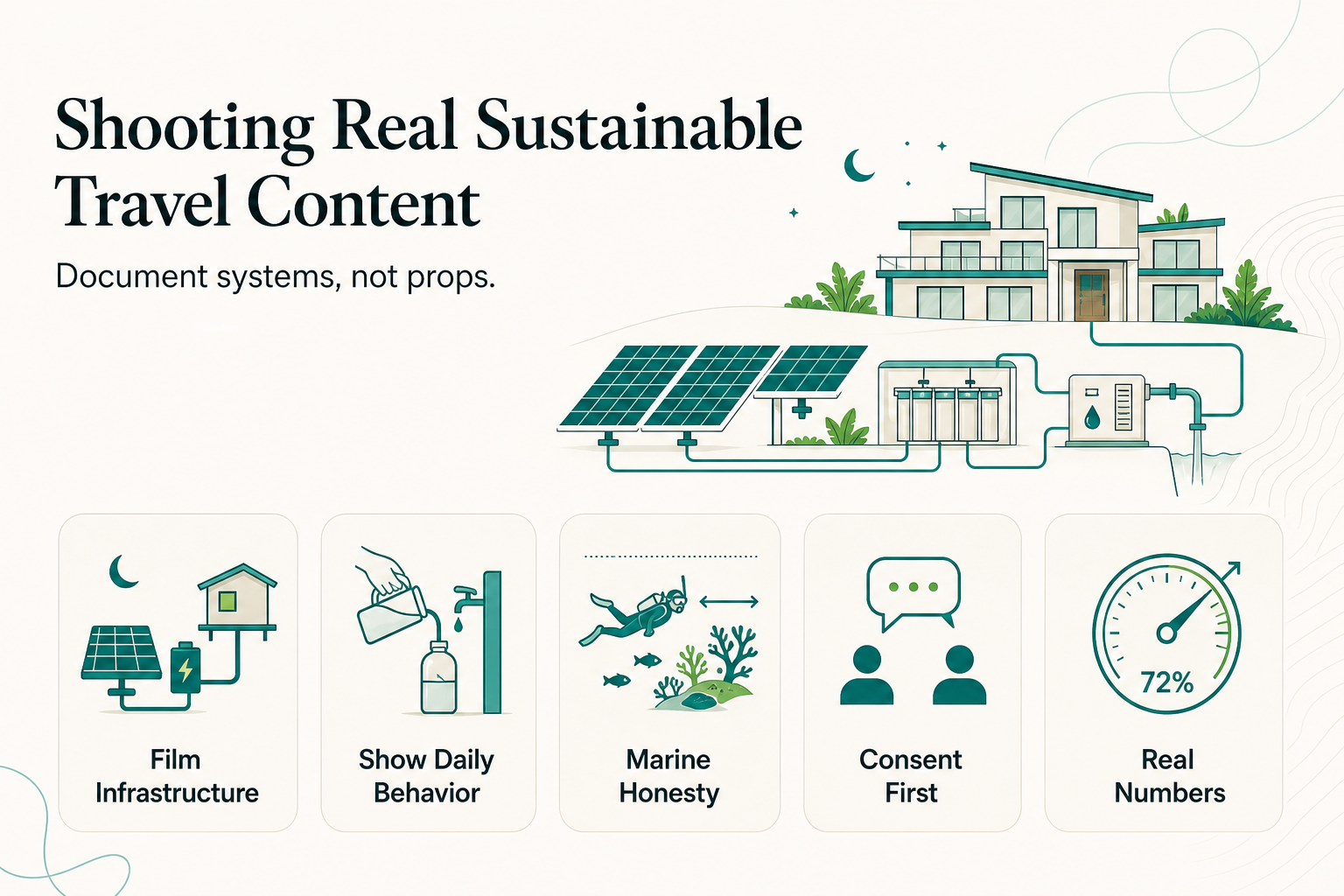
- Genuine sustainable content comes from documenting existing operational systems (solar arrays, desalination units, waste sorting) rather than arranging props.
- Buka Buka Island runs on 93% solar power with battery backup and on-site desalinated water, giving creators verifiable, filmable infrastructure.
- Zero single-use plastic policies (refill stations, cloth bags, liquid soap dispensers) photograph as everyday behavior, not staged eco-decor.
- Reef and marine footage should reflect real visibility conditions (approximately 30 meters average) rather than inflated claims.
- Village visits and dive operations offer authentic B-roll only when filmed with consent and without disrupting local routines.
About the Author: Reconnect has hosted travel and dive content creators documenting its off-grid operation on Buka Buka Island since opening, working directly with visiting photographers and videographers on reef access, solar infrastructure tours, and village-visit logistics in the Togean Islands.
What Makes Sustainability Content "Staged" Versus Real?
Staged sustainability content places eco-signaling objects into a frame that has no functional connection to how the property actually operates. A bamboo straw next to a plastic-lined minibar is staged. A solar panel photographed while the resort runs on diesel at night is staged.
Real sustainability content documents systems that operate whether or not a camera is present. The 93% solar-powered grid with battery backup runs the resort around the clock, including at night when no guest is filming. The desalination unit that supplies 100% of the resort's water is a fixed piece of infrastructure, not a photo prop moved into frame.
The distinction matters for search visibility too. Audiences and platforms increasingly reward specificity over adjectives. "Sustainable tourism Indonesia" as a search phrase attracts viewers looking for verifiable detail, not another shot of a palm leaf.
How Do You Film Off-Grid Power Without Turning It Into a Sales Pitch?
Off-grid power becomes filmable content when you follow the actual energy path rather than shooting a static panel array. Start at the rooftop or ground-mounted panels, follow the cabling to the battery bank, then end at the point of use, a running desalination pump, a charging Starlink dish, or a lit dining room after sunset.
Three concrete choices separate documentary footage from marketing footage:
- Shoot at night. A resort's real solar reliability shows in whether lights, fans, and water systems still function after dark on battery power, not in a daytime panel glamour shot.
- Ask for the load numbers. Off-grid systems are sized to specific loads and battery capacity, and the backup generator rarely activates when systems are properly designed. Quoting real figures from the property, rather than guessing, gives the footage a factual anchor.
- Film the backup honestly. If a generator exists, show it as backup only. Reconnect's generator serves as backup power, never the primary source, and creators who name that distinction on camera build more trust than those who omit it entirely.
What Does Zero-Waste Travel Content Actually Look Like on Camera?
Zero-waste travel content documents the absence of single-use plastic in daily transactions, not a curated flat-lay of reusable items. On Buka Buka Island, that means filming the water refill station guests use instead of bottled water, the liquid soap dispensers in bathrooms, and staff packing supplies in cloth bags rather than plastic.
The strongest zero-waste footage answers a viewer's implicit question: what do I do instead of the plastic version? A refill station only communicates sustainability if the camera also shows a guest using it during a normal moment, not posed with the bottle.
Waste sorting and disposal are harder to film well but carry more weight with skeptical viewers. Following a single piece of packaging, a coffee sack from the kitchen, for instance, from delivery to reuse or disposal gives the footage a beginning, middle, and end that a static "we recycle" caption cannot.
How Should Creators Handle Reef and Marine Footage Honestly?
Reef footage is where sustainable travel content most often drifts into exaggeration, usually through inflated visibility or water-clarity claims. Visibility in the Togean Islands averages about 30 meters, peaking during the calm dry season between April and November, with visibility dropping near river mouths and after wet-season storms. Reporting visibility claims regardless of season or site misrepresents actual diving conditions.
Buka Buka Island's on-site SSI dive center gives creators short boat rides to reef, wall, and pinnacle sites around the island rather than long transfers, which matters for a shoot schedule built around shifting light and tide. A same-day return to a site if morning conditions disappoint is realistic logistics, not a guarantee.
Reconnect is located in the Togean Islands and serves as a gateway to Togean Islands National Park, a UNESCO Biosphere Reserve managed under a four-zone system. Marine park entry fees and no-touch, controlled-buoyancy practices apply to diving and snorkeling in protected zones. Filming a diver or snorkeler making contact with coral or chasing a turtle for a better angle does more damage to a creator's credibility than any staged prop, because viewers who know the regulations will call it out. Species like turtles and dugongs are part of what makes this stretch of the Coral Triangle worth documenting for anyone researching the best snorkeling in Indonesia, but only if the footage shows distance and patience rather than pursuit.
How Do You Film Village Visits and Local Interaction Without Exploiting the Subject?
Village visit footage crosses from documentary into exploitation the moment a creator prioritizes the shot over the consent of the person in it. Reconnect's village visit excursions bring guests to nearby Bajo (Bajau sea nomad) communities, and the resort's supplier partnerships with these villages exist independent of any camera crew.
Three practices keep this kind of footage honest:
- Ask before filming, every time, even if a guide has already secured general permission for the group.
- Show the relationship, not just the scenery. A shot of a fisherman delivering catch to the resort kitchen says more about the local supply chain than a wide shot of stilt houses.
- Credit the specific village and community, not a generic "local village," in captions and descriptions.
Frequently Asked Questions
Does Reconnect allow creators to film the desalination and solar systems directly?
Creators visiting Reconnect can request a walkthrough of the solar and desalination infrastructure as part of arranging their stay; specific access depends on scheduling with the resort directly.
What on-site facilities help creators film both above and below water content?
An on-site dive center reduces transit time between above-water and underwater shoots, which matters for a tight content schedule built around shifting light and tides.
What's a realistic visibility range to state for Togean Islands dive footage?
Visibility in the Togean Islands averages about 30 meters, peaking in the dry season from April to November.
Do dive courses need to be filmed differently from guided dives?
Yes. Courses involve skill checks and instructor supervision at reef sites reached by short boat rides around the island, which makes for slower, more instructional footage than a guided dive focused on reef and wildlife.
How does zero single-use plastic policy affect what gear creators can bring?
Bringing personal reusable bottles and avoiding single-use plastic packaging aligns with the resort's own policy and avoids introducing waste into a documented zero-waste environment.
About Reconnect
Reconnect is a Private Island Resort and SSI-certified dive center on Buka Buka Island in the Togean Islands, founded by Thomas Despin. Creators researching a Togean Islands shoot can review logistics and reach out directly at reconnect.id.