


Most divers researching an SSI divemaster course default to Bali or the Gili Islands because those names dominate search results, not because they are objectively the best training environments. The right base for divemaster training comes down to four measurable factors: student-to-instructor ratios, water visibility and site variety for skills practice, whether the internship structure gives you real teaching reps, and whether the operation's environmental practices match what a professional dive guide should be modeling to future clients. Central Sulawesi's Togean Islands meet all four criteria and see a fraction of the traffic of Indonesia's two most saturated dive hubs.
TL;DR
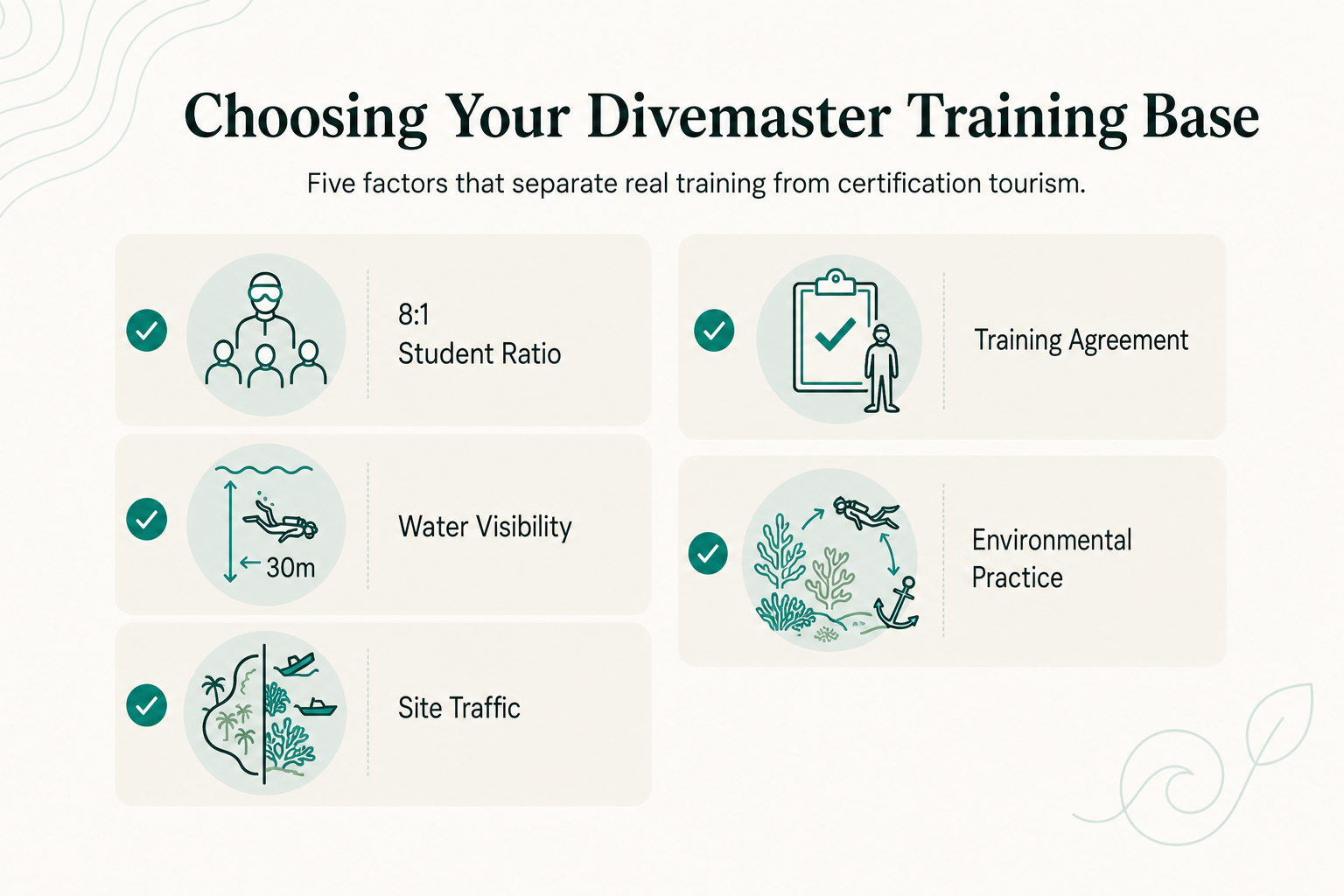
- SSI and PADI cap open water course ratios at 8:1 (up to 12:1 with two certified assistants); ask any prospective base for its actual working ratio, not the legal ceiling.
- Visibility in the Togean Islands averages about 30 meters year-round, clearer and more consistent than Bali or the Gili Islands.
- A divemaster internship is only as good as its supervised teaching hours; a training agreement in writing should specify what you'll actually do, not just what you'll pay.
- Reconnect's on-site SSI dive center runs small guided groups on reefs around Buka Buka Island, with training dives reached by short boat rides rather than long transfers.
- Course fees are always separate from room and board; confirm this before comparing any base's quote.
What Actually Determines Training Quality at a Dive Base?
Water clarity, student ratios, and site access decide whether a divemaster candidate leaves competent or just certified. These three variables affect how many real skills repetitions you get before your internship ends.
Student-to-instructor ratio is the starting filter. SSI and PADI both cap open water courses at 8:1, rising to 10:1 with one certified assistant or 12:1 with two. For divers aged 10 to 11 (PADI) or 10 to 14 (SSI), the ceiling drops to 4:1. A center running at the legal maximum gives you less individual coaching time than one that voluntarily keeps groups smaller. Ask directly what ratio your course will run at, not what the standard allows.
Visibility and site variety matter because a divemaster course involves demonstrating skills at depth, assisting confused Open Water students, and managing real conditions, not just clear water for photos. Consistency matters more than peak clarity: a training site that's excellent in July and murky in January limits when you can practice search-and-recovery or navigation skills reliably.
Crowding at the site itself is the factor most candidates ignore until they're underwater with four other groups on the same wall. Bali's Tulamben and the Gilis' house reefs see heavy daily boat traffic. Fewer boats on a site means more room to run skills circuits without dodging other groups, and less particulate stirred up by fin kicks and anchors.
How Should You Evaluate a Divemaster Internship Before Committing?
A divemaster internship is a working arrangement, not a vacation add-on. The core question is whether the center gives you supervised teaching hours or just charges you to hang around the shop [blog.padi.com].
Ask for specifics before you pay a deposit:
- Who teaches you day to day? Some centers assign one instructor for your entire internship; others rotate you through several, which broadens your exposure but can dilute consistency.
- Is there a written training agreement? It should state expected hours, course fees, refund terms, and what dive insurance covers if something goes wrong during training.
- How many logged dives and assisted courses will you leave with? SSI's Dive Guide track requires logged dives, specific specialties, and medical clearance before you can begin, so confirm the base can actually get you there within your booked timeframe.
- Is the shop eco-conscious in practice, not just in marketing? A divemaster is a role model for future Open Water students on reef etiquette; training somewhere that reinforces anchor damage or reef touching works against everything you're being certified to teach.
Divemaster internship listings are numerous, and the paperwork gap between them is where quality actually separates.
Why Do Remote Training Bases Change the Learning Curve?
A quieter site does not mean a slower course, it means fewer interruptions per skill.
In a saturated hub, your instructor manages boat traffic, other groups, and student overflow at the same site where you're learning. In a lower-traffic setting, more of each dive goes toward you. Reconnect's dive center runs guided dives and skills sessions on reefs, walls, and pinnacles around Buka Buka Island. Training sites are reached by short boat rides rather than longer transfers.
This affects course progression significantly. An Advanced Adventurer course benefits from varied topography: a wall dive, a pinnacle, a night dive, a deep dive. Cramming all four specialty dives into one crowded bay limits variety. Spreading them across distinct sites around one island, reachable without a long boat transfer, is a genuine training advantage.
What Should an All-Inclusive Package Actually Cover?
A full-board rate should cover your room, meals, and non-course diving activities. It should never include dive course fees, which are billed separately regardless of what the marketing implies.
| Included in full-board rate | Billed separately |
|---|---|
| Meals, afternoon tea, coffee/tea/water | SSI course fees (Open Water, Advanced Adventurer, Divemaster) |
| House-reef snorkeling, equipment provided | Guided dive packages (e.g., an 8-dive, 5-day Dive-cation) |
| Kayaking, stand-up paddleboarding | Specialty certifications |
| Airport-to-resort transfer coordination | Park entry fees for excursions |
At Reconnect, full-board rates start from EUR 60 per night and include three meals daily, plus kayaking and paddleboarding. Dive courses and guided dive packages are quoted and paid for on top of that rate. Confirm this with any base you're comparing.
Frequently Asked Questions
Does a remote island location mean fewer dive sites to train on?
Not necessarily. Site count matters less than variety and consistency. Buka Buka Island has direct reef access to walls, pinnacles, and shallow reef for skills work, all within short boat rides.
Is instruction available in languages other than English?
At Reconnect, SSI instruction is offered in English, French, and Indonesian, which matters if you're training candidates from multiple markets or aren't a native English speaker yourself.
Do I need previous diving experience to start toward divemaster?
No. SSI's entry-level Scuba Diver and Open Water Diver certifications require basic swimming ability and a minimum age of 10, with no prior diving experience needed. Divemaster comes after Advanced Adventurer and Rescue, with logged dive minimums along the way.
Are marine park fees included in course pricing?
No. Indonesian marine protected areas require centers to hold entry permits and collect conservation fees separately, and these are billed to the diver, not absorbed into course pricing.
About Reconnect
Reconnect is a private island eco-resort with an on-site SSI dive center on Buka Buka Island in the Togean Islands, Indonesia. The dive center is Blue Oceans certified and runs SSI courses in English, French, and Indonesian. For course structures, site conditions, and logistics, visit reconnect.id.
References
- Find a Divemaster Course: How to Choose a Dive Shop (blog.padi.com)