


Feeding 20 rooms of guests three meals a day, every day, on an island with no supermarket and no municipal supply chain is a logistics problem before it is a culinary one. At Reconnect, on Buka Buka Island in the Togean Islands, full-board meal planning works because it is built backward from what the island can actually produce and receive, not forward from a restaurant menu. The result is a kitchen that runs on weekly boat-based provisioning, daily village produce, and a rotating menu structure designed to avoid repetition without wasting food that cannot be replaced on short notice.
TL;DR
- Reconnect's kitchen plans meals around a fixed weekly supply cycle tied to boat transfers from Ampana, not daily improvisation.
- All-inclusive full-board covers three meals daily, afternoon tea, and unlimited coffee, tea, and water, included in every room rate from EUR 60/night.
- Fresh produce and seafood come through direct partnerships with neighboring villages, reducing dependence on long-haul shipping.
- Zero single-use plastic policy shapes food storage and service, down to water dispensers and cloth bags instead of packaging.
- Meal planning on a remote island is fundamentally a forecasting exercise: overordering wastes perishables, underordering strands guests.
What Does Full-Board Actually Include at a Remote Island Resort?
Full-board at Reconnect means three gourmet meals a day, plus afternoon tea and unlimited coffee, tea, and water. It is not a buffet-style volume operation. With only 20 rooms on the island, the kitchen plans for a known, capped number of covers per meal. A 200-room all-inclusive island resort forecasts for constant guest turnover; Reconnect does not.
That cap is what makes gourmet cooking feasible here at all. A small, predictable headcount lets the kitchen commit to specific ingredient volumes days in advance rather than holding large buffer stock against unpredictable demand. It is closer to running a high-end guesthouse kitchen than a hotel banquet operation.
How Do You Provision a Kitchen With No Local Supermarket?
Provisioning is the real engineering problem behind island meal planning. Buka Buka Island sits in the Maluku Sea, roughly 11 kilometers northeast of Tanjung Api. It is administratively part of Tete B village in the Ampana Tete district of Tojo Una-Una Regency. There is no retail grocery infrastructure on the island itself, so every non-local ingredient arrives by boat.
Reconnect's transfer route runs guests by private car from Luwuk Airport to Ampana (around 5 hours). Then by private speedboat to the island (30-45 minutes). That same Ampana corridor doubles as the resort's supply line for goods that cannot be sourced from nearby villages: dry goods, specific proteins, wine, and packaged staples.
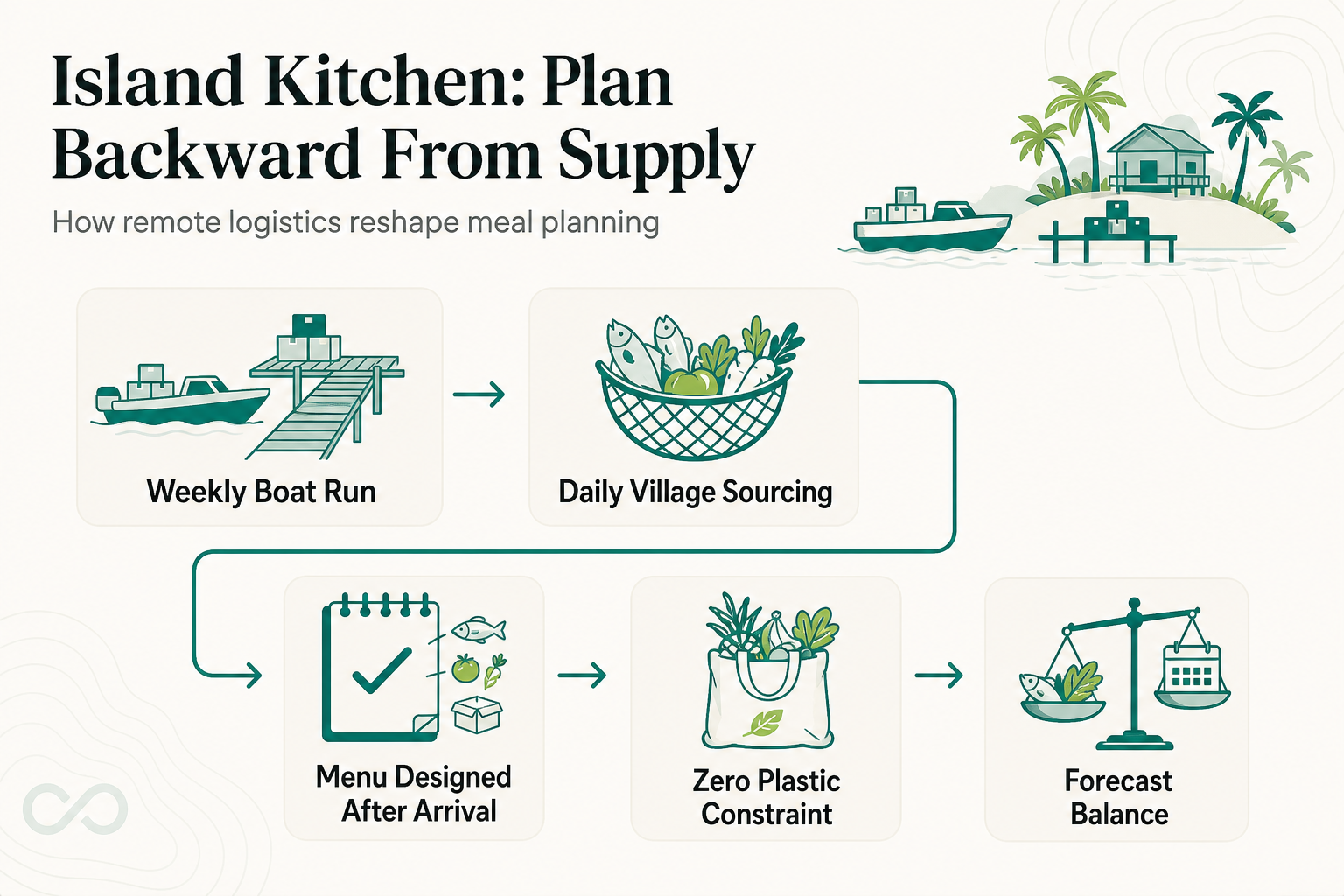
Step 1: The Weekly Supply Run
Bulk and non-perishable goods are ordered on a weekly cycle, timed to the same boat logistics used for guest transfers. The kitchen's ordering calendar is dictated by boat schedules, not by what a chef feels like cooking that week.
Step 2: Daily Village Sourcing
Fresh fish, some produce, and select local ingredients come through direct supplier partnerships with neighboring villages. Sourcing happens daily where possible. This shortens the supply chain for the most perishable items to hours rather than days.
Step 3: Menu Design Around What Arrives
The weekly menu is drafted after the supply run is confirmed, not before. Chefs build dishes around confirmed inventory rather than locking a fixed menu weeks out and hoping ingredients show up on schedule.
Why Does Meal Planning Need a Different Model Than a City Restaurant?
An island kitchen cannot rescue a bad forecast with a same-day delivery. If the fish order runs short on a Wednesday, there is no midweek top-up. This constraint shapes every decision in the kitchen.
Think of it the way a ship's galley plans a long voyage: perishables get used first and in sequence, proteins are rotated by shelf life, and the menu absorbs whatever produce is closest to its use-by date on a given day. That sequencing logic, not a fixed weekly menu, is what governs what appears on the table each night.
- Overordering wastes food that cannot be donated, resold, or easily stored long-term in a tropical climate.
- Underordering leaves guests without meals on a stay they have already paid for as part of an all-inclusive rate.
- Menu rigidity (planning three weeks of fixed menus in advance) collides with the reality of what a boat can actually deliver on a given day.
The practical fix, common to remote-kitchen operations generally, is planning meals around what is on hand and building nutritional balance and variety into that pool rather than into a pre-set recipe list. Reconnect's kitchen applies the same principle: confirm the inventory, then design the week's dishes, not the reverse.
How Does Sustainability Shape What's on the Plate?
Reconnect runs a zero single-use plastic policy throughout the resort, and the kitchen is where that policy meets its hardest test. No plastic water bottles, no individually wrapped condiments, no disposable food packaging for guest service. Water is delivered through dispensers fed by on-site desalinated water, produced using the resort's own solar-powered system. Guests are served from reusable service ware, and takeaway items travel in cloth bags rather than plastic.
This is not a cosmetic choice. It changes what the kitchen can order, since bulk dry goods must arrive in reusable or recyclable containers rather than individually packaged units. It pushes more sourcing toward fresh, local ingredients that need no packaging at all.
The village supplier relationships serve a second purpose beyond freshness: they keep more of the resort's food spend inside the local economy around Tete B and neighboring communities. This aligns with Reconnect's broader locally-hired staffing model and its position as part of Indonesia's wider sustainable tourism push.
How Does This Compare to a Typical Remote Eco-Resort Kitchen?
Most remote eco-resort kitchens, even ones far from major supply hubs, sit within reach of a regional port or airport with regular commercial freight. Reconnect's position is more constrained: everything routes through the same Ampana corridor used for guest transfers. The island itself produces none of its packaged food.
| Factor | Typical remote eco-resort kitchen | Reconnect (Buka Buka Island) |
|---|---|---|
| Supply route | Regular commercial freight | Weekly boat run via Ampana |
| Fresh ingredient source | Regional distributors | Neighboring village partnerships |
| Water for kitchen use | Municipal or bottled | On-site solar-powered desalination |
| Packaging policy | Standard, resort-dependent | Zero single-use plastic |
| Menu planning cycle | Often fixed in advance | Built around confirmed weekly inventory |
Reconnect's model reads differently from a typical island resort because the gourmet result is downstream of hard logistics constraints, not a chef working from an unlimited pantry.
Frequently Asked Questions
Can the kitchen handle dietary restrictions on a remote island?
Menu planning around confirmed weekly inventory makes advance notice for allergies or dietary needs especially important here, since substitutions depend on what has actually arrived by boat.
Is drinking water safe given there's no municipal supply?
Reconnect produces its own drinking water on-site through a solar-powered desalination system, removing dependence on bottled or municipal water entirely.
Does the Dive-cation package include the same full-board meals?
The All-Inclusive Dive-cation Package bundles guided dives with full-board dining on the island. Dive courses are booked and paid for separately from any full-board stay.
About Reconnect
Reconnect is an island eco-resort with an on-site SSI dive center on Buka Buka Island in Indonesia's Togean Islands. For details on rates, room types, and how to book a stay, visit reconnect.id.