


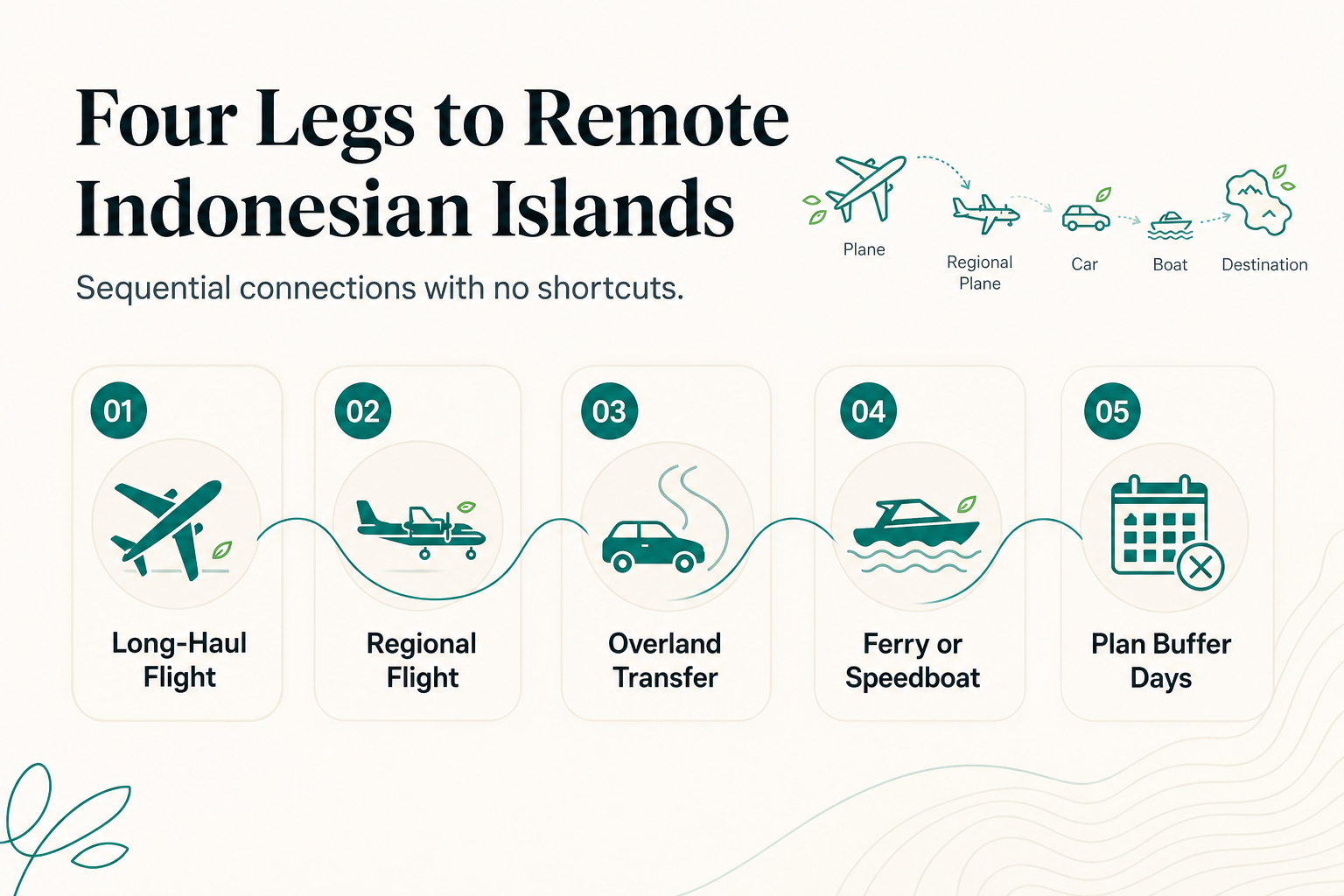
Getting to a remote Indonesian island rarely means one flight and done. It means a chain: a domestic flight into a regional hub, an overland transfer, then a ferry or speedboat for the final stretch, and the whole sequence can fail at any link if weather or a schedule shifts. Reaching the Togean Islands in Central Sulawesi, for example, typically runs 8 to 12 hours from Jakarta or Bali once you count the flight to Luwuk, the 5-hour road transfer to Ampana, and the speedboat crossing.
TL;DR
- Indonesia's remote islands are reached through a fixed sequence: regional airport, overland or short-hop transfer, then ferry or speedboat. There is no shortcut that skips a link.
- Luwuk is the reliable air gateway into the Togean Islands, with multiple daily flights from Makassar. Ampana's airport only offers twice-weekly Wings Air service from Palu.
- Named ferry and speedboat operators (Hercules, Wamburabura, Allya Express, and the ASDP ferry Tuna Tomini) run fixed but limited schedules, so timing your arrival matters.
- December and January bring rough seas that can cancel ferries for multiple days. Build in a buffer day.
- Resorts that coordinate the full transfer chain remove the single biggest source of failure for independent travelers: the connection between legs.
About the Author: Reconnect operates an eco-resort in the Togean Islands and coordinates transfers from Luwuk Airport for guests arriving from Europe, Australia, and beyond, giving us a direct, ongoing view of how well this route actually holds up in practice.
How Does Indonesia's Inter-Island Transport Network Actually Work?
Indonesia has over 17,000 islands and no single transport mode covers them all. The network works as a layered system: major airlines connect big hubs, smaller aircraft and ferries feed the gaps, and the government subsidizes routes that would otherwise be commercially unviable.
The government has been trying to formalize this. Programs referenced under Indonesia's Vision 2045 strategy call for a network of Ro-Ro ferries acting as feeders that link remote regions to hub ports, which are then served by larger container and passenger ships [bimp-eaga.asia]. That is the theory. In practice, a traveler experiences it as three distinct legs, each run by a different operator, on a different schedule, with no single company responsible for the whole trip.
This matters because it explains why "how do I get there" rarely has a one-line answer for places like the Togeans, Raja Ampat, or the Banda Islands. You are booking three separate systems and hoping they line up.
Which Airports Actually Serve as Reliable Gateways to Remote Sulawesi Islands?
For the Togean Islands specifically, four airports service the surrounding region: Luwuk, Palu, Gorontalo, and Ampana. Only two function as dependable entry points.
- Luwuk is the main reliable gateway, with multiple daily flights from Makassar.
- Gorontalo is the other reliable route in, connecting onward to Wakai by overnight ferry.
- Palu serves as a secondary hub feeding limited onward flights to Ampana.
- Ampana has an airport, but it is not a main option. Its only service is twice-weekly Wings Air flights from Palu, which is too thin a schedule to plan a trip around.
Ampana's real role is as a port town, the departure point for boats to Wakai and the wider archipelago, not as a competing airport choice. Travelers sometimes assume Ampana's airport is a shortcut around Luwuk. It is not. Flight frequency there is too limited to be a dependable link in a travel plan, and building an itinerary around it risks a multi-day wait if the twice-weekly service is disrupted.
What Does the Full Journey Actually Look Like, Step by Step?
Breaking the trip into its component legs shows exactly where the time goes and where the risk sits.
Step 1: Long-Haul to a Domestic Hub
Most international travelers land in Jakarta or Bali, then connect via Makassar. This first leg is the most predictable part of the journey. Delays here are the standard commercial-airline kind, rare and short.
Step 2: Regional Flight to Luwuk
The Makassar-to-Luwuk flight runs multiple times daily, and combined with the long-haul leg, the flying portion of the trip is typically 3 to 4 hours. This is the segment with the best operational reliability in the whole chain.
Step 3: Overland Transfer to Ampana
From Luwuk, it is a 5-hour car transfer to Ampana. There is no shorter overland alternative on this route. This is the leg most travelers underestimate when planning their own itinerary, since it eats a full half-day regardless of flight timing.
Step 4: Ferry or Speedboat to the Islands
From Ampana, the final leg to the islands takes 1.5 to 4 hours by speedboat or ferry, depending on the operator and destination. Total door-to-door time across all four legs runs 8 to 12 hours.
What Are the Actual Ferry and Speedboat Operators, and How Fixed Are Their Schedules?
Naming the actual operators matters, because "there's a ferry" is not the same as knowing when it runs.
| Operator | Route | Schedule |
|---|---|---|
| Hercules (speedboat) | Ampana to Wakai | Daily, departs around 9:00 AM |
| Wamburabura | Regional Togean routes | Fixed but limited frequency |
| Allya Express | Regional Togean routes | Fixed but limited frequency |
| Tuna Tomini (ASDP car ferry) | Gorontalo to Wakai | Overnight, Tuesdays and Fridays |
These schedules are the whole planning constraint. Miss the 9:00 AM Hercules departure from Ampana and you are waiting until the next day, because there is no later sailing to fall back on. The Gorontalo route via Tuna Tomini only runs twice a week, so that gateway only works if your international flight timing happens to align with a Tuesday or Friday overnight departure.
Inter-island ferries operate under Ministry of Transportation rules, including MOT Regulation 7/2024, which governs vessel inspection, certification, and age limits on imported ships [youngpioneertours.com]. Pioneer flights on small aircraft to remote areas require their own Air Operator Certificates and adherence to civil aviation safety standards. These frameworks exist, but they do not change the practical reality that schedules are thin and connections are unforgiving.
What Actually Disrupts These Routes, and How Should You Plan Around It?
Weather is the biggest variable, and it is seasonal, not random. December and January bring rough seas that can cancel ferry departures for multiple consecutive days. Beyond weather, mechanical breakdowns and aging vessel infrastructure add a second layer of risk, and flight schedules on the smaller regional routes can shift with little notice.
The practical response is straightforward:
- Avoid booking a same-day onward connection immediately after any of the four legs.
- Build at least one buffer day into the trip, especially if traveling in December or January.
- Treat the Ampana-to-island leg as the least flexible segment, since it runs on the tightest schedule of the whole chain.
This is the exact problem that pushes many travelers toward a resort that coordinates the transfer chain directly rather than booking each leg independently.
How Should You Actually Plan a Trip to a Remote Island Like the Togeans?
The honest answer is to treat the journey as four separate bookings that need to fit together, not one ticket. Confirm the Luwuk flight schedule first, since it is the most reliable leg and anchors everything else. Then work backward and forward from there, checking the Ampana speedboat departure time against your expected arrival in Luwuk plus the 5-hour road transfer.
For travelers who want the logistics handled rather than managed leg by leg, a private island resort in Indonesia that coordinates the full chain removes the single biggest point of failure: the handoff between legs. Reconnect, on Buka Buka Island in the Togeans, arranges the private car from Luwuk Airport to Ampana and the connecting speedboat to the island as one coordinated transfer, so guests are not left reconciling four separate schedules on their own.
Frequently Asked Questions
Is Ampana Airport a good alternative to Luwuk for reaching the Togean Islands?
No. Ampana's airport only offers twice-weekly Wings Air flights from Palu, which is too infrequent to plan a trip around. It functions as a port town for onward boat travel, not as a primary air gateway.
Can you reach the Togean Islands entirely by ferry, without flying?
Not practically for international travelers. The Gorontalo-to-Wakai ferry (Tuna Tomini) runs only twice weekly overnight, so it still requires flying into Gorontalo first and timing the trip around a Tuesday or Friday departure.
How much buffer time should I add for weather disruptions?
At minimum one full day, more if traveling in December or January when rough seas cause the most frequent multi-day ferry cancellations.
Do all the ferry and flight legs run on a fixed daily schedule?
No. Only some legs, like the Hercules speedboat from Ampana, run daily. Others, like the Gorontalo ferry, run twice weekly, and regional flights can shift with limited notice.
What's the single riskiest connection in the journey?
The handoff from the Ampana overland transfer to the speedboat departure, since it runs on the tightest schedule and has the least flexibility if any earlier leg runs late.
About Reconnect
Reconnect is a private island eco-resort and SSI-certified dive center on Buka Buka Island in the Togean Islands, founded by Thomas Despin. The resort runs on 93% solar power with on-site desalinated water and coordinates the full transfer chain from Luwuk Airport, including the 5-hour car transfer to Ampana and the connecting speedboat, so guests skip the scheduling risk described above. Rooms start from EUR 60/night, all-inclusive full board.
Ready to plan the crossing properly? Get in touch through reconnect.id and we will walk you through the current transfer schedule before you book flights.
References
- How to Take the Ferry in Indonesia Like a Local (youngpioneertours.com)
- Indonesia Plans Network of Ro-Ros to Link Eastern Regions | BIMP-EAGA (bimp-eaga.asia)