


Getting to snorkel, dive, and explore reef environments from a single island base in Indonesia typically means access to around 30 named sites, all inside a 30 to 60 minute boat ride. This holds across the Togean Islands in Central Sulawesi, where fringing reefs, atolls, barrier reefs, and even a World War II bomber wreck sit close enough to reach without long transfers between locations.
TL;DR
- Island bases in the Togean Islands can access roughly 30 named reef sites within a 30 to 60 minute boat ride.
- Recreational depths at deeper sites (Apollo, for example) run to 35-40 meters, with visibility averaging around 30 meters.
- Dry season (April-November) gives the calmest seas and clearest water; wet season (December-March) brings 25-knot winds and surface chop.
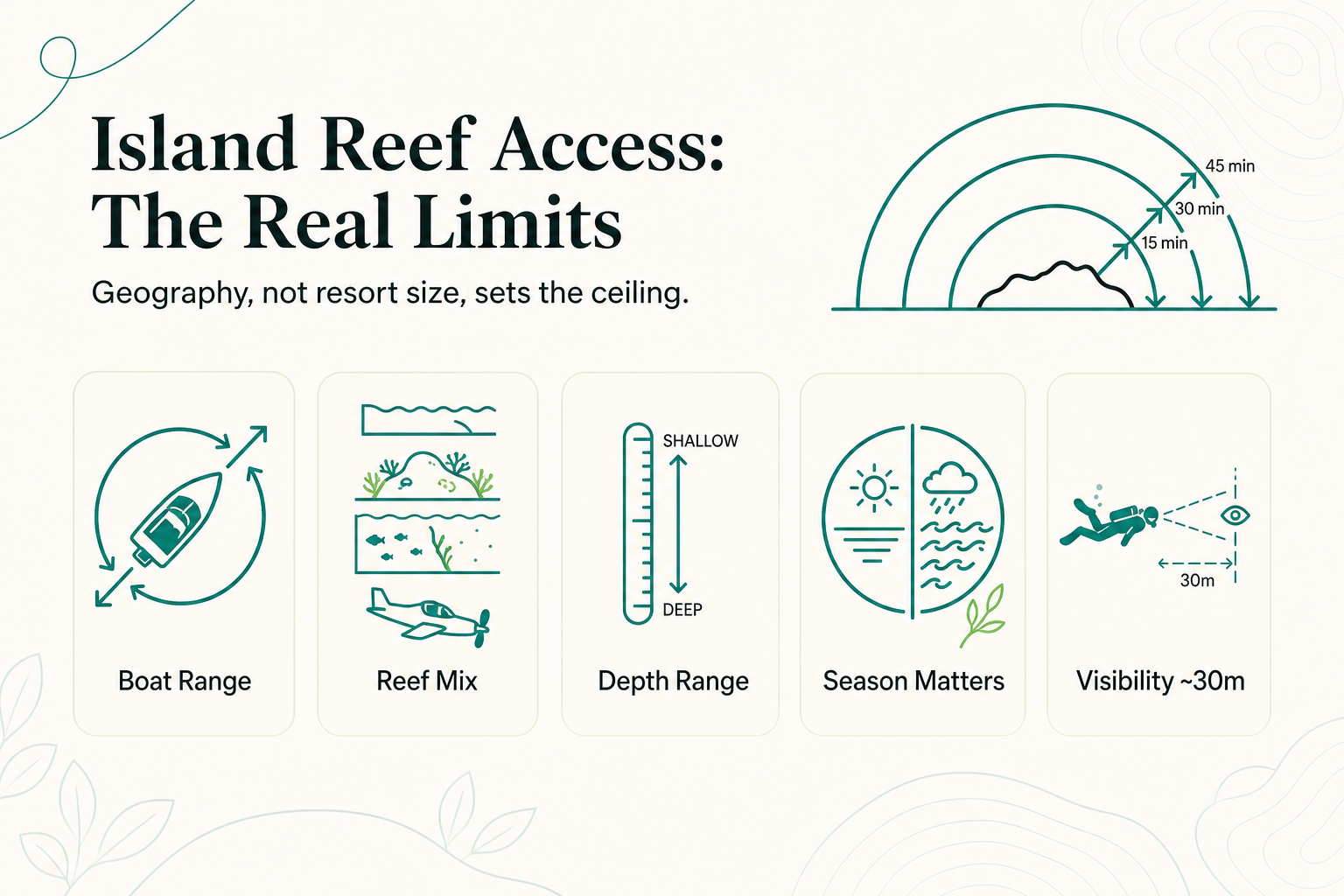
- Site access depends on boat range and reef geography, not resort size, so a small island base can outperform a larger one if positioned closer to varied reef structure.
What Determines How Many Reef Sites One Island Base Can Reach
Reef access is really a function of two things: boat range and reef geography around the base. A base sitting inside a cluster of reefs, atolls, and walls will always out-produce one surrounded by open water, no matter how large the resort is.
Think of it like a delivery radius for a restaurant. The kitchen's quality doesn't change the map, only the number of houses within a 30-minute drive does. Reef geography works the same way: it sets a hard ceiling on how many sites are reachable, and no amount of resort infrastructure moves that ceiling.
In the Togean Islands, that ceiling lands around 30 named reef sites per base, reachable within 30 to 60 minutes by boat. The mix includes fringing reefs, atolls, barrier reef sections, and one wreck. That range is consistent across the roughly dozen eco-resorts with on-site dive centers working the archipelago, which suggests the geography, not any single resort's boat fleet, is the limiting factor.
What Kinds of Sites Actually Make Up That Number
"30 reef sites" is a headline figure. What matters more is the mix underneath it, because a count padded with repetitive shallow reefs is a different product than one spanning walls, pinnacles, and a wreck.
A representative day-trip radius from a Togean base typically includes:
- Fringing reefs close to shore, good for check dives and less experienced divers
- Atoll and barrier reef sections with more current and larger schooling fish
- Wall and pinnacle sites dropping to recreational depth limits
- One World War II bomber wreck, a fixed historical point rather than a natural reef
Depth range across these sites runs from shallow reef flats to around 35-40 meters at the deeper pinnacles, such as Apollo. Visibility across the archipelago averages about 30 meters, which is high enough that wall and pinnacle detail is visible well before a diver reaches it.
How Does the Togean Islands Compare to Other Indonesian Reef Bases
Indonesia has multiple regions where a single island base opens onto dozens of reef sites: Raja Ampat, Komodo, Wakatobi, and the Togean Islands all work on the same boat-radius model. What varies between them is reef density, current strength, and how developed the surrounding accommodation is.
| Factor | Togean Islands |
|---|---|
| Named sites within boat range | ~30 |
| Typical boat time to sites | 30-60 minutes |
| Recreational depth range | Shallow reef to 35-40m at deeper sites |
| Average visibility | ~30 meters |
| Resort density | ~12 eco-resorts with on-site dive centers |
| Best season | April-November (dry) |
The Togean Islands sit inside the Coral Triangle, the same reef system feeding Raja Ampat and Wakatobi's biodiversity, but with far fewer resorts competing for the same reef space. A dozen bases sharing an archipelago-sized reef system means less pressure per site than in more developed reef hubs.
Do Seasonal Conditions Change How Many Sites Are Actually Reachable
The 30-site figure assumes workable sea conditions, and that assumption only holds for part of the year. Season changes which sites a boat can safely reach, even if the total count on paper stays the same.
- Dry season (April-November): calmest seas, best visibility, full site list realistically reachable
- Wet season (December-March): southwest winds exceeding 25 knots, surface chop, reduced clarity, and some crossings become unreliable
A resort quoting 30 sites in a wet-season booking is quoting a theoretical maximum, not a practical one. Ask any operator which sites are wind-exposed before booking a December-March stay, since that's the detail a site count alone won't tell you.
Where Reconnect Fits Into This Picture
Reconnect is a private island eco-resort on Buka Buka Island in the Togean Islands with an on-site SSI-certified dive center. Reef access, snorkeling, kayaking, paddleboarding, village visits, and park excursions all sit alongside diving-most guests don't come purely for one activity.
The reefs, walls, and pinnacles around Buka Buka Island are reached by short boat rides rather than long transfers, at the same approximately 30-meter visibility that holds across the archipelago. Training dives happen at surrounding reef sites, not on the house reef, which is reserved for complimentary snorkeling. Instruction runs in English, French, and Indonesian, and courses are booked and paid for separately from the room rate.
On accommodation: Reconnect's all-inclusive full-board rate starts from EUR 60/night across 8 room types, covering three meals daily, kayaking, paddleboarding, and house-reef snorkeling. Divers looking for guided reef exploration specifically can book the 5-day Dive-cation package, which bundles 8 guided dives with full board. That structure separates what's included in a stay from what's paid per dive or per course, a distinction worth checking against any Togean Islands accommodation before booking, since not every property prices the two the same way.
Reconnect is also one of the few properties in the Togean Islands offering air conditioning, in the Beachfront Villa with AC, though not every room type includes it. Power for the resort comes from an off-grid solar system (93% of total supply), with a backup generator that runs only when needed.
Frequently Asked Questions
How does SSI certification compare to PADI for a traveler choosing a base?
SSI follows the same global safety standards as PADI and NAUI, so certifications are interchangeable between agencies. SSI gives instructors more flexibility in teaching order and provides digital learning materials at no extra cost, where PADI requires purchased course materials and a fixed skill sequence.
Does weather actually close off reef access, or just make it less comfortable?
Both. Wind above 25 knots and wet-season chop don't just reduce comfort, they can make certain crossings unsafe, which is why the practical number of reachable sites drops below the theoretical count from December to March.
Do I need diving experience to stay at a place like Reconnect?
No. Many guests never dive at all and instead use the house reef for snorkeling, plus kayaking and paddleboarding, all included in the full-board rate.
Reconnect is an island eco-resort on Buka Buka Island in the Togean Islands with an on-site SSI dive center. Full off-grid operation on solar power, on-site desalinated water, zero single-use plastics. Rated 4.9 on TripAdvisor and 9.2 on Booking.com. Plan your stay at reconnect.id.