


If you're researching remote island destinations in Indonesia, you've probably noticed that almost every traveler ends up in Bali or Jakarta. The reason isn't a lack of islands. It's infrastructure.
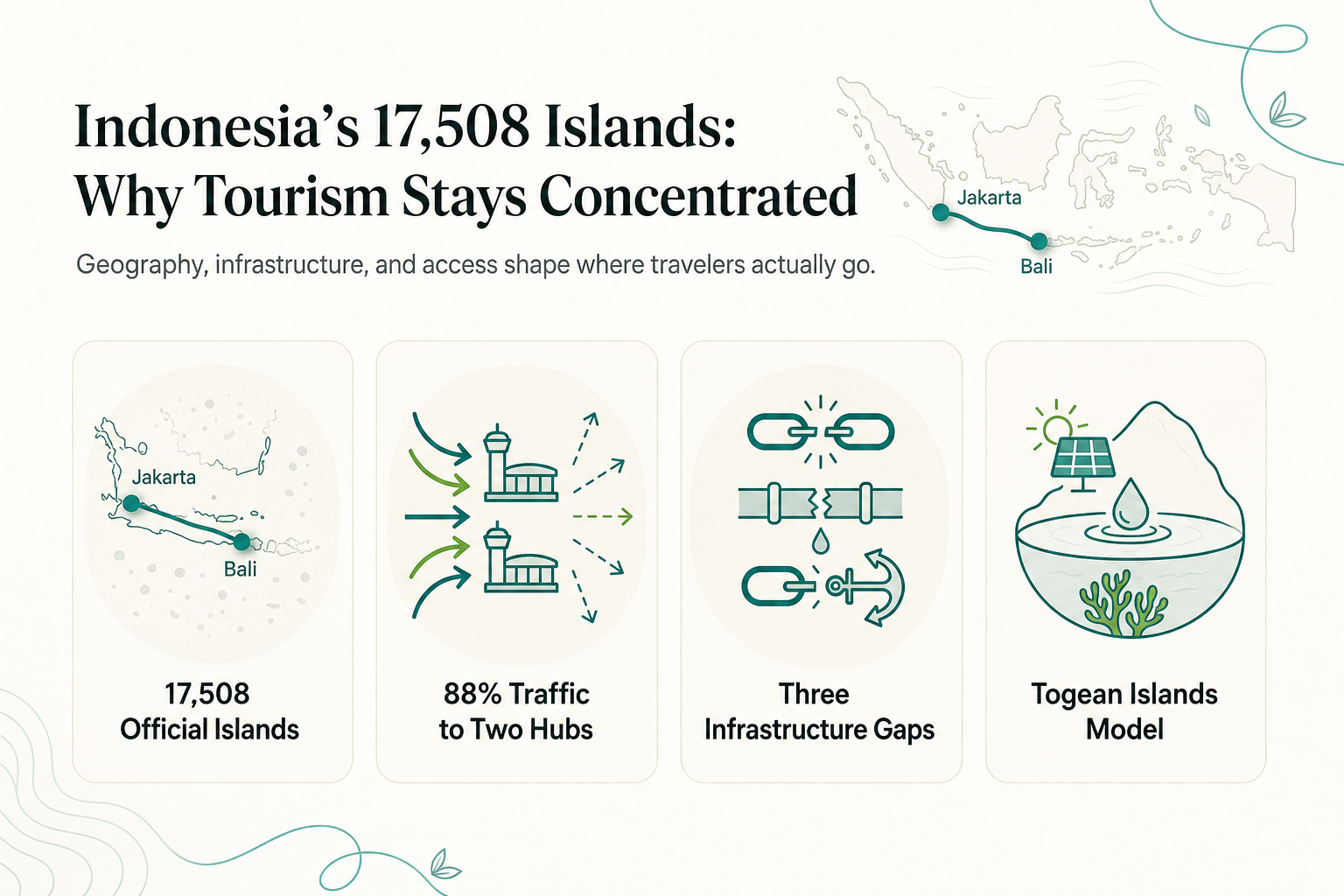
Indonesia has 17,508 officially registered islands [Indonesian Ministry of Marine Affairs and Fisheries]. Only a tiny fraction see a tourist in any given year. Roughly 88 percent of foreign air arrivals land in Bali or Jakarta alone, which means the other 17,000-plus islands, from the Togean archipelago in Central Sulawesi to hundreds of unnamed outcrops in Maluku and Papua, are left largely to the people who live there.
TL;DR
- Indonesia's official island count is 17,508, set by the Ministry of Marine Affairs and Fisheries.
- About 92 percent (16,056) of those islands are named and registered with the United Nations; the remaining 8 percent are unnamed.
- An "island" under Indonesia's UNCLOS-based definition is simply naturally formed land, surrounded by water, above the surface at high tide. No minimum size applies.
- Indonesia drew 13.9 million international tourists in 2024, but nearly 88 percent entered through Bali or Jakarta, bypassing almost every other island.
- Remoteness isn't a marketing adjective here. It's the direct result of power, water, and transport infrastructure that simply doesn't exist on most of these islands yet.
How Many Islands Does Indonesia Actually Have?
The count is 17,508, confirmed by Indonesia's Ministry of Marine Affairs and Fisheries after a nationwide toponymy survey. That number settled a long-running discrepancy: older estimates ranged anywhere from 13,000 to 18,000 depending on who was counting and how.
The count stabilized once Indonesia adopted a single legal definition of what qualifies as an island, tied to the UN Convention on the Law of the Sea (UNCLOS).
Under that definition, an island is any naturally formed area of land, surrounded by water, that stays above the surface at high tide. No minimum size applies. A sandbar the size of a tennis court counts exactly the same as Sumatra.
That single rule is why the number only firmed up recently. Tidal variation, erosion, and inconsistent mapping standards had produced wildly different totals for decades.
Why Are Only 92 Percent of Indonesia's Islands Named?
Of the 17,508 total, approximately 16,056 islands-about 92 percent-are named and registered with the United Nations. The remaining 8 percent, roughly 1,450 islands, have no official name at all.
This isn't an oversight. It reflects scale.
- Many unnamed islands are uninhabited and smaller than a few hectares.
- Some sit in disputed or overlapping maritime zones where naming carries diplomatic weight.
- Naming and registering an island requires a formal government process, not just local usage.
- Several thousand islands across Maluku, Papua, and parts of Sulawesi have never been surveyed closely enough to warrant paperwork.
The named 92 percent cluster heavily around the five major landmasses: Sumatra, Java, Kalimantan (Borneo), Sulawesi, and Papua. The unnamed fraction is scattered thin across remote archipelagos, exactly the kind of geography that makes Sulawesi islands and groups like the Togeans hard to reach and harder still to develop.
Why Do Most Indonesian Islands Remain Untouched by Tourism?
Indonesia welcomed 13.9 million international tourists in 2024. Nearly 88 percent of foreign air arrivals entered through Bali or Jakarta. That leaves a small fraction of visitors to reach the other thousands of islands, and the reason isn't a lack of interest. It's infrastructure.
Three barriers compound on each other:
Geographic remoteness. Many islands sit days from the nearest international airport by a combination of flights, overland transfer, and boat.
Infrastructure gaps. Reliable electricity, running water, and transport links are often simply absent. Building a resort means building the utilities first.
Regulatory friction. Bureaucratic coordination between national, provincial, and village-level authorities slows permitting, and policy frameworks designed for Java-scale development don't translate well to a 200-person island community.
Think of it like trying to open a restaurant on a mountain with no road, no water main, and no power line. You're building the utility company first. That's the real cost structure behind "untouched."
This is the exact calculation Reconnect made on Buka Buka Island in the Togean Islands. There was no grid to connect to, so the resort runs on 93 percent solar power with battery backup. Drinking water comes from an on-site desalination system, also sun-powered.
Guests reach the island through coordinated transfer: a private car from Luwuk Airport to Ampana (around 5 hours overland), then a speedboat crossing of 30-45 minutes. That logistics chain is the infrastructure gap, made manageable rather than eliminated.
What Makes the Togean Islands Different?
The Togean Islands sit within the Coral Triangle, the marine region with the highest coral and reef fish diversity on the planet. That biological density is exactly why remoteness and reef quality tend to travel together here: the islands that stayed hardest to reach are often the ones with the least reef damage.
Diving around Buka Buka Island benefits directly from that isolation. Visibility averages about 30 meters, and the reef systems sit in protected, low-traffic water. Reconnect is a gateway to Togean Islands National Park, reached on a paid day-trip excursion.
A few practical distinctions worth knowing before comparing options:
- Reconnect is an island eco-resort with an on-site SSI dive center. Diving sits alongside house-reef snorkeling, kayaking, paddleboarding, village visits, and park excursions.
- The house reef is available for complimentary snorkeling with equipment provided, no boat required.
- Dive training for certification courses happens at reef sites around Buka Buka Island, reached by short boat rides, not on the house reef itself.
- All-inclusive full-board rates start from EUR 60 per night and cover three meals daily, kayaking, paddleboarding, and house-reef snorkeling. Dive courses are booked and paid separately from the room rate.
Frequently Asked Questions
Is the 17,508 figure final, or could it change again?
It's the current official figure from the Ministry of Marine Affairs and Fisheries, based on the standardized UNCLOS definition. Coastal erosion, sea-level change, and new surveys could still shift the count in future audits.
Does Indonesia have more islands than the Philippines?
Indonesia's 17,508 islands make it the world's largest archipelagic nation by count, ahead of the Philippines' roughly 7,600.
Can I visit an unnamed island?
Many unnamed islands are uninhabited, have no facilities, and may sit within protected marine areas requiring permits. Most travelers experience Indonesia's remote geography through named, inhabited islands with basic transfer infrastructure.
Why do lodges with dive centers cluster in a handful of regions despite 17,508 islands?
Diving operations require reliable power, boat access, and trained staff, which only a small number of remote regions have managed to build. That scarcity is also why reef quality in those few developed regions tends to be high.
About Reconnect
Reconnect is an island eco-resort and SSI-certified dive center on Buka Buka Island in the Togean Islands, Central Sulawesi. The resort runs on 93 percent solar power with on-site desalinated water and a zero single-use plastics policy. All-inclusive full-board rates start from EUR 60 per night. To plan a stay or arrange transfers from Luwuk, visit Reconnect.