


A resort brochure can show you a private villa with an infinity plunge pool, and that photo tells you nothing about whether you will actually eat breakfast alone. Alone time at a small resort is determined less by your room and more by the shared spaces around it: the dining area, the dock, the bar, the beach chairs. The real question to ask before booking is how the shared space is laid out and when it fills up.
TL;DR
- Room privacy and communal-space privacy are two different things. A villa with a locked door can still sit 10 meters from a shared dining pavilion with fixed seating times.
- Look for resorts under 25 rooms. Above that, shared dining and boat logistics tend to force fixed schedules that put every couple in the same room at the same hour.
- Ask about meal seating structure specifically: open-seating over a 2-3 hour window gives couples control; single-seating dinners do not.
- A private villa for couples only delivers on its promise if the paths between villa, beach, and dining area are not the resort's only circulation route.
- Island layout matters as much as room count. Spread-out properties naturally stagger guest movement; compact ones concentrate it.
What Determines Alone Time at a Small Resort, Really?
Alone time is a function of circulation, not room size. Every resort has choke points: one dining room, one bar, one boat dock, one reception desk.
A couple's privacy depends on how many times a day they're forced through those choke points at the same moment as everyone else.
A 60-room resort with three restaurants spreads guests out naturally. A 15-room resort with one dining pavilion and a single dinner seating concentrates them instead, regardless of how private the villas look in photos. Smaller is not automatically more private.
Privacy emerges only when shared spaces are either large relative to guest count, or structured with flexible timing.
The mechanism is simple: think of communal space like a hallway with one door. If 30 people need to pass through it between 7 and 7:30pm, it's crowded no matter how nice the hallway is.
If the same 30 people can pass through any time between 7 and 9:30pm, it rarely feels crowded.
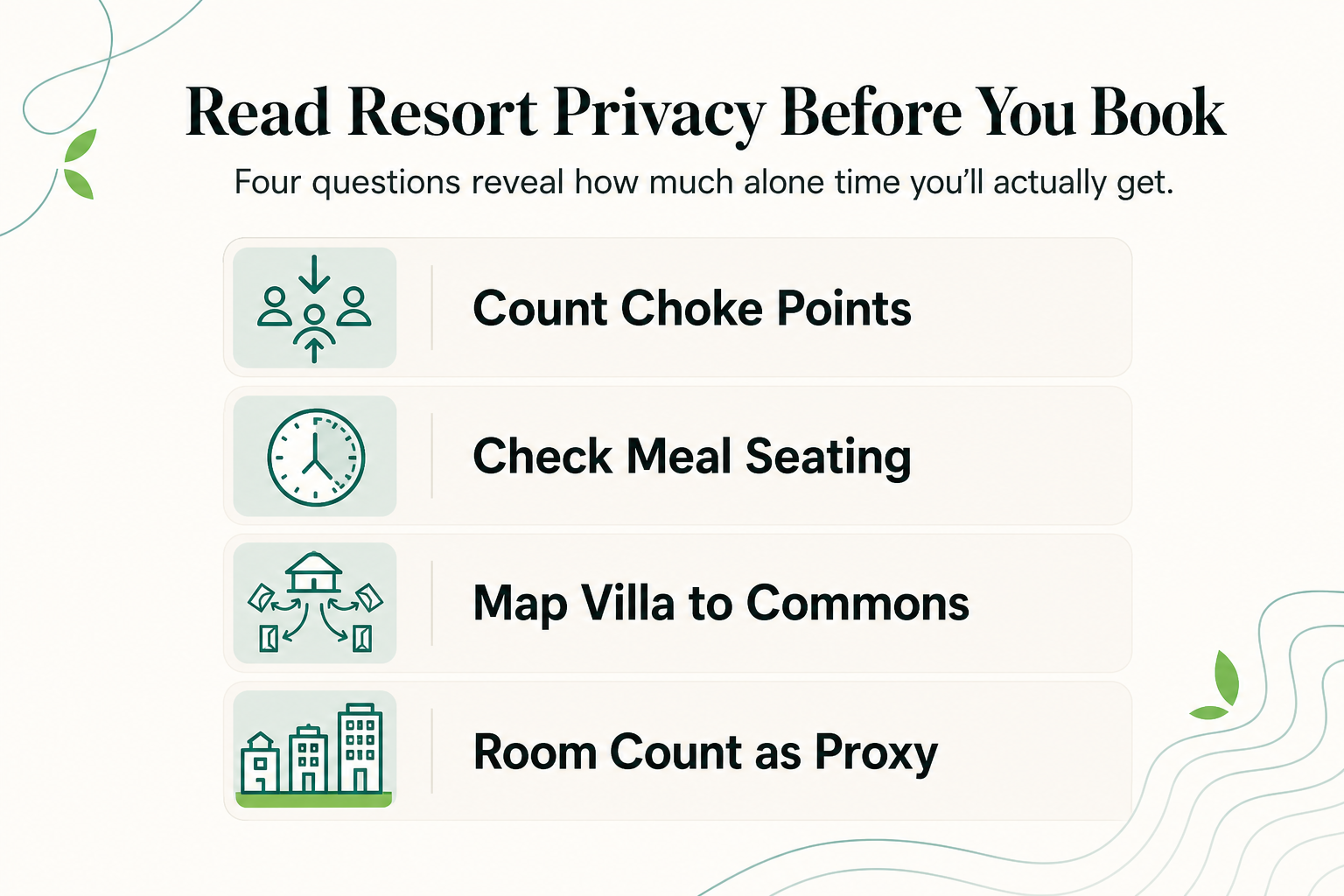
How Do You Read a Resort's Layout Before You Book?
Resort websites rarely show a floor plan, but a few questions reveal the real layout.
Step 1: Count the Choke Points
Ask, or look for in photos, how many of these exist:
- Dining venues (one pavilion vs. multiple spread locations)
- Bars or lounge areas
- Boat docks and transfer points
- Reception or check-in areas
A resort with one of each concentrates every guest interaction into four daily moments. A resort with two dining areas or a beach bar separate from the main restaurant doubles your options for avoiding crowds.
Step 2: Ask About Meal Seating Structure
This is the most revealing question you can ask a small resort directly.
There's a real difference between:
- Single-seating dinner: everyone eats at one fixed time, usually 7 or 7:30pm. Guaranteed overlap with every other couple on the property.
- Open-seating window: meals served across a 2-3 hour block, guests choose their own time. Natural staggering, far less overlap.
Reconnect runs full-board open seating across breakfast, lunch, and dinner, so two couples can eat at completely different hours without either missing any included meal.
Step 3: Look at the Physical Distance Between Villas and Communal Areas
A private villa for couples loses value if the only path to the beach runs directly past five other room doors. Properties built on a spread-out footprint, where villas sit a genuine walk from the central pavilion, give couples a stretch of path that feels theirs alone.
On Buka Buka Island, the eight accommodation types sit along a shoreline rather than clustered around a central courtyard. The walk to dinner is part of the privacy, not a compromise of it.
Does Room Count Actually Predict Privacy?
Not on its own, but it's a useful proxy when paired with communal space size. Here's a rough framework for reading it correctly.
| Room count | Typical shared-space pattern | What it means for couples |
|---|---|---|
| Under 15 rooms | Often one small dining area, fixed hours | High room privacy, but communal crowding is near-guaranteed at meal times |
| 15-25 rooms | Varies widely; depends on layout and seating structure | Check seating policy directly, room count alone won't tell you |
| 25-50 rooms | Usually multiple venues or staggered schedules | More built-in flexibility, but less exclusivity per venue |
| 50+ rooms | Multiple restaurants, bars, pools | Most communal flexibility, least intimate atmosphere overall |
Reconnect sits at 20 rooms, in the range where the seating structure, not the room count, decides whether two couples run into each other constantly or barely cross paths.
What Role Does Total Privatization Play?
Some small resorts offer full privatization, booking every room on the property so no other guests are present at all. This isn't a workaround for a badly designed resort.
It's a deliberate option for anniversaries, honeymoons, or small group retreats where the couple wants the entire footprint, dining pavilion included, for themselves.
Reconnect offers this as island privatization, where a couple or small group books the full 20-room resort and every shared space on it. It's a different product from a standard stay, not a fix for one.
Frequently Asked Questions
Does an all-inclusive rate reduce privacy because everyone eats at the same restaurant?
Not inherently. All-inclusive describes what's covered (meals, drinks, activities), not how it's served. The seating structure, open versus single-seating, is the actual variable to check, and it's independent of whether the rate is all-inclusive.
Is a private villa for couples ever really private if it's part of a shared resort?
The villa itself, yes, assuming it has its own entrance and no shared walls. But privacy stops at the door. What happens between the door and the beach, pool, or dining room is governed by the resort's layout, not the villa's design.
Do adults-only resorts automatically offer more alone time than mixed resorts?
No. Adults-only removes children from communal spaces but doesn't change choke points, seating structure, or room count. A 15-room adults-only resort with single-seating dinner has the same crowding mechanics as a mixed-guest one.
How many rooms is "too many" for a couple prioritizing privacy?
There's no fixed number. A 40-room resort with three dining venues can feel less crowded than a 12-room resort with one small pavilion and a 7:30pm-only seating. Ask about venue count and seating windows before ruling a property out on size alone.
Does island or property size matter more than room count?
Often, yes. A spread-out footprint staggers guest movement naturally, even at a similar room count. Compact properties concentrate guests into the same paths and spaces no matter how few rooms they have.
Ready to Plan Your Stay?
Reconnect is a private island eco-resort on Buka Buka Island in Indonesia's Togean Islands with an on-site SSI dive center. Eight accommodation types are laid out along the shoreline, with open-seating meals and the option to privatize the full resort for couples or small groups. Visit reconnect.id to see the layout and book.