


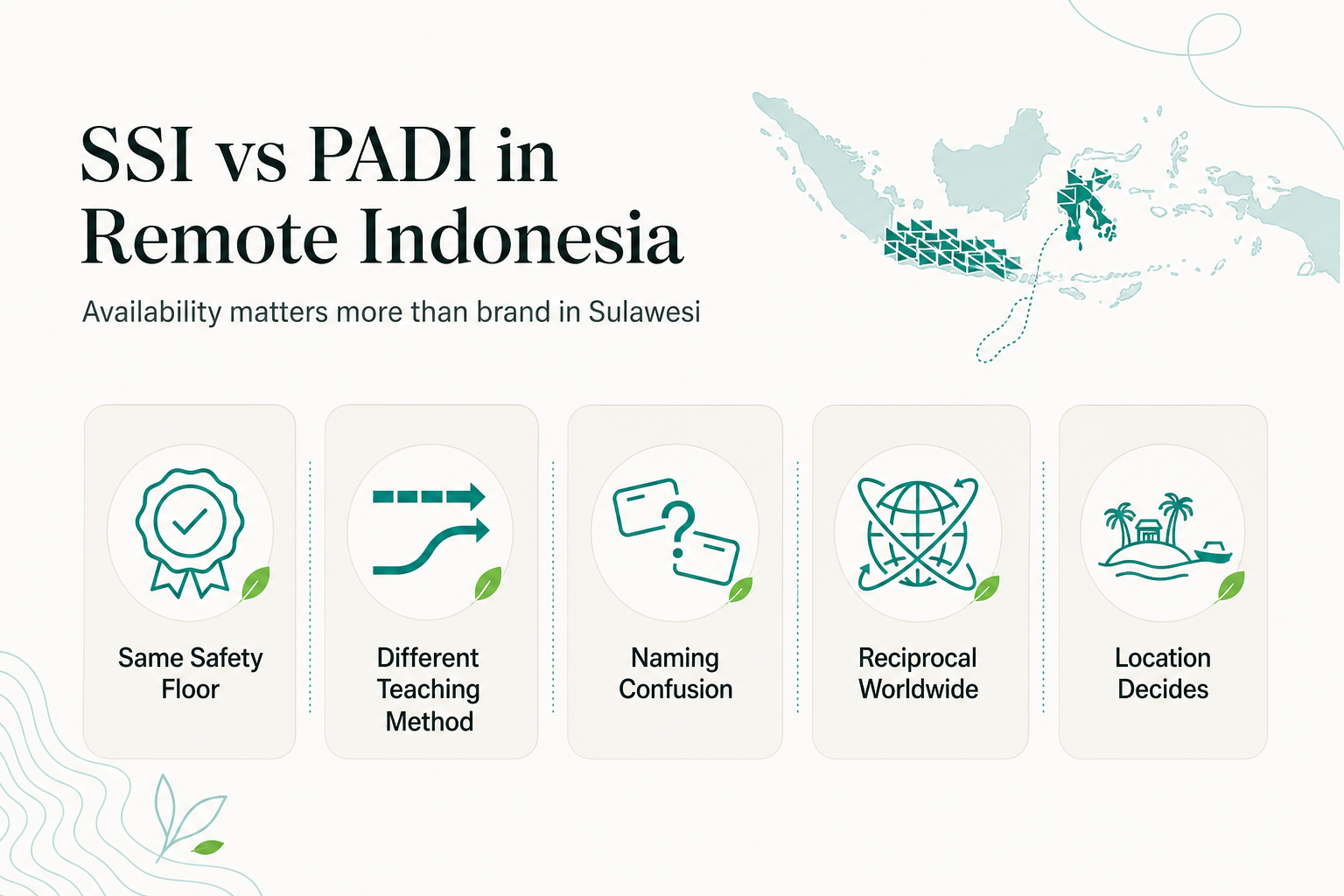
For a diver planning a trip to Central Sulawesi, the practical answer is this: choose the agency that has a certified center where you are actually going, not the one with the bigger global logo. SSI and PADI are both reciprocal, globally recognized, and built on the same core safety standards. In remote Togean Islands locations, availability decides the question before brand preference ever matters.
TL;DR
- SSI and PADI both follow World Recreational Scuba Training Council (WRSTC) standards, so Open Water skills taught are functionally identical between the two.
- The real difference is teaching structure: PADI sequences skills in a fixed order, SSI gives instructors flexibility to adapt the order to the student and site.
- Indonesia has over 300 combined SSI and PADI centers, but they cluster in Bali and Lombok. Central Sulawesi has only 2 to 3 SSI centers and a similarly small number of PADI centers.
- Certifications from both agencies are fully reciprocal for recreational diving, so a course taken in Sulawesi carries forward anywhere else in the world.
- SSI's five-dive course after Open Water is called Advanced Adventurer, not Advanced Open Water Diver, which is a recognition rating earned later through specialty dives and logged experience.
What Is the Actual Difference Between SSI and PADI Training?
Both agencies answer to the same regulatory body. Core Open Water skills, mask clearing, buoyancy control, emergency ascents, are identical in substance because WRSTC sets the floor both must meet.
The difference is in sequencing, not content:
- PADI requires skills to be taught in a fixed, pre-set order across the course.
- SSI allows the instructor to reorder skills to match the student's pace, the site conditions, or group size.
Neither approach is objectively safer. It is a teaching philosophy difference. For a first-time diver in a remote setting with small groups and variable weather, like at Buka Buka Island, that instructor flexibility often means skills get grouped around what the reef and tide conditions allow on a given day rather than forced into a rigid script.
Course materials differ too. SSI dive centers can typically include digital learning materials in the course price without an added fee, which keeps course pricing varied depending on center and region. Pricing still varies by operator, so always check what is bundled before comparing one Open Water quote against another.
Does Agency Choice Matter More in Remote Indonesia Than in Bali?
Yes, and this is the part most comparison articles miss. Indonesia has more than 300 combined SSI and PADI dive centers nationally, SSI lists around 181, PADI over 120, but they are heavily concentrated in Bali and Lombok. In Central Sulawesi, the count drops to roughly 2 to 3 SSI-certified centers and a similarly small handful of PADI centers.
That scarcity changes the decision entirely. In Bali, a diver can pick an agency on brand preference and still have a dozen dive shops to choose from within a few kilometers. In the Togean Islands, the practical question is which agency has a center where you are actually staying.
What Does a Course Actually Look Like on a Remote Reef Like Buka Buka Island?
A Discover Scuba Diving course is the entry point for anyone who has never used scuba gear. It includes a short briefing, confined-water skills, then a guided shallow dive, usually completed in a single day.
It is not a certification, but it is the standard way beginners test the water before committing to a full Open Water course.
The full Open Water course runs over several days and combines:
- Theory sessions (digital or in-person, depending on center)
- Confined-water skill practice
- Open-water training dives at reef sites around the island
At Buka Buka Island, training dives happen at reef sites around the island reached by a short boat ride, not on the house reef. The house reef stays reserved for complimentary snorkeling. Water temperatures in the Togean Islands run 27 to 30 degrees Celsius year-round with visibility averaging about 30 meters, conditions well suited to skill practice because divers can see their instructor and buddy clearly at distance.
After Open Water, the next bookable step is the Advanced Adventurer course, five dives covering navigation, deep diving, and buoyancy, among other skills chosen by the student. This is where SSI terminology causes real confusion.
Why Does the "Advanced Open Water" Name Cause Confusion Between Agencies?
Because PADI and SSI use the same words for two different things. PADI's Advanced Open Water Diver is a bookable, standalone course: five adventure dives completed over a few days. SSI's course with a similar scope is called Advanced Adventurer, not Advanced Open Water.
SSI does have a certification called Advanced Open Water Diver, but it works differently:
| PADI Advanced Open Water | SSI Advanced Open Water Diver | |
|---|---|---|
| Structure | Bookable course, 5 adventure dives | Automatic recognition rating |
| Requirement | Complete the course directly | 4 completed specialty courses + 24 logged dives |
| Can you book it directly? | Yes | No, it's earned over time |
A diver asking a dive shop in Sulawesi to "book the advanced open water course" under SSI will actually want the Advanced Adventurer course. The SSI Advanced Open Water Diver rating comes later, once specialties and logged dives accumulate. This naming overlap is one of the most common points of confusion for divers crossing between agencies.
Does Crossing Over Between Agencies Create Problems?
For recreational diving, no. SSI and PADI certifications are globally recognized and fully reciprocal, meaning a PADI-certified Open Water diver can enroll directly in an SSI Advanced Adventurer course, and vice versa, with no bridging course required.
The friction only appears at the professional level. Divemaster and instructor candidates crossing agencies need specific crossover modules and pay professional fees, a different situation from the recreational path most travelers are on. For a leisure diver planning a trip to Sulawesi, agency choice at the recreational level is a non-issue for future diving anywhere else in the world.
Frequently Asked Questions
Is SSI as recognized as PADI internationally?
Yes. Both are globally recognized and reciprocal for recreational certification levels; dive operators worldwide accept either.
Can I do my Open Water course and then dive recreationally at a resort that uses a different agency?
Yes, reciprocity means a certification from either agency is accepted at dive centers worldwide, including mixed-agency operations.
Why do some remote dive centers only offer one agency?
Running both SSI and PADI instructor certifications and paperwork in parallel adds cost and administrative overhead, so smaller remote operators typically standardize on one to keep training consistent.
Does the agency affect what marine life or sites I can access?
No. Site access depends on the dive center's location and boat range, not the certifying agency. At Buka Buka Island, divers see turtles, eagle rays, blacktip reef sharks, and schooling barracuda across reef, wall, and wreck sites regardless of which agency certified them.
About Reconnect
Reconnect is a private island eco-resort on Buka Buka Island in the Togean Islands, Central Sulawesi, with an on-site SSI-certified dive center and Blue Oceans certification for dive operations. The resort runs fully off-grid on solar power, with on-site desalinated water and zero single-use plastics, and offers all-inclusive full-board stays from EUR 60 per night. Reach out through reconnect.id to plan a stay or ask about course availability.