


Room count is the single most overlooked spec in island resort comparisons, yet it predicts more about your reef experience than star ratings or photos ever will. A property with 20 rooms puts fundamentally less pressure on its house reef than one with 200, both in water quality and in how many divers are queueing at the same coral head. If you're choosing between small island resorts and larger developments, room count is the number to check first, before amenities, before pool size, before anything else.
TL;DR
- Boutique island resorts typically run 15 to 50 rooms; large-scale resorts run 100 to 300+. The difference shows up directly in reef condition, not just guest experience.
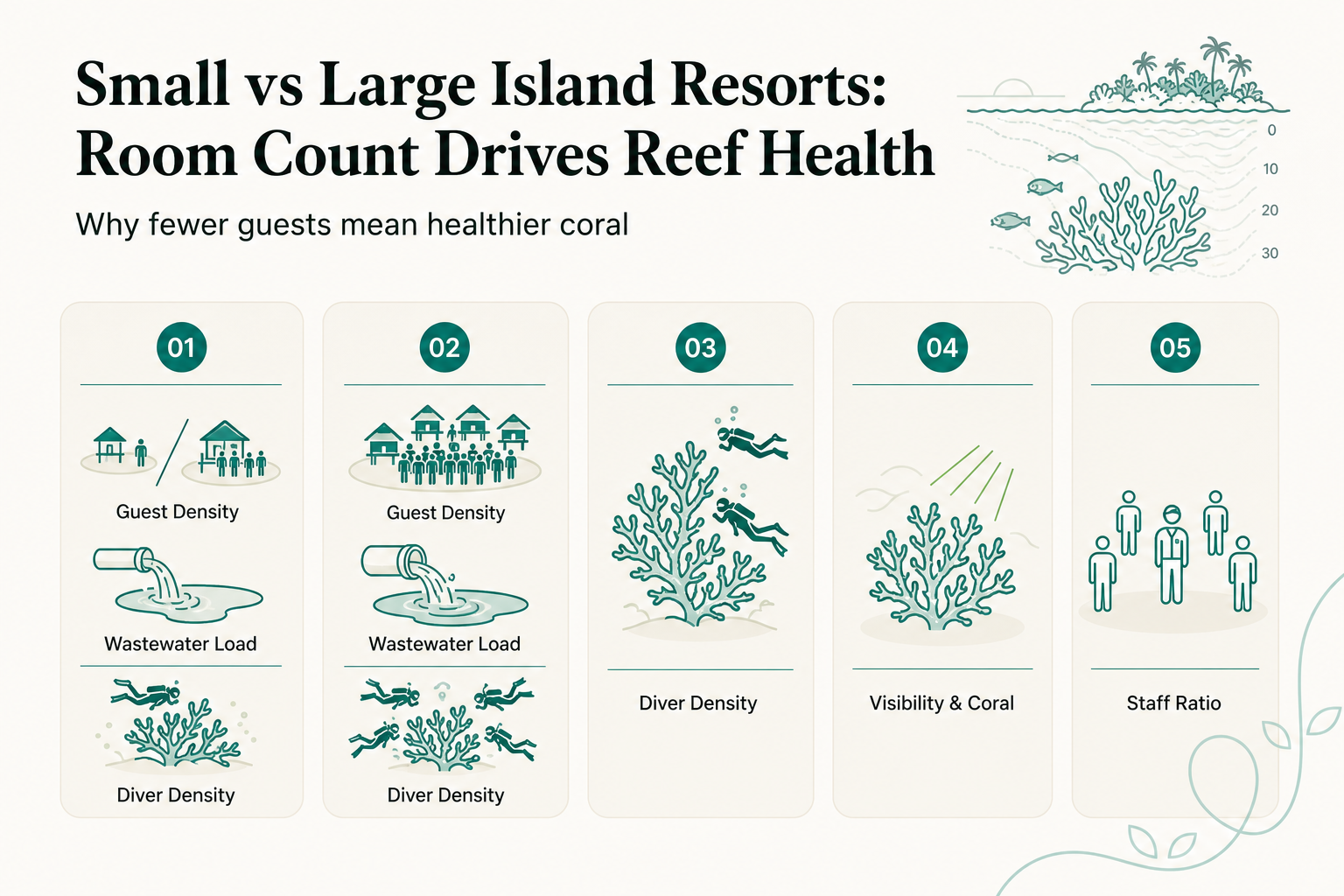
- Larger room counts correlate with higher wastewater and nutrient discharge, which feeds algae growth that competes with and degrades coral.
- Small-scale properties generally put fewer divers on each reef at once, which matters for both coral contact and visibility.
- Reconnect runs 20 rooms across 8 accommodation types on Buka Buka Island in the Togean Islands, with direct house-reef access and no long boat transfers to dive sites.
- Room count is a useful filter, but check it alongside water treatment, staff ratios, and distance to the reef itself.
What Does Room Count Actually Tell You About a Resort?
Room count is a proxy for guest density, and guest density is a proxy for environmental load. It is one of the few hard numbers you can compare across resort websites before you ever book a flight.
Boutique island resorts typically run 15 to 50 rooms. Large-scale developments run 100 to 300+. Below 50 rooms, a resort is built around personalized service; above 200, it typically carries multiple restaurants, event spaces, and far more staff turnover per guest.
Smaller room counts also tend to mean higher staff-to-guest ratios. Small luxury hotels often run three to four staff per guest, well above what large-scale resorts typically offer [equipoiseresort.com].
For reef-focused travel, that ratio determines whether your dive guide knows the reef by name or rotates through dozens of divers a day.
Why Does Room Count Affect Reef Health?
More rooms means more guests means more wastewater, and wastewater is the mechanism, not a side effect. Every additional occupied room adds laundry, greywater, and sewage output, and in most island locations that output ends up in or near the lagoon the resort was built to showcase.
Higher nutrient discharge into coastal water feeds algae growth. Algae competes directly with coral for light and substrate.
Larger resorts also add physical pressure through more construction, more boat traffic, and more sedimentation stirred up by infrastructure.
Think of a reef like a shared aquifer. One household drawing water barely registers. Two hundred households drawing from the same source, even if each one is careful, changes the system. Room count is the headcount on that aquifer.
Indonesia enforces visitor quotas in its protected marine areas rather than relying on resorts to self-regulate. Komodo National Park caps visitors at 1,000 per day based on ecological carrying-capacity studies. The Seribu Islands Marine National Park sets daily snorkeler and diver limits tied to the actual square meterage of reef available.
Room count is, in effect, a resort's visitor quota.
How Should You Compare Small vs Large Resorts for Diving and Snorkeling?
Side-by-side, the tradeoffs are consistent across the industry.
| Factor | Small-scale (under 50 rooms) | Large-scale (200+ rooms) |
|---|---|---|
| Typical staff-to-guest ratio | 3-4 staff per guest [equipoiseresort.com] | Lower ratio, more standardized service |
| Reef pressure | Lower nutrient and traffic load | Higher wastewater and sedimentation load |
| Amenities | Focused, fewer venues | Multiple restaurants, event spaces |
| Guest experience on reef | Fewer divers per site, more personal guiding | Higher diver density per site |
Physical layout matters as much as room count [deluxetargets.com]. Two 30-room resorts on the same island can have very different reef outcomes depending on land use and construction footprint.
What to check beyond the room count number
- Does the resort publish its water treatment method, or just its room count?
- Is the dive center on-site, or do guests boat 45+ minutes to reach dive sites?
- What is the stated average visibility?
- Are staff locally hired, with village supplier relationships, or flown in seasonally?
Where Does Reconnect Fit This Framework?
Reconnect runs 20 rooms across 8 accommodation types on Buka Buka Island, in the Togean Islands of Central Sulawesi. That puts us firmly in the small-scale category, well under the 50-room boutique threshold.
We built the resort off-grid because of the reef-health mechanism described above. We run 93% on solar, with on-site desalinated water and zero single-use plastics. Wastewater and runoff are treated and contained on-site rather than discharged at a volume that would stress the house reef.
Our dive center sits on-site, with direct reef access around Buka Buka Island by short boat ride. Visibility around the island averages about 30 meters. Dive instruction is SSI-certified and offered in English, French, and Indonesian, in small groups rather than large rotating classes.
We are one of the very few Togean Islands resorts offering air conditioning at all, in select room types. All-inclusive full-board rates start from EUR 60/night and cover three meals daily, house-reef snorkeling, kayaking, and paddleboarding.
Dive courses and the Dive-cation package (8 guided dives over 5 days) are booked and paid separately from the room rate.
Frequently Asked Questions
Is a smaller room count always better for reef health?
Generally yes, because it caps wastewater and traffic volume, but land use and water treatment matter too. A poorly managed 30-room resort can outpace a well-managed 60-room one on nutrient discharge.
How many rooms count as "small-scale" in the industry?
Most hospitality analysts use 50 rooms as the boundary: under 50 is boutique or small-scale, over 200 is large-scale.
Does a smaller resort mean fewer dive sites available?
Not necessarily. Site count depends on proximity to reef systems, not room count. Reconnect's 20 rooms sit in the Togean Islands, adjacent to Togean Islands National Park, with multiple reef, wall, and pinnacle sites reachable by short boat ride.
What visibility should I expect in the Togean Islands?
Visibility in Indonesian reef destinations typically runs 15 to 35 meters depending on season and currents. Reconnect's average sits at about 30 meters.
About Reconnect
Reconnect is a Private Island Resort and SSI-certified dive center on Buka Buka Island in Indonesia's Togean Islands, founded by Thomas Despin. With an on-site dive center offering direct reef access and a small-scale 20-room design, we prioritize both guest experience and reef health. Rated 4.9 on TripAdvisor and 9.2 on Booking.com. Get in touch at reconnect.id.
References
- Small Luxury Hotel vs 5-Star Resort: Which Fits Your Trip (equipoiseresort.com)
- Resort Density: When Fewer Villas Are Worth More (deluxetargets.com)