


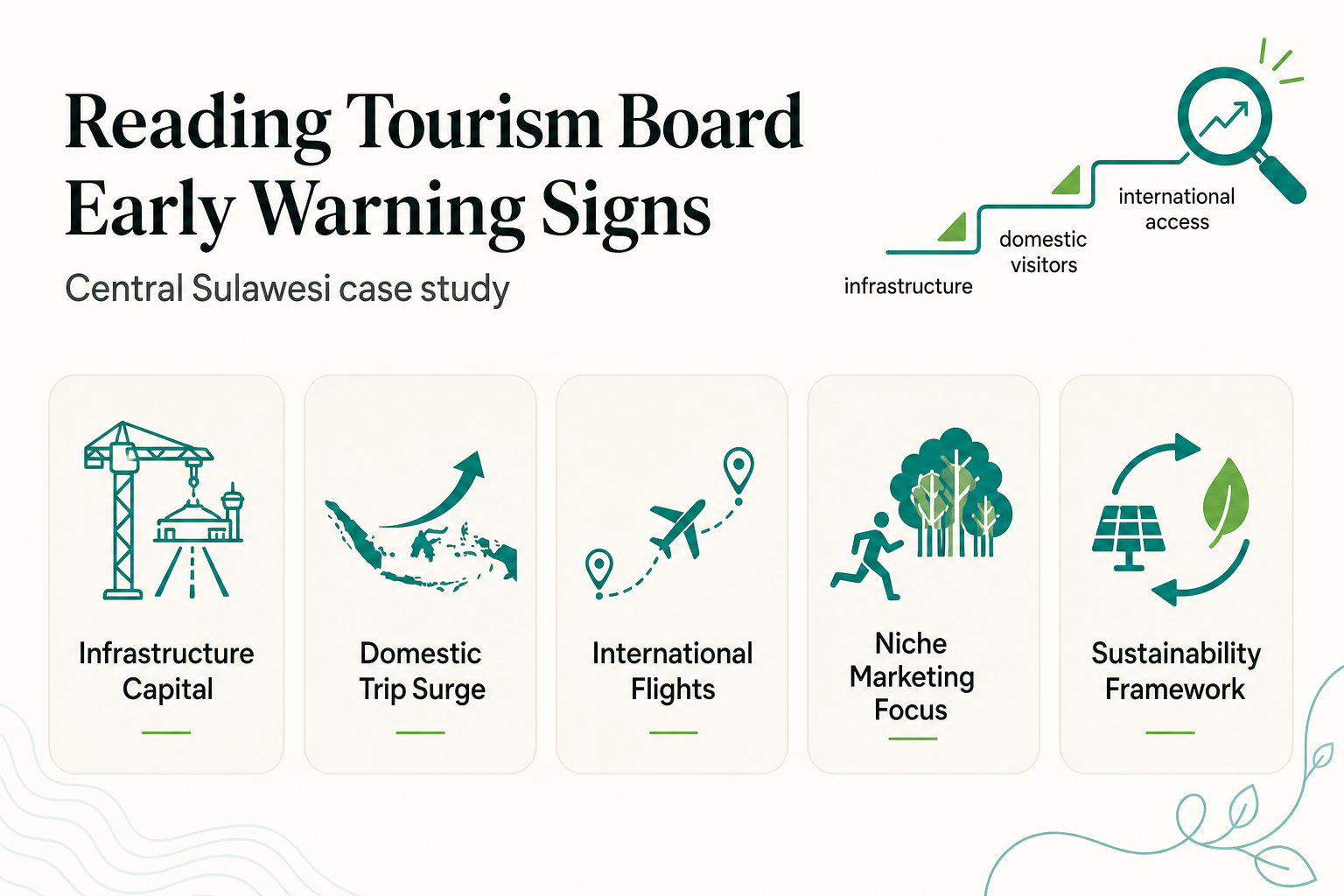
Tourism boards rarely announce a destination's turning point directly. Instead, the signal shows up in port investment budgets, half-marathon sponsorships, and which lake gets featured in a new digital campaign. In Central Sulawesi, three of these signals have appeared in the past two years: a 36.47 percent jump in domestic tourist trips between 2023 and 2024, a $297.75 million Asian Development Bank infrastructure package, and a direct international flight route launched to Guangzhou in August 2026. Read together, they describe a region moving from undiscovered to early-stage, not a region that has already arrived.
TL;DR
- Domestic tourist trips to Central Sulawesi rose 36.47 percent from 2023 to 2024, a growth rate well above mature destinations.
- A $297.75 million ADB rehabilitation project has upgraded roads, water systems, and Mutiara Palu Airport.
- Direct flights from Central Sulawesi to Guangzhou began in August 2026, opening a new international feeder market.
- Provincial tourism offices are running experiential campaigns (the Togean Half Marathon, Lake Paisu Pok promotion) rather than mass-market ads, a hallmark of the pre-boom phase.
- The Togean Islands remain low-volume relative to Bali or Lombok, positioning them among the emerging travel destinations to watch in 2026.
What Infrastructure Spending Tells You Before Visitor Numbers Do
Infrastructure budgets move years ahead of tourist arrivals, because roads and ports take years to plan and fund. A region that attracts development capital before it attracts tour operators is signaling something specific: someone with technical due diligence has already concluded the market is coming.
In March 2024, the revitalized Wani and Pantoloan ports in Palu Bay were inaugurated. Combined with the ADB's $297.75 million rehabilitation project covering roads, water supply, and Mutiara Palu Airport, this is capital committed to moving people and goods at a scale well beyond current demand.
That gap between built capacity and current traffic is the tell. Airports and ports are expensive to expand and slow to build. When a government funds capacity ahead of need, it is pricing in growth that has not shown up in visitor statistics yet.
The August 2026 launch of direct flights from Central Sulawesi to Guangzhou reinforces this. Airlines do not open new international routes speculatively. They open them when origin-market demand data or bilateral tourism agreements justify the aircraft.
Why Domestic Growth Numbers Matter More Than International Ones Early On
Domestic tourism growth is the leading indicator that most international travelers never see, because it happens before foreign marketing budgets get deployed. Central Sulawesi's 36.47 percent increase in domestic trips between 2023 and 2024 fits this pattern precisely.
Domestic travelers respond first to new destinations because they face lower information costs. They already know the language, the currency, and often have relatives or contacts in the region. International demand typically lags domestic demand by two to four years in Indonesia, based on the pattern seen in Lombok, Flores, and now apparently Central Sulawesi.
This is analogous to how early-stage real estate investors watch rental yield changes before resale prices move. The rental market reacts first because it has lower switching costs; homebuyers commit later once the trend is already confirmed by data. Domestic tourism plays the same leading role that rental yields play in property markets.
What Kind of Marketing Campaign Signals "Not Ready for Mass Tourism Yet"
The nature of a tourism board's marketing spend tells you more than its size. Mass-market destinations run broad brand awareness campaigns. Emerging destinations run experiential, narrow campaigns aimed at specific traveler segments.
Central Sulawesi's recent initiatives fit the emerging-destination pattern:
- The 2024 Togean Half Marathon, a niche sporting event designed to draw a self-selecting, active traveler segment rather than mass volume.
- Digital and experiential promotion of Lake Paisu Pok, a single flagship site rather than a broad destination-wide ad campaign.
- A September 2026 cross-border partnership with Malaysian investors, signaling interest in hospitality capital rather than in visitor volume alone.
- Sustainable eco-tourism frameworks tied to the provincial Long-Term Development Plan, suggesting policymakers are trying to manage growth rather than simply chase it.
That last point is the most telling. A region actively drafting sustainability frameworks before a tourism surge is trying to avoid the overtourism mistakes documented elsewhere in Southeast Asia. Central Sulawesi's approach prioritizes sustainable, managed growth over volume maximization.
How Does the Togean Islands' Growth Compare to Other Indonesian Destinations
The Togean Islands remain a niche, low-volume destination centered on diving and eco-tourism, even as the broader province sees double-digit domestic growth. This gap between provincial momentum and Togean-specific volume is itself informative.
| Signal | Central Sulawesi Province | Togean Islands Specifically |
|---|---|---|
| Domestic trip growth (2023-2024) | +36.47% | Gradual, still low-volume |
| Major infrastructure | $297.75M ADB project, revitalized ports, upgraded airport | Small port town access via Ampana |
| International flight access | New Guangzhou route (Aug 2026) | No direct international access |
| Marketing focus | Half marathon, Lake Paisu Pok | Niche eco-tourism, diving |
The Togeans sit downstream of provincial infrastructure gains without yet absorbing the visitor surge. That is precisely the window where an eco resort in Indonesia can establish itself before demand catches up to supply.
What This Means for Travelers Considering the Togean Islands Now
For travelers weighing whether to visit before or after wider discovery, the honest answer is that the region is not undiscovered anymore, but it is not mainstream either. Reef conditions, boat traffic, and village life still reflect a low-volume destination.
The Togean Islands sit in one of the world's richest marine regions, with reef systems built on atolls, barrier reefs, and fringing reefs dominated by hard coral. Visibility in the Togeans averages about 30 meters, though conditions around specific reef systems vary with season and site. Marine life includes reef sharks, sea turtles, bumphead parrotfish, and the well-known stingless jellyfish lake, features that make this one of the areas worth watching among the best snorkeling in Indonesia.
Reconnect is a Private Island Resort and SSI dive center on Buka Buka Island in the Togean Islands, built specifically to operate ahead of this curve rather than in response to it. The resort runs 93 percent on solar power, produces its own desalinated water on-site, and holds to a zero single-use plastic policy, an operating model built for a place still defining its own tourism identity rather than retrofitted onto an already-crowded destination.
The on-site SSI dive center gives direct reef access around Buka Buka Island with recorded visibility averaging about 30 meters, without long boat transfers to reach dive sites. Full-board, all-inclusive stays start from EUR 60 per night and cover meals, house-reef snorkeling, kayaking, and paddleboarding, with dive courses sold separately and guided dives bundled only in the dedicated Dive-cation package.
Frequently Asked Questions
What separates an all-inclusive eco-resort with a dive center from a dedicated diving-only operator?
An eco-resort with an on-site dive center, like Reconnect, includes house-reef snorkeling, kayaking, and paddleboarding within its standard full-board stay, while dive courses are sold separately and guided dives are only bundled in a dedicated dive package. This allows guests who do not dive to experience the full range of activities.
How does sustainable tourism in Indonesia apply to the Togean Islands specifically?
Provincial planners have built eco-tourism frameworks into the Long-Term Development Plan. Individual operators apply this through renewable energy, on-site resource production, and hiring local staff.
Are the Togean Islands among the best emerging destinations in Indonesia for 2026?
The Togeans are gaining recognition for reef quality and low crowding, though they remain smaller in scale than established hubs like Raja Ampat or Komodo.
What is the fastest way to know a destination is entering its growth phase?
Track infrastructure capital and domestic trip data before international marketing volume. Both moved first in Central Sulawesi, ahead of any visible surge in foreign arrivals.
About Reconnect
Reconnect is a Private Island Resort and SSI-certified dive center on Buka Buka Island in the Togean Islands, founded by Thomas Despin. The resort emphasizes sustainable operations and offers all-inclusive full-board stays from EUR 60 per night. For more information, visit Reconnect.
References
- Asian Development Bank infrastructure project information (Central Sulawesi provincial planning documents)