


Most travelers researching Indonesia's islands ask one question: when is visibility best for diving? That framing misses most of what actually changes. Season affects road conditions, ferry reliability, mosquito-borne disease risk, coral stress, fish behavior, and even which villages are easy to reach by boat. Visibility is one variable in a much longer list.
TL;DR
- Dry season (May to October) brings humidity around 60%, calm seas, and better transport reliability across Indonesia's islands.
- Wet season (November to March) raises humidity to 80-90% and brings northwest monsoon swells that can disrupt ferries and rural roads.
- Coral bleaching risk tracks thermal anomalies like El Nino, not the regular wet/dry cycle, so reef health doesn't swing as dramatically as people assume.
- Dengue and malaria risk rises with wet-season rainfall, but can persist into dry months depending on local water storage habits.
- Species like the Banggai cardinalfish show more active spawning during calmer dry-season conditions.
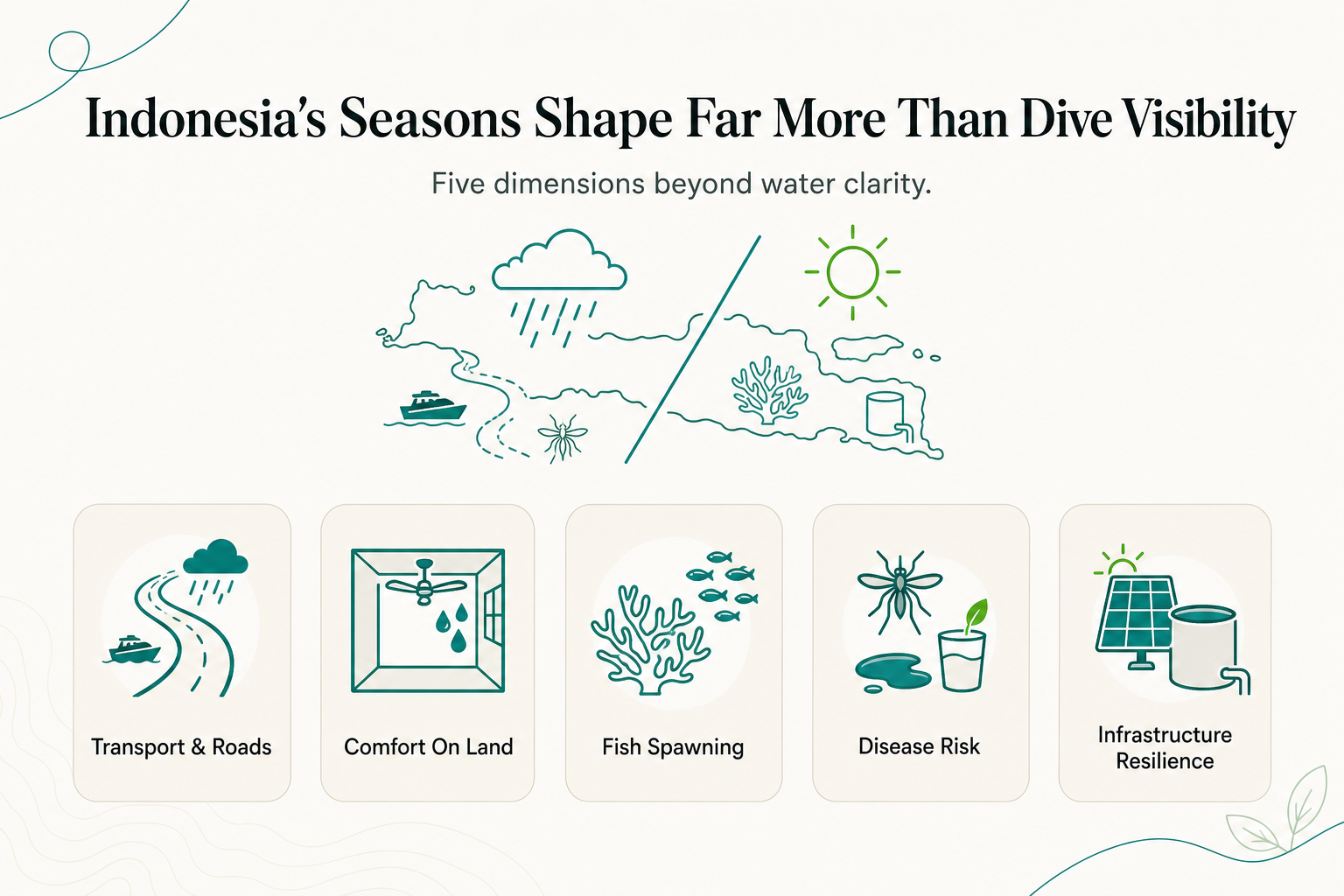
What Actually Changes Between Indonesia's Wet and Dry Seasons?
The dry season runs roughly May through October: lower humidity near 60%, minimal rainfall, and calm seas[travellocal.com]. The wet season, November through March, brings humidity up to 80-90% and rougher water driven by the northwest monsoon. Humidity and sea state cascade into things travelers don't think to check before booking.
- Comfort on land: higher humidity means slower drying laundry, more condensation, and a harder time cooling rooms without air conditioning.
- Comfort at sea: calmer dry-season water means smoother boat transfers and less seasickness risk on longer crossings.
- Photography and visibility topside: clearer skies in dry months mean better sunset and underwater light penetration, not just better dive visibility.
Reconnect is one of the few resorts in the Togean Islands offering air conditioning at all. During wet-season humidity spikes, that's a meaningfully different stay than a fan-only room, though most rooms rely on natural ventilation and sea breeze the way most Togean Islands accommodation does.
How Does Season Affect Getting There, Not Just Being There?
Transport reliability changes more than comfort does.
During the wet season, heavy rainfall frequently causes floods and landslides that block rural roads and disrupt inter-island ferry schedules. The dry season improves transportation accessibility and road conditions, but prolonged dry spells can create drought-related water shortages in some regions.
For a destination like the Togean Islands, reached via Luwuk Airport followed by a private car to Ampana and a speedboat crossing, this matters concretely:
- Wet-season rain can slow the Ampana road leg and roughen the speedboat crossing.
- Dry-season transfers are generally more predictable, which is why most operators coordinate logistics tightly around this window.
- Drought conditions in prolonged dry stretches can strain water systems on islands that depend on rainfall or municipal supply.
Self-sufficiency stops being a marketing line and starts being operational here. Reconnect runs on-site desalinated water production, powered by solar, so our water supply isn't tied to rainfall patterns or municipal infrastructure the way many smaller island properties are. We're also 93% solar-powered with battery backup, with a generator held strictly as backup, never as the primary source.
Does Season Change What's Happening Underwater Beyond Visibility?
Monsoon patterns drive nutrient mixing and seasonal shifts in reef conditions across Central Sulawesi. That mixing changes what's actually living and breeding on the reef, not just water clarity.
Species like the Banggai cardinalfish, endemic to the Banggai Archipelago near Central Sulawesi, show more intense spawning activity during the calmer dry-season months. Other pelagic species have spawning peaks aligned instead with the southeast monsoon.
| Factor | Dry season | Wet season |
|---|---|---|
| Water clarity | Clear, calm | Reduced by runoff and sedimentation |
| Reef stress from sediment | Lower | Higher, especially near river mouths |
| Bleaching risk driver | Not seasonal | Not seasonal |
Coral bleaching risk in the Coral Triangle is primarily driven by broader thermal anomalies like El Nino, not the regular wet-dry cycle. A wet season doesn't mean a bleaching event, and a dry season doesn't guarantee reef safety.
At Reconnect, visibility around Buka Buka Island averages about 30 meters year-round, and our SSI dive center runs guided dives on reefs, walls, and pinnacles across both seasons.
What Health and Safety Factors Shift With the Season?
Tropical disease risk deserves equal billing with visibility and road conditions.
Dengue and malaria show higher prevalence during Indonesia's wet season, driven by increased rainfall creating abundant mosquito breeding sites. Transmission can persist into the dry season in some regions due to water storage practices and changing peri-urban environments.
Dry season reduces but doesn't eliminate mosquito-borne disease risk, so standard precautions, repellent, and appropriate clothing at dawn and dusk apply regardless of when you travel. Remote, low-density destinations have a structural advantage: fewer standing water sources and fewer peri-urban breeding grounds mean fewer vectors in the first place.
How Should Travelers Actually Plan Around This?
Stop treating "best season to dive" as the only filter. Build the decision in this order:
Step 1: Match your priority to the season.
- Want calm seas, lower humidity, and the most predictable transfers: book May to October.
- Want fewer crowds and don't mind rougher crossings and higher humidity: wet season works, provided your itinerary has flexibility built in.
Step 2: Check the property's self-sufficiency, not just its marketing photos.
- Does it depend on municipal water or rainfall collection.
- Is power solar-based with real backup, or generator-reliant.
- Does road or ferry disruption actually affect guest transfers, or does the operator coordinate around it.
Step 3: Confirm what's included versus what's seasonal.
At Reconnect, all-inclusive full-board stays from EUR 60 per night cover three meals daily, afternoon tea, unlimited coffee and tea, house-reef snorkeling, kayaking, and paddleboarding, year-round regardless of season. Dive courses and the Togean Day Trip into Togean Islands National Park are booked and paid separately from the room rate.
Frequently Asked Questions
Is the dry season always better for visiting Indonesia's islands?
Not universally. It's better for calm seas, humidity, and transport reliability, but coral bleaching risk doesn't track the dry season, and some fish species are more active outside it.
Can mosquito-borne disease risk be avoided entirely in dry season?
No. Risk is lower but transmission can persist into dry months depending on local water storage and peri-urban conditions, so standard precautions still apply.
Does rain mean bad diving at an eco-resort in Sulawesi?
Not necessarily. Visibility can drop with runoff near river mouths, but reef health and bleaching risk are governed by thermal anomalies, not rainfall itself.
Is an island resort in Indonesia less affected by seasonal disruption than a mainland destination?
It depends on the property's infrastructure. One with on-site desalination and solar power is structurally more resilient to both seasons than properties that depend on municipal water or ferry-delivered supplies.
About Reconnect
Reconnect is a Private Island Resort and SSI dive center on Buka Buka Island in the Togean Islands, Central Sulawesi, founded by Thomas Despin. The resort operates year-round at 93% solar power with on-site desalinated water, zero single-use plastics, and coordinated transfers from Luwuk Airport. All-inclusive full-board stays start from EUR 60 per night.
Ready to see how the seasons play out for yourself? Get in touch at reconnect.id.