


Couples marking a retirement or a major career milestone increasingly skip the branded beach resort in favor of remote, small-scale islands. The reasoning is practical, not just romantic: fewer people around means more actual conversation, a slower pace forces the recalibration a life transition demands, and a milestone trip works better as a reset than as a repeat of every other vacation. This shift shows up in how couples now plan travel around meaning rather than convenience, and it is reshaping which properties get booked for the trips that matter most.
TL;DR
- Milestone trips (retirement, career transitions) work better in low-stimulation, remote settings because the goal is recalibration, not distraction.
- 61.4% of couples now book trips with no fixed occasion at all, suggesting travel motivation is shifting from milestone-only to intentional connection generally [jaywaytravel.com].
- Retirement itself often means loss of routine and identity alongside gained freedom, which changes what a couple needs from a trip.
- Remote island stays force the kind of shared decision-making and undivided attention that resort chains, with their built-in distractions, do not.
- All-inclusive remote resorts (like eco-resorts with on-site dive centers) can offer the same comfort and predictability as a chain, without the crowd.
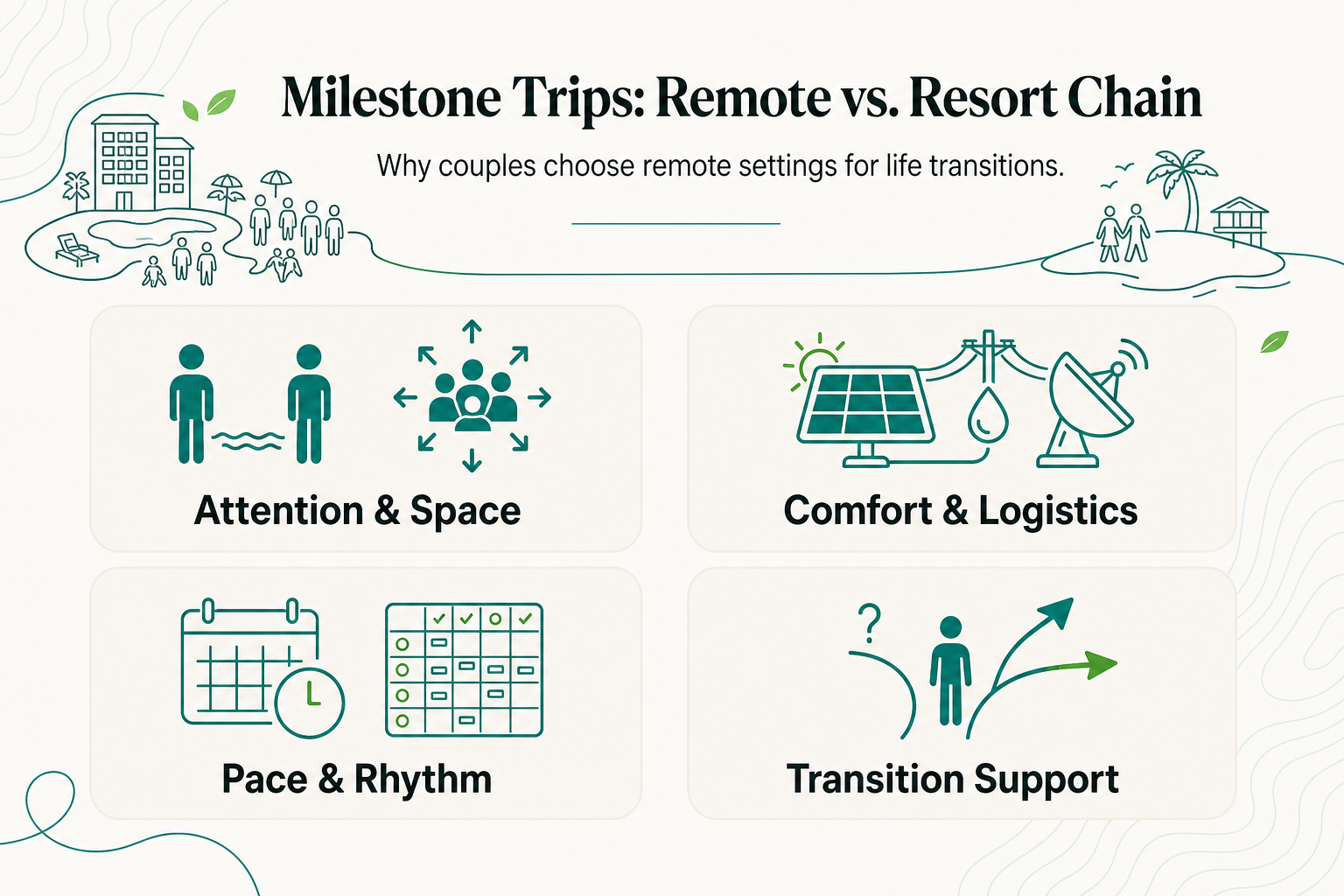
Why Do Couples Choose Remote Destinations for Milestone Trips?
A milestone trip is different from a normal vacation because the couple is not just resting, they are marking a transition. Retirement can bring personal freedom, but it can also bring the loss of a routine or identity that structured a person's days for decades [retirement.berkeley.edu].
A resort chain is built for stimulation: pools, bars, entertainment schedules, other guests. A remote island removes most of that by design. What is left is the two of you, the reef, and long stretches of unscheduled time. Couples report that this is precisely the point.
Retirement transitions go better when both partners actively choose to understand each other and build a shared sense of what comes next [meawisdom.com]. That kind of conversation happens more easily without a poolside DJ competing for attention.
There is also a quieter trend behind this. Romance travel data from 2026 shows 61.4% of couples now book trips for no occasion at all, skipping the traditional milestone hierarchy of engagement, honeymoon, anniversary entirely [jaywaytravel.com]. Milestone trips are not disappearing, but they are being joined by a broader shift toward travel as a relationship habit rather than a reward. Remote settings suit both motivations equally well.
What Does "Remote" Actually Solve That a Resort Chain Doesn't?
Remote is not about deprivation. It solves a specific problem: attention gets diluted in a crowd, and a milestone trip needs the opposite. A large resort chain optimizes for volume, more guests, more amenities, more programming to keep everyone occupied. Occupied guests do not need to lean on each other for entertainment.
A remote, small-scale property optimizes for the reverse: fewer distractions, so the couple has to generate their own rhythm together.
When one partner is adjusting to retirement and the other is not, this matters more. Retirement research on couples shows the person still working, or still tied to routine, often values structure differently than the partner who just left a career behind [dovetailfin.com].
Traveling separately is sometimes the honest answer to that mismatch. But when a couple travels together specifically to mark the transition, a remote setting with a slower, self-directed pace tends to bridge the gap better than a resort with a fixed activity board, because neither partner is boxed into someone else's schedule.
Comparing the two settings:
| Factor | Resort Chain | Remote Small-Scale Property |
|---|---|---|
| Guest volume | High, often 200+ rooms | Low, often under 30 rooms |
| Daily structure | Programmed activities, set meal times | Self-directed, flexible pacing |
| Connectivity | Constant, resort-wide Wi-Fi and TV | Deliberately limited or satellite-based |
| Setting | Familiar chain branding, repeatable | Distinct location, harder to replicate elsewhere |
| Best suited for | Short breaks, family trips with kids | Transitions, recalibration, deep conversation |
Does Remote Mean Giving Up Comfort and Reliability?
No. The old idea of "remote" as rustic and unreliable is outdated. A well-run remote property can match a resort chain on essentials-meals, connectivity, predictable logistics-while dropping the crowd.
Reconnect, an eco-resort with an on-site SSI dive center on Buka Buka Island in the Togean Islands, shows how this works in practice. The island sits in the southern Togean Islands of Central Sulawesi and is reached by a coordinated boat transfer from Luwuk Airport, bypassing the public ferry network entirely.
Comfort details that matter for a milestone trip:
- All-inclusive full-board pricing from EUR 60/night, covering three meals daily, afternoon tea, and unlimited coffee, tea, and water.
- Starlink connectivity throughout the resort, so a milestone trip does not mean going fully off the map for family who want updates.
- 93% solar-powered, off-grid electricity with battery backup, meaning reliable power without a generator as the main source.
- Coordinated transfers from Luwuk Airport, removing the logistics burden that makes remote destinations feel risky to book.
- Just 20 rooms across eight accommodation types, so the property stays intimate rather than crowded.
All-inclusive remote eco-resort models deliver predictable costs and no surprise add-ons for meals, paired with an authentic, uncrowded island experience rather than a resort chain outpost.
What Should Couples Actually Do to Plan This Trip?
Step 1: Decide what the trip is actually for
Recalibration and celebration need different settings. If the goal is deep conversation and space to process a transition, choose low-stimulation and low-guest-count. If the goal is pure celebration with friends and family, a resort chain's group capacity may serve better. A retirement milestone trip usually calls for the former.
Step 2: Check the property's self-sufficiency, not just its brochure
Ask how power, water, and connectivity actually work. A property fully dependent on diesel generators or municipal water in a remote area carries more operational risk (outages, shortages) than one designed to be self-sufficient. Reconnect's on-site desalinated water production and solar-first power are the kind of concrete details worth asking any remote property about before booking.
Step 3: Match activity level to what recharges the couple, not what looks good in photos
For couples who want structured activity alongside downtime, an on-site dive center matters. Reconnect's SSI-certified dive center offers guided dives with 30-meter average visibility around Buka Buka Island, alongside complimentary house-reef snorkeling, kayaking, and paddleboarding included with every stay.
SSI's certification path runs from Open Water Diver through Specialty Diver and Advanced Adventurer to Master Diver, so a first-time diver and an experienced one can both progress on the same trip without switching operators.
Frequently Asked Questions
Is a remote island trip riskier to plan than a resort chain?
The main risk is logistics, not safety. Properties that coordinate transfers directly, such as private car and boat connections from the nearest airport, remove most of that risk.
How long should a milestone trip like this be?
Multi-day stays (5+ nights) give couples time to settle into an unscheduled pace, which is the actual point of choosing remote over resort-chain structure.
Does remote mean no internet at all?
Not necessarily. Some remote properties now run Starlink connectivity alongside off-grid power, so guests can stay reachable without the trip feeling plugged-in.
About Reconnect
Reconnect is a Private Island Resort on Buka Buka Island in the Togean Islands, with an all-inclusive stay from EUR 60/night, 93% solar power, on-site desalinated water, and an SSI-certified dive center. Learn more at Reconnect.
References
- What Couples Need To Know About Retirement - MEA ... (meawisdom.com)
- Should One Partner Travel Alone When the Other Prefers to Stay Home in Retirement? | Dovetail Financial (dovetailfin.com)
- Retirement and Your Relationship | Retirement Center (retirement.berkeley.edu)
- Romance Travel Trends 2026: The Rise of "Just Because" Trips (jaywaytravel.com)