


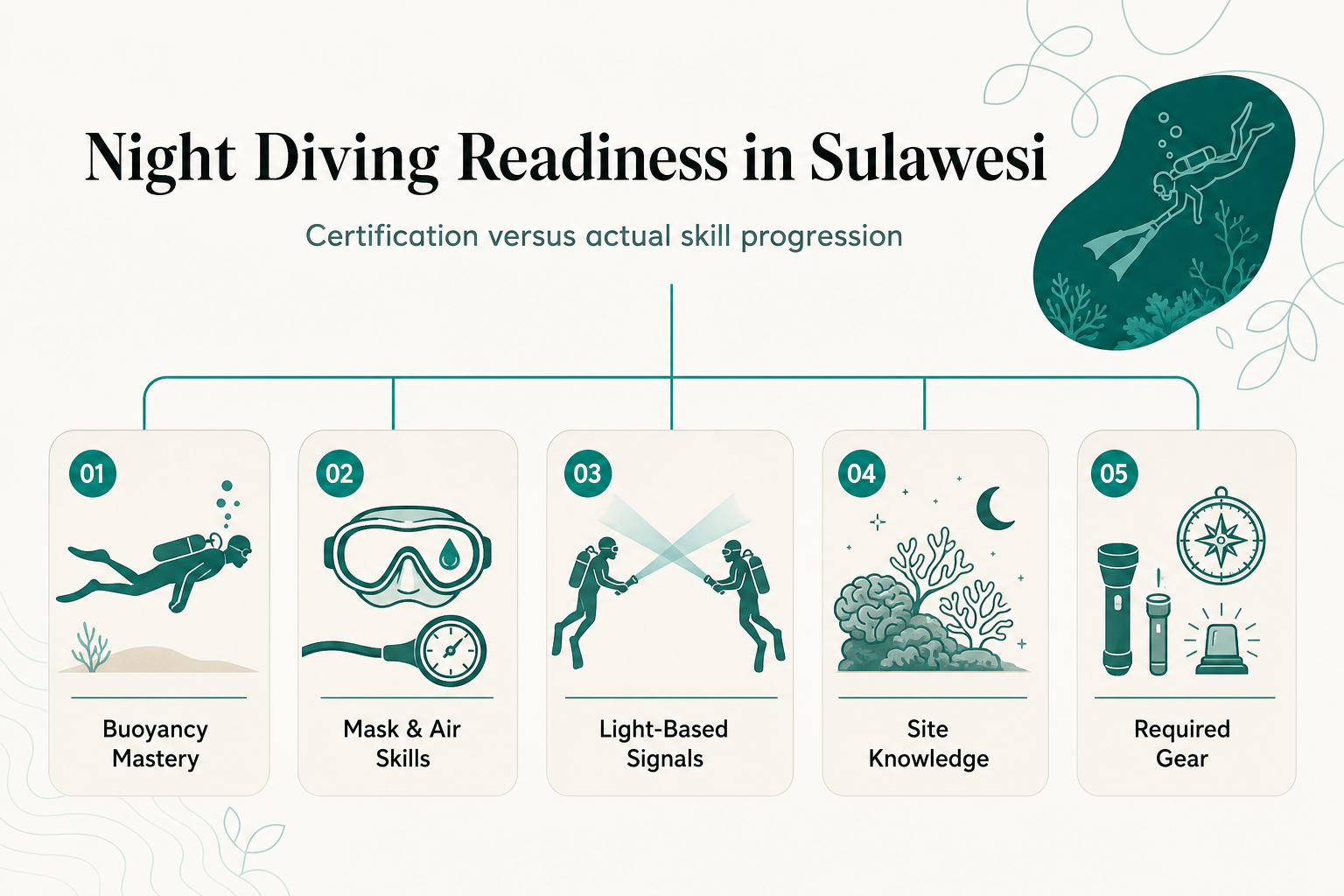
A diver is ready for a night dive once they can control buoyancy without looking at it, manage a mask flood without surfacing, and hold a stable position while thinking about something other than their own body position. Certification agencies set the formal bar lower than that. SSI and PADI only require an Open Water certification to enrol in a night diving specialty, with no mandatory minimum number of logged dives beyond that. Readiness, in practice, is a skill question, not a certification-card question, and the two don't always line up.
TL;DR
- SSI's Night Diving and Limited Visibility specialty requires a minimum age of 10, an Open Water certification, online academic sessions, and at least two open water training dives to a maximum depth of 30 meters.
- No major agency requires a minimum dive count beyond Open Water, but both PADI and SSI recommend daytime experience first.
- Visibility around Sulawesi's reefs averages about 30 meters.
- Required gear for a certified night dive: primary light, backup light, compass, and a marker/strobe light.
- Buka Buka Island's reefs sit a short boat ride from shore, keeping the focus on skill readiness rather than complex logistics.
What Does the Night Diving Certification Actually Require?
The SSI Night Diving and Limited Visibility specialty has a defined structure. It is not a vague add-on to Open Water; it is a course with its own academic and practical requirements.
- Minimum age: 10 years old.
- Prerequisite: Open Water Diver certification.
- Academic component: online sessions covering light behavior underwater, communication signals for darkness, and dive planning under limited visibility.
- Practical component: a minimum of two open water training dives, capped at a maximum training depth of 30 meters.
That structure tells you what the course teaches. It does not tell you when a diver is actually prepared to use those skills without a course guiding every step.
Why Does Certification Not Equal Readiness?
Certification confirms a diver has completed a defined set of academic sessions and training dives. It does not measure how that diver performs in conditions the course didn't script. Neither PADI nor SSI mandates a minimum number of logged dives before a night specialty, beyond the Open Water card itself.
Both agencies recommend daytime experience first, and that recommendation exists for a specific reason: night diving removes visual reference points a new diver still leans on without realizing it.
Think of it like driving a familiar road in daylight versus at night for the first time. The turns are the same. The car handles the same. What's gone is the peripheral information you didn't know you were using: the tree line, the shape of an oncoming intersection ahead of the headlights. A driver who has to relearn the road and the reduced visibility at the same time is task-loaded in a way that shows up as hesitation, overcorrection, or missed cues.
Underwater, that peripheral information is the horizon line, the surface glow, the silhouette of a reef wall in the distance. Take those away and a diver who hasn't yet automated buoyancy, trim, and air awareness is now doing three jobs instead of one. That's the gap the specialty course narrows but a single weekend of training dives can't fully close for everyone.
What Skills Should a Diver Have Mastered Before Going Night Diving?
Before booking a night dive, an instructor is really looking for automaticity, not just competence. The difference matters.
- Buoyancy control without conscious effort. If a diver still needs to check their depth gauge to know they're holding steady, night diving adds a distraction they can't afford.
- Mask clearing and flood recovery on the first try. A flooded mask at night, with a light in one hand, is a different problem than the same event in daylight.
- Comfortable air consumption at rest. Elevated breathing from anxiety burns through a tank faster and signals stress an instructor can't always see clearly in low light.
- Buddy awareness using light signals only. Hand signals rely on a beam pointed at the right place, not on catching a buddy's eye across open water.
- A logged track record of calm behavior during minor problems, like a fin strap coming loose or a slight current push, rather than a single clean dive that hasn't been tested.
A diver who ticks these boxes on their fifteenth dive is often more ready than one who technically qualifies on their fifth.
Why Is Sulawesi a Strong Place to Progress Into Night Diving?
Visibility around Sulawesi's reefs averages about 30 meters, and that consistency works in a diver's favor. Muck diving sites like the Lembeh Strait behave differently: the nutrient-rich water and dark volcanic sand there absorb torchlight and reduce effective visibility even when the water itself is clear.
Reef diving around the Togean Islands sits at the better end of that range, which is one reason a first night dive here feels more forgiving than a first night dive in murkier coastal water. A wide, well-lit beam meets less particulate resistance, and a diver can see their instructor's signal at a real distance instead of guessing at a shape in the gloom.
| Factor | What to look for |
|---|---|
| Buoyancy | Stable at a stop without watching the gauge |
| Mask skills | Flood and clear without surfacing |
| Air consumption | Calm breathing rate at rest, not elevated |
| Buddy signaling | Comfortable using light-based signals only |
| Site visibility | About 30 meters average around the Togean Islands |
| Required gear | Primary light, backup light, compass, marker light |
What Gear and Site Conditions Matter Most for a First Night Dive?
Standards for the specialty are specific on equipment, and they exist because a night dive with a single point of failure in the lighting system is a different risk profile than a daytime dive with the same failure. PADI and SSI both mandate four items: a primary dive light, a backup dive light, a compass, and a marker light for identification.
A first night dive works best on a reef the diver has already seen in daylight, ideally the same site, so the topography is familiar even when the color and detail aren't. Training dives around Buka Buka Island happen at reef sites reached by a short boat ride from shore, not a long open-water crossing.
Frequently Asked Questions
Is there a minimum number of dives required before a night dive certification?
No. Agencies require an Open Water certification but no specific logged dive count, though daytime experience beforehand is strongly recommended.
What's the minimum age for the SSI Night Diving specialty?
10 years old, alongside the Open Water Diver prerequisite.
How deep do night diving training dives go?
SSI's specialty caps training dives at a maximum depth of 30 meters, across at least two open water sessions.
Does murky water make night diving more dangerous?
It increases task load rather than danger directly. Reduced visibility, like the volcanic sand conditions in the Lembeh Strait, absorbs light and makes navigation and buddy contact harder.
About Reconnect
Reconnect is an island eco-resort on Buka Buka Island in the Togean Islands of Central Sulawesi, with an on-site SSI dive center offering guided dives and instruction in English, French, and Indonesian. Dive sites sit a short boat ride from the resort rather than a long transfer. The resort runs fully off-grid on solar power, with all-inclusive full-board stays from EUR 60 per night. Diving is one part of the experience alongside house-reef snorkeling, kayaking, and paddleboarding, all included in every stay. Get in touch through reconnect.id.