


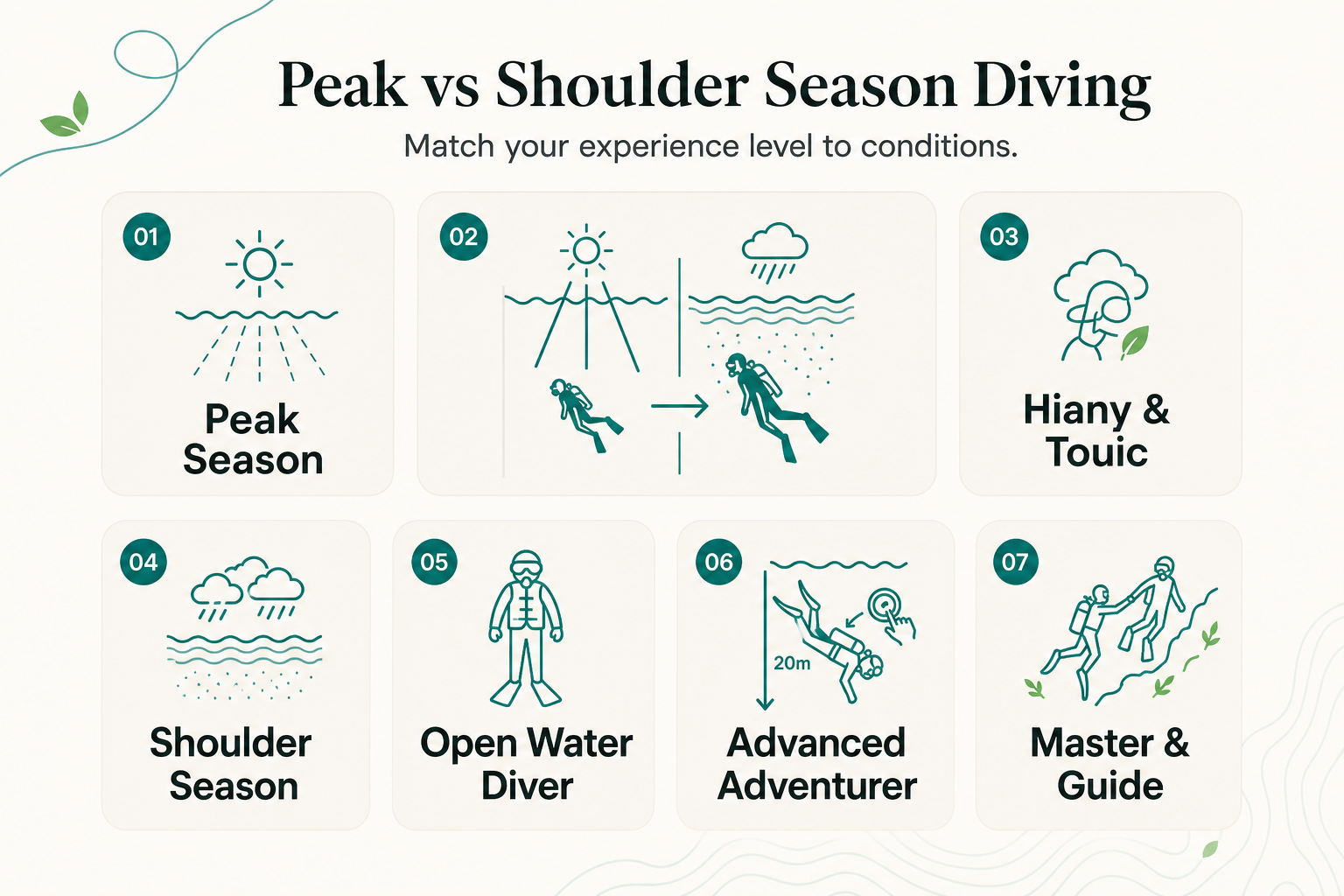
The best time to dive the Togean Islands depends less on the calendar and more on who is holding the regulator. Peak dry season (April to October) delivers calm seas, minimal rainfall, and visibility that consistently reaches 20 to 40 meters, which is why it suits newer divers building comfort underwater. Shoulder months carry a higher chance of choppy crossings and reduced visibility in shallow areas, conditions that experienced divers can read and adapt to but beginners generally cannot.
TL;DR
- Peak dry season (April-October): calm seas, minimal rain, best for Open Water and newly certified divers who need predictable conditions.
- Shoulder months (November-March, northwest monsoon): more rain and choppier water, but manageable and often rewarding for divers with Advanced Adventurer training or higher.
- Visibility around Buka Buka Island averages about 30 meters through most of the year, with dry-season days pushing toward the top of the wider 20-40m regional range.
- Certification level should drive your booking date more than price or crowd levels do.
- Training dives for courses happen at reef sites around Buka Buka Island, a short boat ride out, not on the house reef.
About the Author: Reconnect operates an SSI-certified dive center on Buka Buka Island in the Togean Islands, running guided dives and certification courses across both dry and monsoon months every year. This gives us a direct, season-by-season read on which conditions suit which experience level, rather than a generalized regional forecast.
What Actually Changes Between Peak and Shoulder Season Here?
Peak season in the Togeans runs April through October: dry, sunny, and calm. Shoulder and wet-season months, November through March, bring the northwest monsoon, which means more intermittent rain, higher humidity, and rougher sea conditions on the crossing out to dive sites.
This isn't a binary switch. Shoulder season doesn't mean storms every day, it means less predictability. A calm week in December can dive as well as a calm week in July. The difference is you can count on the July week; the December one is a gamble.
For visibility, the regional range sits at 20 to 40 meters in dry conditions, narrowing somewhat in shallower spots when wet-season runoff stirs sediment. Around Buka Buka Island specifically, we see visibility average about 30 meters across most of the year, which is why we quote that single figure to guests rather than a swinging range.
How Should a Beginner Diver Choose Their Timing?
A beginner here means Discover Scuba Diving through Open Water level, someone still building basic buoyancy and comfort before adding real-world variables like current or swell.
Industry standards from SSI and PADI are explicit on this: divers should only dive in conditions similar to or better than the ones they trained in. An Open Water diver trained in a calm pool and flat seas has no business managing a choppy afternoon crossing on their fourth ocean dive.
Why peak season fits beginners better:
- Calm seas make the 30-45 minute speedboat transfer to dive sites smoother and less stressful.
- Consistent visibility (toward the higher end of the 20-40m range) means less task-loading. A new diver isn't managing poor sightlines and buoyancy control at the same time.
- Predictable weather means fewer schedule disruptions to a multi-day course, where missed days compound quickly.
If you're booking Open Water certification, April through October removes variables you don't yet have the experience to manage. This isn't caution for its own sake, it's matching the environment to the skills you actually have logged.
When Does Shoulder Season Actually Work Better?
Shoulder season rewards divers who can read water instead of just following it. Advanced Adventurer divers and above, typically with 10 or more logged dives and some specialty training completed, have the skill margin to handle a rougher crossing or a site with reduced visibility without it becoming a safety issue.
There's a practical upside too: shoulder season means fewer boats at popular sites, and reef life doesn't disappear when the rain does. Pinnacles around Una Una and the fringing reefs near Buka Buka still hold schooling barracuda, pygmy seahorses, and bumphead parrotfish through the wet months. What changes is how much patience the conditions demand of the diver, not what's living on the reef.
Shoulder season travel more broadly is defined by this same tradeoff: moderate conditions and fewer crowds in exchange for more variability [celebritycruises.com][cluballiance.aaa.com]. Divers who already have the certification and comfort in the water can lean into that tradeoff. Beginners generally can't yet, because they don't have the reference points to know when conditions have shifted from "manageable" to "not for me today."
How Does This Map to SSI Certification Levels Specifically?
Depth limits set by SSI and PADI give a useful proxy for how much environmental variability a diver is trained to handle: Open Water divers to 18 meters, Advanced divers to 30 meters, Deep Divers to a maximum of 40 meters. More depth training generally correlates with more exposure to current, thermoclines, and visibility swings, which is exactly what shoulder season adds.
| Certification Level | Typical Logged Dives | Best-Suited Season | Why |
|---|---|---|---|
| Discover Scuba / Open Water | 0-10 | Peak (Apr-Oct) | Still building basic buoyancy and comfort; needs predictable conditions |
| Advanced Adventurer | 10-24 | Peak, transitioning into early/late shoulder | Comfortable to 30m, starting to handle mild current and lower visibility |
| Master Diver / Dive Guide track | 40-50+ | Peak or shoulder | Enough logged experience to read changing conditions and adjust the dive plan |
Our SSI dive center runs the five-dive Advanced Adventurer course at reef sites around Buka Buka Island, a short boat ride out rather than off the house reef, specifically because those sites offer the depth and current variation the course is built to teach. Instruction is available in English, French, and Indonesian, in small groups.
One honest caveat: Advanced Open Water Diver is not something you book. It's an SSI recognition rating awarded automatically once a diver logs 24 dives and completes four specialties. The bookable course after Open Water is Advanced Adventurer, five dives, and it's worth doing before you plan a shoulder-season trip if you're currently sitting at Open Water level. Master Diver and Dive Guide sit further along that path, requiring 40 to 50 logged dives depending on the track, which is why they represent divers with enough seasoning to handle either season.
What Should You Actually Do With This Information?
Step 1: Count your logged dives honestly. Under 15-20 dives with no specialty training, book peak season. The margin for error you need doesn't exist yet in shoulder-season conditions.
Step 2: Match your course goals to the season. Planning to complete Advanced Adventurer? Peak season gives you calmer water to focus on skills rather than conditions. Note that the course itself is booked and paid separately from your stay, it isn't bundled into an all-inclusive rate.
Step 3: If you're experienced, use shoulder season deliberately. Fewer boats at sites, same reef life, and rates that often reflect the quieter months. This is where the tradeoff genuinely favors you.
Transfers into the Togeans run through Luwuk Airport, the reliable gateway, with a private car to Ampana (5 hours) and a speedboat crossing to the island (30-45 minutes). We coordinate that full transfer regardless of season, but sea conditions on the speedboat leg are naturally calmer in dry months, which is one more reason beginners should lean peak season for their first trip.
Frequently Asked Questions
Does Reconnect close during shoulder season?
No. The resort operates year-round, and diving continues through the northwest monsoon months with adjusted site selection based on daily conditions.
Can I still snorkel the house reef in shoulder season?
Yes, house-reef snorkeling is complimentary for all guests year-round and doesn't require the boat crossing that open-water dive sites do.
Is peak season more expensive?
Pricing at Reconnect starts from EUR 60/night all-inclusive full-board across the year; broader seasonal demand patterns can affect availability more than rate.
How much notice do I need to book a course around season?
Courses run in small groups, so booking ahead matters more in peak months (April-October) when demand for Open Water certification is highest.
What if bad weather hits mid-course during shoulder season?
Course schedules can extend by a day if sea conditions require it. This is one reason experienced instructors, not calendar dates alone, make the final call on whether a training dive proceeds.
About Reconnect
Reconnect is an island eco-resort with an on-site SSI dive center on Buka Buka Island in the Togean Islands, running 93% on solar power with on-site desalinated water and zero single-use plastics. All-inclusive full-board stays start from EUR 60/night, with guided dives, courses in English, French, and Indonesian, and house-reef snorkeling available to every guest. The dive center holds Blue Oceans certification and works with locally hired staff and neighboring village suppliers.
If you're weighing your own experience level against the season, get in touch through reconnect.id and we'll help you pick dates that match your logbook, not just the forecast.
References
- What Is Shoulder Season? Travel Guide | Celebrity Cruises (celebritycruises.com)
- The Ultimate Guide to Shoulder Season Travel | AAA Club Alliance (cluballiance.aaa.com)