


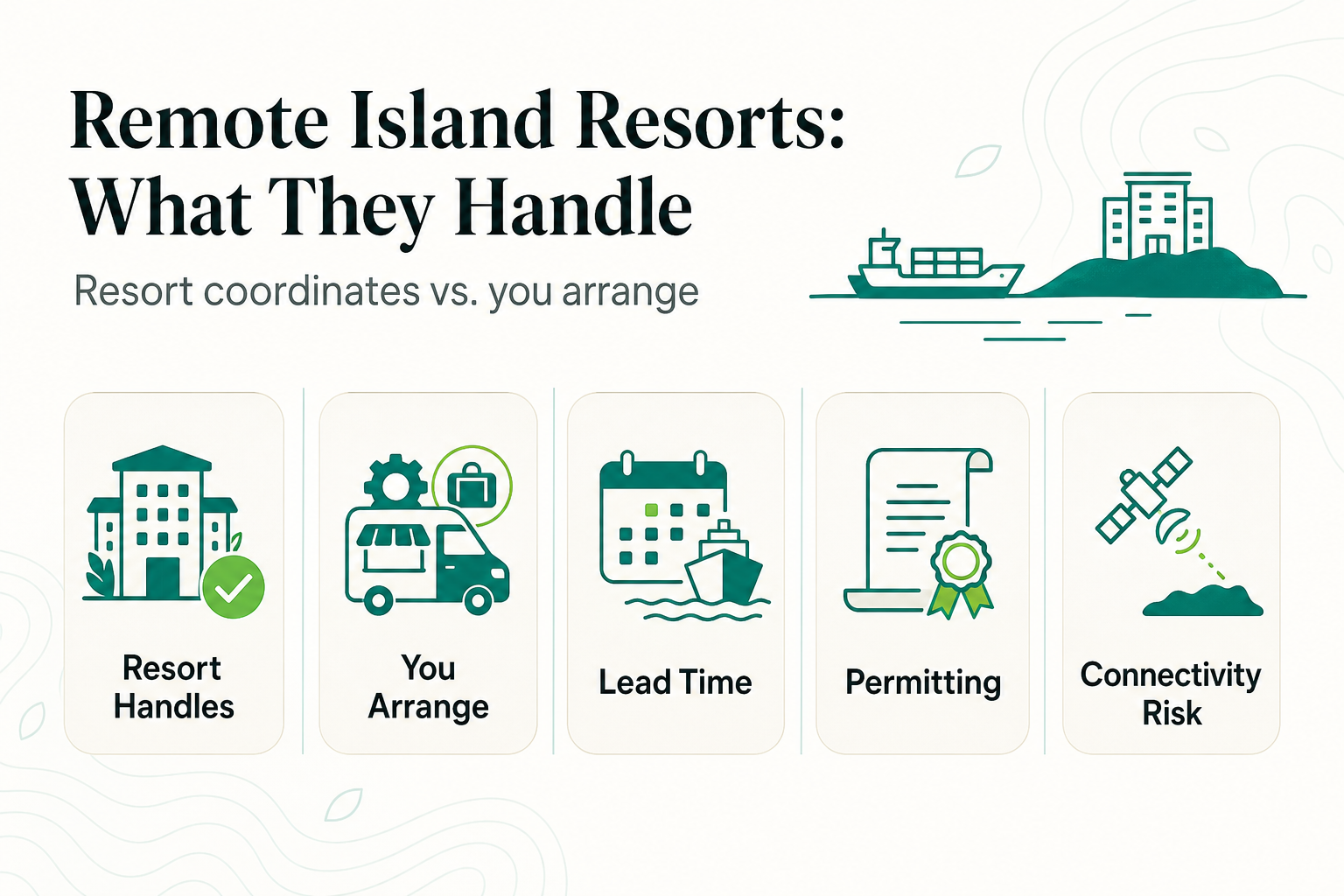
A remote island resort can handle your meals, rooms, boat transfers and a barefoot ceremony spot. It cannot source a florist flying in fresh stems, manage a live-stream feed, or file your paperwork on short notice. Knowing that split before you book is what separates a vow renewal that runs smoothly from one that stalls at the permit stage or the internet connection.
TL;DR
- Remote resorts typically cover venue, in-house catering, basic decor and a day-of coordinator on site. Specialized vendors (photography, floristry, hair and makeup) usually need to be arranged separately.
- Logistics for remote islands run on 12 to 18 month lead times because of freight schedules, temporary infrastructure and equipment shipping.
- Indonesia's Togean Islands require an Izin Keramaian (public crowd permit) for formal events, plus a valid business license (SIUPAR) on the operator side.
- Connectivity gaps mean offline planning tools and realistic expectations around coordination, not last-minute vendor calls.
- A vow renewal checklist for a remote island should separate "resort handles this" from "you arrange this" before a single deposit is paid.
About the Author: This article draws on Reconnect's operational experience running an off-grid, 20-room island eco-resort in Indonesia's Togean Islands, where guests have hosted vow renewals and private celebrations without a dedicated wedding planner on site.
What Can a Remote Island Resort Actually Coordinate?
A remote resort without a wedding department can still deliver the core mechanics of a ceremony: a physical setting, food, accommodation and someone on the ground managing the day's schedule. Destination venues generally provide in-house catering, basic decor and a day-of coordinator to run venue logistics. That is the baseline you should expect anywhere, island or not.
What sits inside that baseline changes a lot depending on scale. A resort with a restaurant kitchen and a small team can plate a private dinner on the beach. It cannot, on its own, produce a five-tier cake, a live band or a custom floral installation, because those require specialized vendors that destination venues typically do not carry in-house.
On a remote island specifically, the resort's in-house capacity usually covers:
- The ceremony site itself (beach, jetty, garden) and basic setup
- Full-board meals and a private dinner setting
- Accommodation for the couple and any guests traveling with them
- Boat transfers between the mainland gateway and the island
- A staff member coordinating the day's timeline on site
Anything beyond that, specialized photography, a hair and makeup artist, custom decor beyond what's on hand, falls to external vendors who need to be sourced, briefed and flown or shipped in.
Why Do Remote Islands Need So Much Lead Time?
Coordinating events on remote islands typically requires 12 to 18 months of lead time to manage complex logistics constraints. That includes importing equipment, securing temporary infrastructure like marquees or generators, and working around limited sea or air freight schedules.
A florist on a mainland city can drive to a wholesale market the morning of an event. On a remote island, flowers must survive a flight and a speedboat crossing, and freight boats don't run daily. If a shipment misses its slot, there often isn't another one for a week.
What this means for your planning calendar:
- Anything shipped in (specialty decor, printed materials, imported equipment) needs to be ordered and freighted months ahead, not weeks
- Temporary infrastructure, like a marquee or backup generator capacity, has to be requested and confirmed well before arrival
- Vendors traveling to the island need their own transfer logistics booked alongside yours
A resort that is already all-inclusive and self-sufficient reduces some of this pressure. Reconnect, for instance, runs 24/7 solar power with battery backup and produces its own desalinated drinking water on-site, so a ceremony dinner doesn't depend on a fuel delivery or a municipal water truck arriving on schedule. That removes two of the more fragile dependencies from the list, but it doesn't remove the need to plan a florist's freight schedule months out.
What Permits and Paperwork Does an Island Ceremony Actually Need?
A vow renewal is not a legal marriage, which simplifies some of the paperwork, but hosting any formal gathering in the Togean Islands still requires clearing local permitting. Formal events here require an Izin Keramaian, a public crowd permit issued by local police. On the operator side, the venue itself needs to hold a valid business license, typically a SIUPAR (Surat Izin Usaha Pariwisata, or Tourism Business License) or a TDUP, to legally host commercial events.
This is where a resort without a dedicated event department earns its keep or falls short. A property that already operates as a licensed hospitality business can request the crowd permit as a routine part of hosting your event. A property operating informally, or a rented private villa with no formal licensing, puts that burden back on you or your guests, often with far less local knowledge of who to file with.
Before booking, ask directly:
- Does the resort hold a SIUPAR or TDUP?
- Has the resort filed an Izin Keramaian for a group event before?
- Who is responsible for filing it, the resort or you?
Get this in writing. A verbal "we'll handle it" is not the same as a named person with a filing history.
How Do Connectivity Gaps Change the Planning Process?
A related but distinct problem is communication, both during planning and on the day itself. Remote island resorts in Indonesia frequently experience unreliable internet and cellular blank spots, often relying on limited satellite connections. That forces coordinators toward offline planning tools and limits real-time contact with off-island vendors.
Practically, this means confirming details with a videographer or florist by email weeks in advance, not by phone call the night before. If a vendor needs a same-day answer about weather or timing, a weak connection can turn a five-minute decision into a half-day delay.
Reconnect runs Starlink connectivity throughout the resort alongside its off-grid solar setup, which is a genuine departure from the blank-spot experience common elsewhere in the archipelago. With that kind of high-speed connection, tasks that would otherwise be impractical elsewhere, like live-streaming a ceremony for family who couldn't travel, become realistic. It doesn't eliminate the broader lesson for resorts without this infrastructure: plan for slower turnaround with anyone off-island, and build a buffer day into your schedule rather than counting on same-day fixes.
What Should Be On Your Vow Renewal Checklist?
Pulling the previous sections together, a vow renewal checklist for a remote island resort needs two columns, not one: what the resort handles, and what you or an outside vendor need to arrange.
| Task | Resort typically handles | You typically arrange |
|---|---|---|
| Ceremony site and basic setup | Yes | - |
| Meals and private dinner | Yes | - |
| Accommodation and transfers | Yes | - |
| Day-of timeline coordination | Yes | - |
| Photography/videography | No | Yes |
| Floral design beyond on-site greenery | No | Yes |
| Hair and makeup | No | Yes |
| Crowd permit (Izin Keramaian) | Depends, confirm in writing | Depends |
| Live-stream for absent family | Depends on connectivity | Confirm infrastructure in advance |
An eco-friendly wedding venue built for off-grid living, like a solar-powered island resort, naturally limits some vow renewal ceremony ideas that assume unlimited power draw or daily freight access. A live band with heavy equipment, for instance, or elaborate lighting rigs may not be feasible. It also opens up others: a barefoot beach ceremony at sunset, a house-reef snorkel the morning after, a private dinner lit by what the resort already runs on solar. The honest move is matching your ceremony concept to what the location can actually sustain, not the other way around.
Frequently Asked Questions
Do I need a wedding planner for a vow renewal on a remote island?
Not necessarily. If the resort has in-house coordination, catering and transfer logistics, you can manage vendor bookings yourself, provided you start early given the 12-to-18-month lead times typical of remote locations.
Can an eco-resort host a legal vow renewal ceremony?
A vow renewal isn't a legal ceremony, so no marriage license is required. Formal gatherings still need local permitting, such as Indonesia's Izin Keramaian, regardless of venue type.
How far in advance should I book vendors for an island ceremony?
Specialized vendors like photographers or florists should be booked at least 12 months out. Floral shipments in particular need to be scheduled around the limited sea and air freight frequency to remote islands, while photographers typically just need their travel and accommodation arranged.
Will I have internet access to coordinate with vendors during the trip?
It depends entirely on the resort. Many remote islands have unreliable or no connectivity; a resort with dedicated connectivity infrastructure like Starlink is the exception, not the rule.
What's the biggest planning mistake couples make with remote island venues?
Assuming resort staff can source specialized vendors on short notice. In-house teams typically manage venue logistics and catering, not external hair, makeup or floral sourcing.
Reconnect
Reconnect is an island eco-resort in the Togean Islands with 20 rooms, Starlink connectivity, and an on-site SSI dive center. Book full-island privatization for vow renewals with all meals and transfers included. Learn more at Reconnect.