


If your last dive was more than a year ago, the safe path back is a structured refresher, not a straight jump into open water. Diving safety organizations generally recommend a refresher after 6 to 12 months out of the water: PADI sets the marker at 6 months, SSI at a year. Skills like buoyancy control, mask clearing and emergency response degrade quietly during long breaks, and a short in-water session with an instructor is the standard way to rebuild them before you're back on a reef around Buka Buka Island.
TL;DR
- Refresh after 6-12 months of inactivity: PADI recommends 6 months, SSI recommends a year.
- An SSI Scuba Skills Update pairs an academic review with an in-water session covering buoyancy, mask skills and emergency procedures.
- Certification still counts after a break. What needs rebuilding is muscle memory and comfort, not paperwork.
- Reconnect's SSI dive center runs refreshers and guided dives at reef sites around Buka Buka Island.
- Visibility in the Togean Islands averages about 30 meters.
What Actually Happens to Diving Skills During a Long Break?
Certification doesn't expire. What fades is muscle memory: the automatic hand movements for clearing a mask, adjusting buoyancy, or handling a regulator free-flow without hesitation.
Think of it like riding a bicycle in choppy traffic after years away from the road. You remember the theory instantly, but your reflexes need a few minutes to catch up before conditions get demanding.
That gap between knowledge and reflex is exactly what a refresher targets. It's not a re-test of your certification. It's a supervised tune-up of the physical skills that only stay sharp through repetition.
Industry-standard protocols for returning divers require an entry-level certification on file and a basic medical screening before any refresher begins. From there, programs like SSI's Scuba Skills Update and PADI's ReActivate follow the same shape: an academic knowledge review, then a confined or shallow open-water session to practice buoyancy control and emergency procedures before any deeper dive.
How Do You Choose the Right Refresher Course?
Not every returning diver needs the same amount of rebuilding. The right choice depends on how long you've been out and how confident you feel with the basics.
| Time since last dive | Recommended step | What it typically covers |
|---|---|---|
| Under 6 months | Optional self-check | Review your logbook, and do an easy first dive at a familiar, shallow site |
| 6-12 months | Refresher strongly advised | Academic review plus shallow skills practice |
| Over 12 months | Refresher required by most operators | A full skills update or refresher session, such as SSI's Scuba Skills Update, before any guided dive |
| Several years | Refresher plus a guided check-out dive | Extended in-water session, instructor accompanies first 1-2 dives [dan.org] |
A refresher is not a downgrade of your ability. It's the same logic as a pilot doing a check flight after months away from the cockpit: the license is still valid, but a supervised run-through catches anything rusty before it matters.
What Does an SSI Refresher Course Actually Involve?
An SSI Scuba Skills Update is built around two parts: a short academic review and a supervised in-water session.
The academic portion resets your understanding of dive tables, buoyancy principles and emergency signals.
The in-water portion is where the real rebuilding happens.
Expect an instructor to walk you through:
- Mask removal and clearing at depth
- Regulator recovery and clearing
- Buoyancy control using your BCD and breathing
- Basic emergency ascent procedures
- Weight checks, since body composition and gear can change between trips
None of this requires re-sitting your original certification exam. It's a supervised practice session, typically completed in under half a day, before you join a guided dive at a real site.
How Does This Apply to Diving Buka Buka Island Again?
If your return dive is happening around Buka Buka Island, the conditions work in your favor. Visibility in the Togean Islands averages about 30 meters.
A returning diver gets more margin to reorient, spot a dive buddy, and read the reef without the added stress of murky water.
Easy visibility is not a substitute for skills practice. A refresher still comes first.
At Reconnect, training and refresher dives happen at reef sites around Buka Buka Island, reached by a short boat ride from the resort. They never happen on the house reef, which is reserved for complimentary snorkeling. Instruction is available in English, French and Indonesian.
Depth limits matter too. Current safety guidelines cap Open Water divers at 18 meters and Advanced Adventurer divers at 30 meters, with an absolute recreational ceiling of 40 meters reserved for Deep Diver specialists.
A returning diver rebuilding confidence should plan a first dive well inside their certified depth, not at the limit of it.
What Comes After the Refresher: Rebuilding Toward Advanced Certification?
Once your fundamentals are solid again, some divers use the trip to progress rather than just restore. The step after Open Water Diver is the Advanced Adventurer course: five specialty training dives, including Deep Diving and Navigation.
This is a distinct, bookable course, separate from the Advanced Open Water Diver rating, which SSI awards automatically once a diver logs four specialties and 24 dives total.
For a returning diver, sequencing matters:
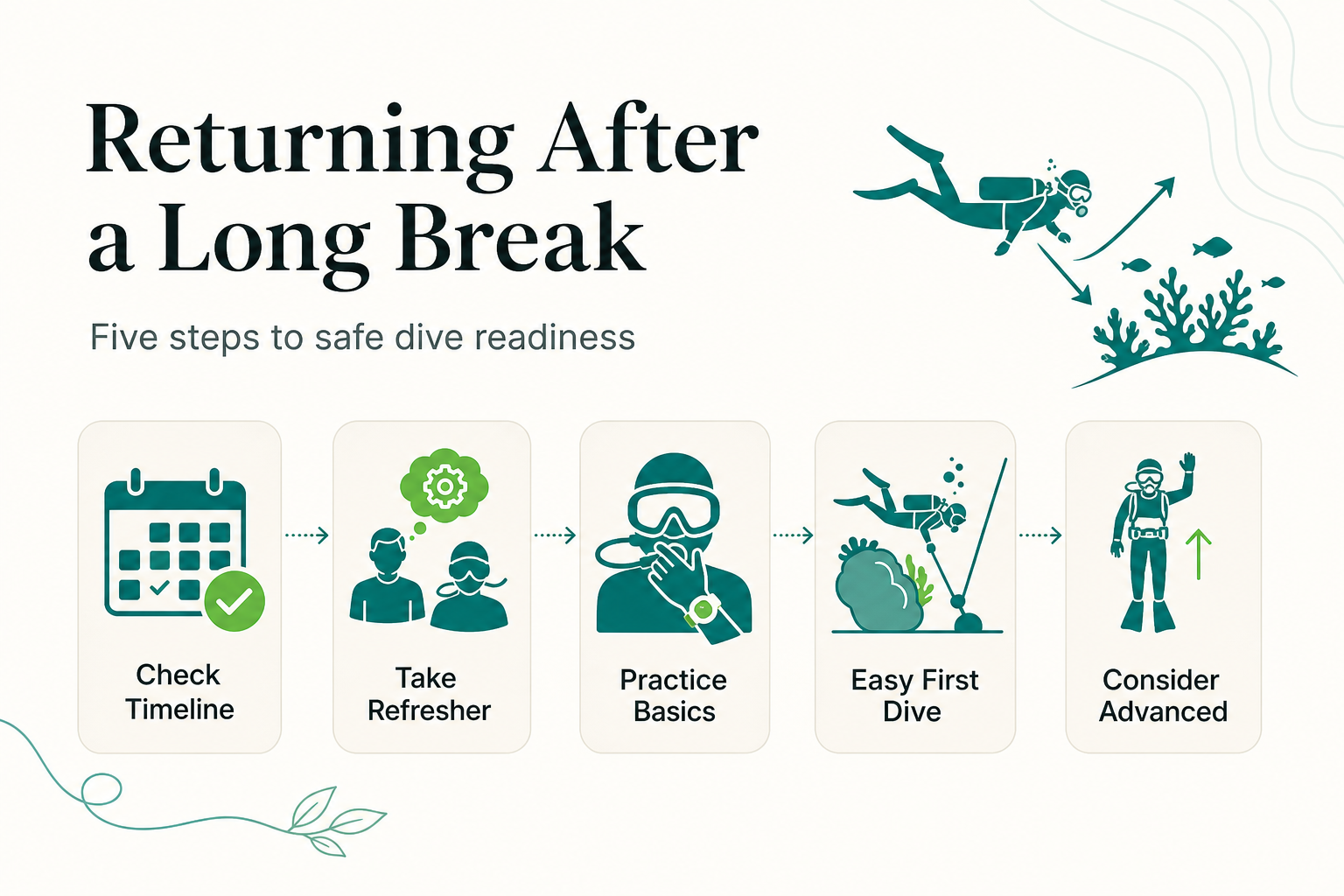
- Complete the refresher first, regardless of certification level.
- Log 1-2 easy dives at familiar depths to rebuild comfort.
- Only then consider Advanced Adventurer specialty dives, which push depth and navigation skills further.
Dive courses are booked and paid for separately from a resort stay. At Reconnect, the all-inclusive full-board rate covers meals, house-reef snorkeling, kayaking and paddleboarding, but course fees sit outside that rate. Guided dives are bundled into the Dive-cation package instead.
Frequently Asked Questions
Is it safe to dive again after a multi-year break without any refresher?
Not recommended. Most operators, including SSI-affiliated centers, require a documented refresher or recent dive log before booking a guided dive after a year or more of inactivity.
Does a refresher course replace my original certification?
No. Your original certification remains valid for life. The refresher rebuilds practical comfort and skill sharpness; it doesn't retest or reissue your credential.
Can beginners and returning divers train together?
Generally no. Refreshers focus on skill recovery for certified divers, while Discover Scuba Diving and Open Water courses start from zero. Small-group setups, like Reconnect's, typically separate the two.
What's a realistic first dive back at Buka Buka Island?
A shallow reef dive within your original depth limit, guided by an instructor, ideally during the dry season (April to October) when visibility around 30 meters is most consistent.
Do I need new gear after a long break?
Not necessarily, but a weight check is standard practice, since body composition and wetsuit fit can shift the amount of weight you need for neutral buoyancy.
About Reconnect
Reconnect is a private island eco-resort in the Togean Islands with an on-site SSI dive center. Fully off-grid and solar-powered, the resort offers refresher training and guided reef dives around Buka Buka Island. Get in touch through reconnect.id.