


Most travel insurance policies were written for lost luggage and cancelled flights, not for a medical emergency two hours by boat from the nearest hospital. In the Togean Islands, that gap matters more than almost anywhere else in Indonesia. A standard travel policy and a dive-specific policy cover different risks, and knowing which one pays for what before you plan a remote island trip can be the difference between a covered evacuation and a five-figure bill paid out of pocket.
TL;DR
- Standard travel insurance covers trip cancellation, lost baggage, and general medical care, but most exclude scuba diving beyond set depth limits or without a certified instructor [resident.com].
- Dive-specific insurance (DAN or equivalent) covers diving injuries, hyperbaric chamber treatment, and dive accident costs that general policies typically exclude [insurance-indonesia.com].
- The Togean Islands have no hyperbaric chamber locally; the nearest ones are in Palu, Manado, or Makassar, so evacuation coverage is not optional here.
- Emergency evacuation from a remote island can run into the tens of thousands of dollars without insurance, driven by speedboat-to-air-ambulance logistics.
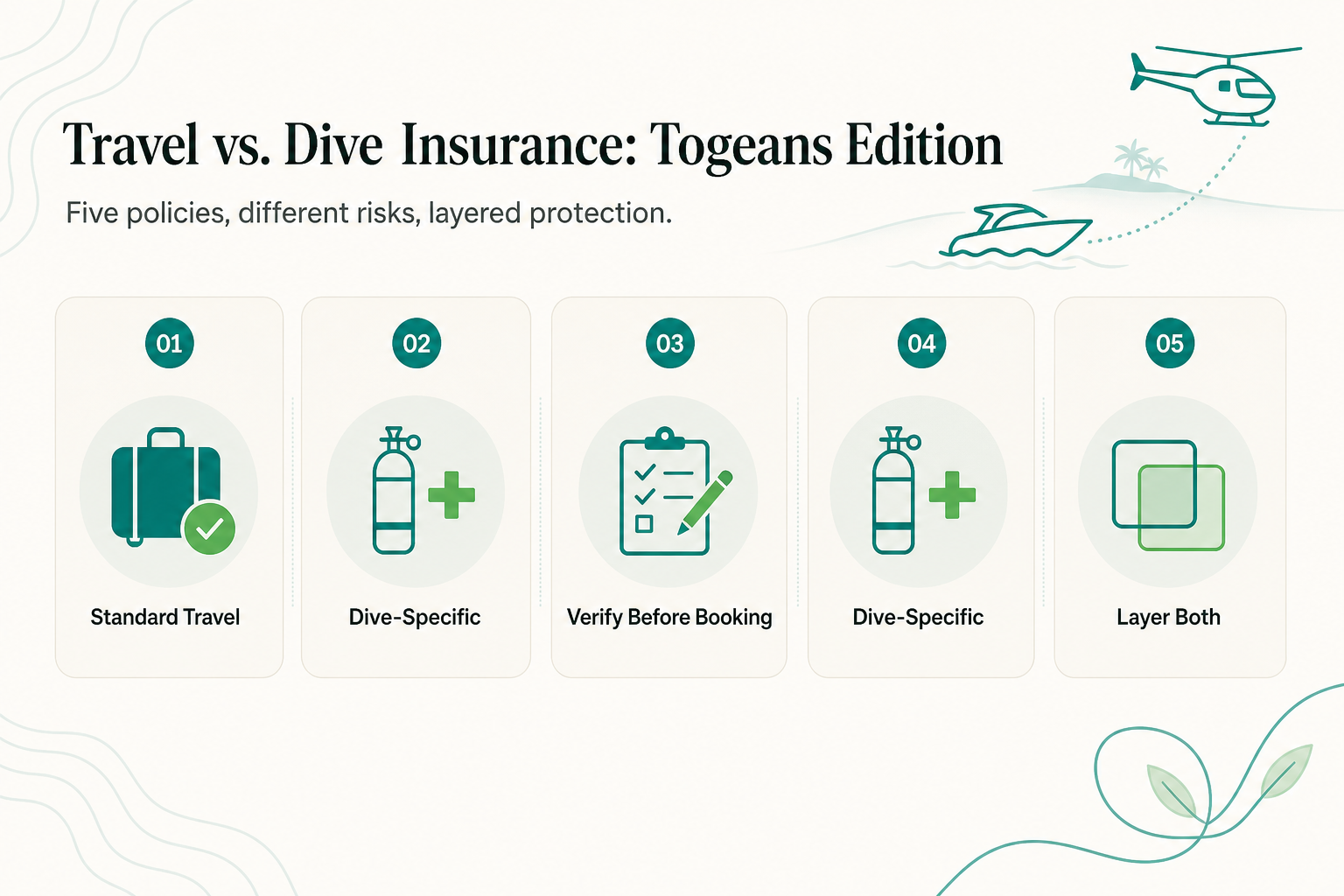
- The safest approach for divers is layering both policy types rather than relying on one.
What Does Standard Travel Insurance Actually Cover for Indonesia?
Standard travel insurance is built around trip logistics, not underwater risk. It typically covers trip cancellation, interruption, lost or delayed baggage, and general emergency medical treatment for illness or injury unrelated to diving [uhc.com].
For Indonesia specifically, entry requires a passport valid at least six months, an onward ticket, a valid e-Visa or visa-free entry, and a completed digital arrival card within 72 hours of landing. Mandatory COVID-19 insurance is no longer required, but comprehensive medical coverage is strongly recommended given the country's dispersed healthcare infrastructure.
Most general travel policies exclude scuba diving beyond a set depth, commonly between 30 and 50 meters. They exclude diving without a certified instructor present, professional or commercial diving activity, and medical evacuation and hyperbaric chamber treatment unless you've added a specific adventure sports rider.
That last point catches people out. A policy can look comprehensive on paper and still exclude the exact scenario a remote island trip is most likely to produce: a diving injury requiring evacuation from a location with no road access.
Why Doesn't General Travel Insurance Cover Diving Well?
Insurers price a policy based on the statistical risk of the activities it covers. Diving sits in a different risk category than sightseeing or hiking. General travel insurers build their standard product around low-severity, high-frequency claims: missed connections, delayed bags, food poisoning.
Diving injuries are the opposite: low-frequency but potentially very high-severity, involving hyperbaric treatment, air ambulance transport, and specialist care. Rather than price that risk into every policy, insurers carve it out and sell it separately as a rider, or exclude it entirely.
This is why "travel insurance" and "dive insurance" serve different purposes. One protects the trip. The other protects you in the water.
What Does Dive-Specific Insurance Cover That General Policies Don't?
Dive accident insurance is built specifically around the risk profile that general travel insurance excludes: decompression sickness, arterial gas embolism, and other diving-related injuries requiring specialist treatment.
DAN (Divers Alert Network) dive insurance is the best-known example. It is frequently recommended alongside a separate general travel policy rather than as a replacement for one.
Dive-specific coverage typically adds:
- Hyperbaric chamber treatment costs, which general policies often exclude
- Dive accident medical expenses, including specialist evaluation and treatment
- Emergency medical evacuation specifically triggered by a diving incident
- In some policies, coverage that follows you regardless of which operator you're diving with
Most established dive operators in the country request proof of coverage before a guest dives. This reflects how thin the medical safety net actually is once you're away from a major city.
Why Does Medical Evacuation Coverage Matter More in the Togean Islands Specifically?
The Togean Islands are remote by design, and that remoteness makes evacuation coverage non-negotiable rather than optional. There is no hospital on the outer islands. The nearest basic hospital is in Ampana, roughly two to three hours by boat, and it is not equipped for serious trauma or decompression cases.
The closest hyperbaric chambers and advanced hospital care are in Palu, Manado, or Makassar, all of which require an additional flight after the initial boat transfer. That two-stage logistics chain (speedboat first, then air ambulance) drives evacuation costs into the tens of thousands of dollars for uninsured travelers.
Standard travel insurance figures often quoted for Indonesia trips recommend at least $100,000 in emergency medical coverage and $250,000 in emergency evacuation coverage. These amounts are calibrated for exactly this kind of remote-location scenario [americanvisitorinsurance.com].
At Reconnect, this reality shapes how we brief guests before any dive. Visibility around Buka Buka Island averages about 30 meters, and our SSI instructors run training dives at reef sites reached by short boat rides from the resort. We are direct with guests about the distance to a hospital and the importance of evacuation coverage during check-in.
How Should You Actually Compare Travel Insurance Policies Before a Togean Trip?
The comparison that matters is coverage triggers: what specifically activates a payout, and what specifically excludes one.
| Coverage type | What it typically includes | What it typically excludes |
|---|---|---|
| Standard travel insurance | Trip cancellation, baggage, general illness/injury [uhc.com] | Diving beyond depth limits, evacuation for dive incidents [resident.com] |
| Dive-specific insurance (e.g. DAN) | Dive accident treatment, hyperbaric care, dive-triggered evacuation [insurance-indonesia.com] | Non-diving trip disruptions (cancellation, baggage) |
| Operator-required policy | Minimum medical + dive coverage to join trips | Varies significantly; always confirm evacuation limits |
Before booking a policy, check three things directly against the policy wording:
- Depth limit for diving coverage. Confirm it covers recreational depths you'll actually reach, typically to 30 or 40 meters for Open Water and Advanced Adventurer-level diving.
- Evacuation trigger and dollar cap. Confirm evacuation coverage explicitly includes remote-location transport, not just general medical evacuation.
- Whether a rider is needed. Many general policies require an add-on for adventure sports or scuba diving specifically.
Trip interruption and cancellation coverage remains useful for remote travel logistics: missed connections through Luwuk or Ampana, delayed onward transfers, or a cancelled leg before you reach the boat. That is a separate value from dive accident coverage, which is why most experienced Indonesia divers carry both rather than choosing one over the other.
Frequently Asked Questions
Do I need dive insurance if I'm only snorkeling in the Togeans, not diving?
No. Dive accident insurance is priced and designed around scuba-specific injuries like decompression sickness. Snorkeling is covered under general travel and medical insurance policies.
Can I buy dive insurance after I arrive in Indonesia?
Yes. Insurers such as DAN offer short-term dive insurance that can be purchased after you arrive, with coverage starting as soon as payment is processed. It cannot cover an incident that already happened before you signed up, so it is still best to arrange it early.
Does Reconnect require proof of insurance before diving?
Guests booking dives or courses through our on-site SSI dive center are asked about insurance coverage as part of standard pre-dive procedure.
About Reconnect
Reconnect is a private island eco-resort on Buka Buka Island in the Togean Islands, with an on-site SSI-certified, Blue Oceans dive center. We coordinate full transfers from Luwuk Airport and ask every diving guest about insurance coverage before they enter the water. Visit reconnect.id to check availability.
References
- Indonesia insurance and destination guide | UnitedHealthcare (uhc.com)
- Diving Insurance Indonesia 2026: Best Coverage for Scuba Divers - Insurance Indonesia (insurance-indonesia.com)
- Travel Insurance Tips: Best Coverage for Indonesia Adventures (resident.com)
- Best travel insurance Indonesia from USA 2026 | Best travel health insurance for Indonesia cost (americanvisitorinsurance.com)