


Choosing between a villa, a hut, or a glamping tent in Indonesia comes down to one question: how much privacy and comfort do you want to pay for, and how much do you want to spend your days outdoors instead of in a room? Villas suit travelers who want space, air conditioning, and sometimes a private pool. Huts suit budget-conscious travelers who mainly want a bed near the water. Glamping tents sit in between: real beds and proper bathrooms, but a canvas or thatch structure that keeps you closer to the island itself. The right choice depends less on budget alone and more on how you actually plan to spend your days.
TL;DR
- Villas typically range from $400-800/night for luxury overwater options, built for privacy and climate control.
- Huts are the budget entry point, often starting around $20-30/night, with simpler shared facilities.
- Glamping tents bridge the gap: proper bathrooms and real beds, formally classified in Indonesia under KBLI 55209 for short-term accommodation.
- Reconnect offers 8 room types across villa, hut, and glamping styles, from EUR 60 to EUR 175/night.
- Air conditioning is rare across Togean Islands resorts generally; confirm before booking if climate control matters to you.
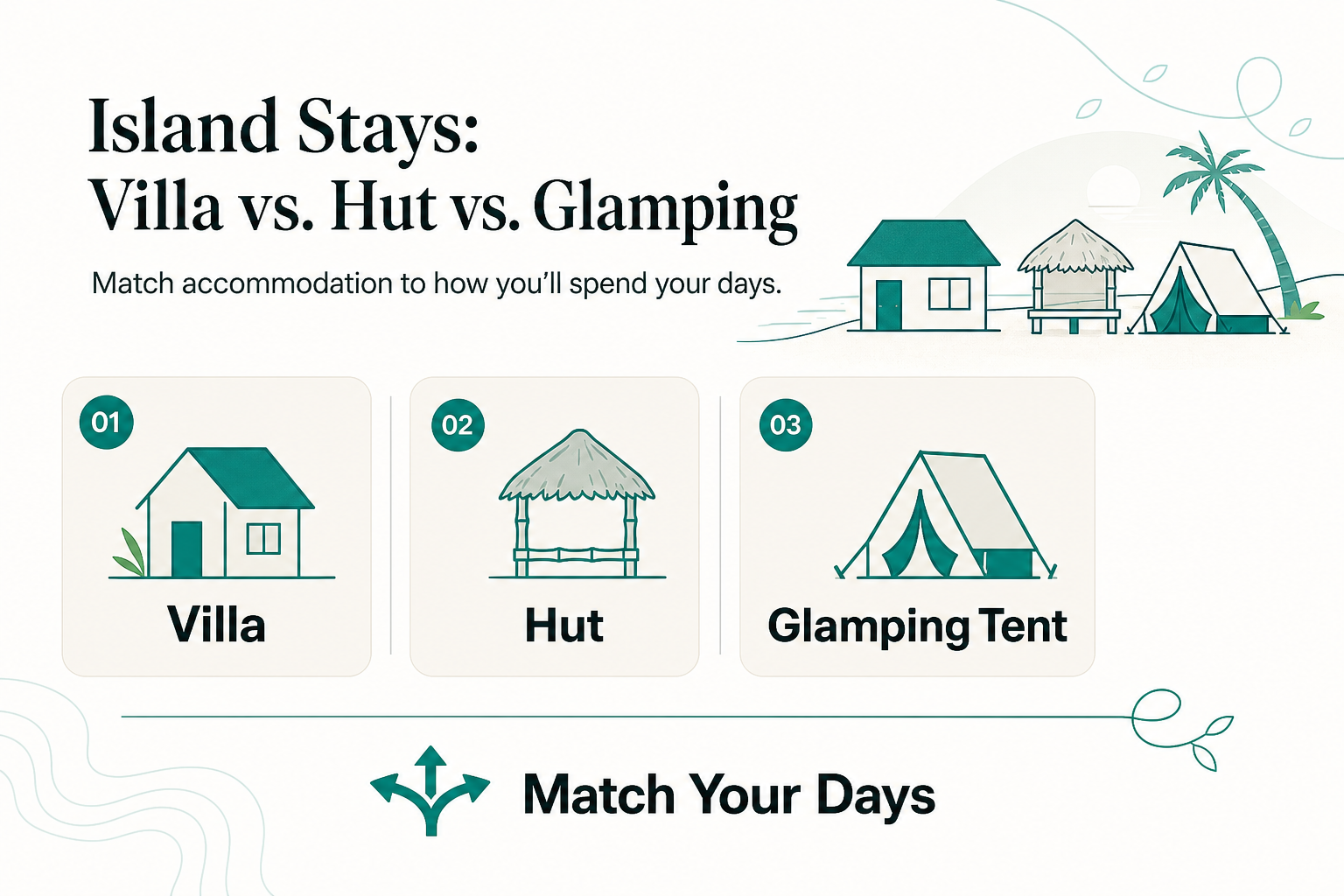
What's the Actual Difference Between a Villa, a Hut, and a Glamping Tent?
A villa is a standalone private building, usually with solid walls, an enclosed bathroom, and often air conditioning. Luxury overwater villas elsewhere in Indonesia run $400-800 per night. A hut is simpler: a small wooden or bamboo structure, often with shared or semi-open bathroom facilities, historically the budget option on backpacker islands starting around $20-30 per night.
Glamping tents are a distinct category, not a cheaper villa or a dressed-up hut. Indonesia's tourism regulators classify glamping separately under KBLI 55209, "Other Short-Term Accommodation Provision Activities," covering tents, cabins, and treehouses that offer real facilities without daily hotel-style housekeeping. The practical result: you get a proper bed and private bathroom, but the structure stays lighter and more open to the outdoors than a villa.
| Type | Typical structure | Price range (general market) | Best suited to |
|---|---|---|---|
| Villa | Solid walls, private bathroom, often AC | $400-800/night (luxury overwater) | Comfort-first travelers, couples, families wanting privacy |
| Hut | Simple wood/bamboo, basic facilities | $20-30/night (budget) | Backpackers, divers prioritizing beach access over comfort |
| Glamping tent | Canvas/structure with real bed and bathroom | Varies widely by resort | Travelers wanting nature immersion without roughing it |
How Do You Match Accommodation Type to Travel Style?
Matching the structure to how you'll actually spend your trip saves more money than chasing the cheapest nightly rate. A diver who's underwater six hours a day doesn't need a villa's living room. A couple celebrating an anniversary might.
Option 1: You Want Comfort and Climate Control
If heat and humidity bother you, or you're traveling with family and want a defined private space, a villa is the right call. Air conditioning is genuinely rare across Togean Islands resorts; when a property offers it at all, that's an unusual differentiator. Reconnect's Beachfront Villa with AC (from EUR 110/night) is one of the few AC-equipped rooms in the archipelago, alongside non-AC options like Sunrise and Sunset Villas (from EUR 80/night).
Option 2: You're Diving or Snorkeling Most of the Day
If your days are structured around dive schedules and reef time, you don't need villa-level space. A glamping hut or simple room near the water, with solid meals and quick boat access to the reef, matters more than square footage. Reconnect's Beachfront Glamping Hut and Pyramid rooms (both from EUR 60/night) are built for exactly this travel style: full-board meals included, house-reef snorkeling steps away, and an on-site SSI dive center for guided dives.
Option 3: You're Traveling as a Small Group or Family
Groups of three or four need sleeping capacity more than they need a specific structure type. Le Cabanon (from EUR 150/night) and Villa Athena (from EUR 175/night) both sleep up to 4, which changes the per-person math significantly compared to booking two separate rooms.
Why Does Glamping Work So Well on Remote Indonesian Islands Specifically?
Glamping solves a real logistics problem on remote islands: building and maintaining solid concrete structures requires materials shipped in, while lighter glamping structures use less imported material and lower embodied energy. That matters on an island reached by boat, not road.
It also matches what people actually come to these islands for. You're not choosing a remote Togean island to sit in an air-conditioned box watching television. A canvas wall with a sea breeze through it, the sound of water a few meters away, and a real mattress underneath is often the better match for the destination than a fully sealed villa. The tradeoff is worth naming honestly: you'll feel the heat more than you would in an AC villa, and nighttime sounds carry in. For most travelers who chose a remote island in the first place, that's the point rather than a drawback.
What You'll Find at Reconnect on Buka Buka Island
Reconnect is an island eco-resort on Buka Buka Island in the Togean Islands, offering all three accommodation types rather than standardizing on one. The resort is fully off-grid, running on 93% solar power with on-site desalinated water and zero single-use plastics, and every stay is all-inclusive full-board regardless of which room type you book.
- Budget/diver-focused: Beachfront Glamping Hut, Pyramid (from EUR 60/night)
- Mid-range, no AC: Sunrise Villa, Sunset Villa, Maison Coco (from EUR 80-110/night)
- AC and comfort: Beachfront Villa with AC (from EUR 110/night)
- Groups/families: Le Cabanon, Villa Athena (from EUR 150-175/night, sleep up to 4)
Water visibility around Buka Buka Island averages about 30 meters, among the clearer conditions found among the best snorkeling in Indonesia, and diving is handled through an SSI-certified, Blue Oceans certified dive center. It's an eco-resort with an on-site dive center; diving, snorkeling, kayaking, and paddleboarding all sit alongside the accommodation choice, and many guests never dive at all.
Frequently Asked Questions
Does air conditioning matter if I'm only on the island during the day?
Yes, mainly for sleep quality. Humidity in the Togean Islands stays high overnight even when daytime heat is manageable, which is why AC remains a genuine differentiator rather than a minor amenity.
Is glamping accommodation in Indonesia formally regulated?
Yes. It falls under KBLI 55209, a specific business code requiring local zoning and tourism business licensing separate from standard hotel classifications.
How do I choose between accommodation types if I'm an experienced diver?
Prioritize proximity to the dive center and reef access over room size. A short boat ride to dive sites around the island matters more to your daily schedule than villa square footage.
Is sustainable tourism in Indonesia compatible with villa-style comfort?
Yes. Solar power, desalinated water, and plastic-free operations can run across all room types on a property, including AC-equipped villas, without compromising the sustainability model.
Get in Touch
Reconnect is an eco-resort with an on-site SSI dive center on Buka Buka Island in the Togean Islands, founded by Thomas Despin. To explore villa, hut, and glamping options or book your stay, visit reconnect.id.