


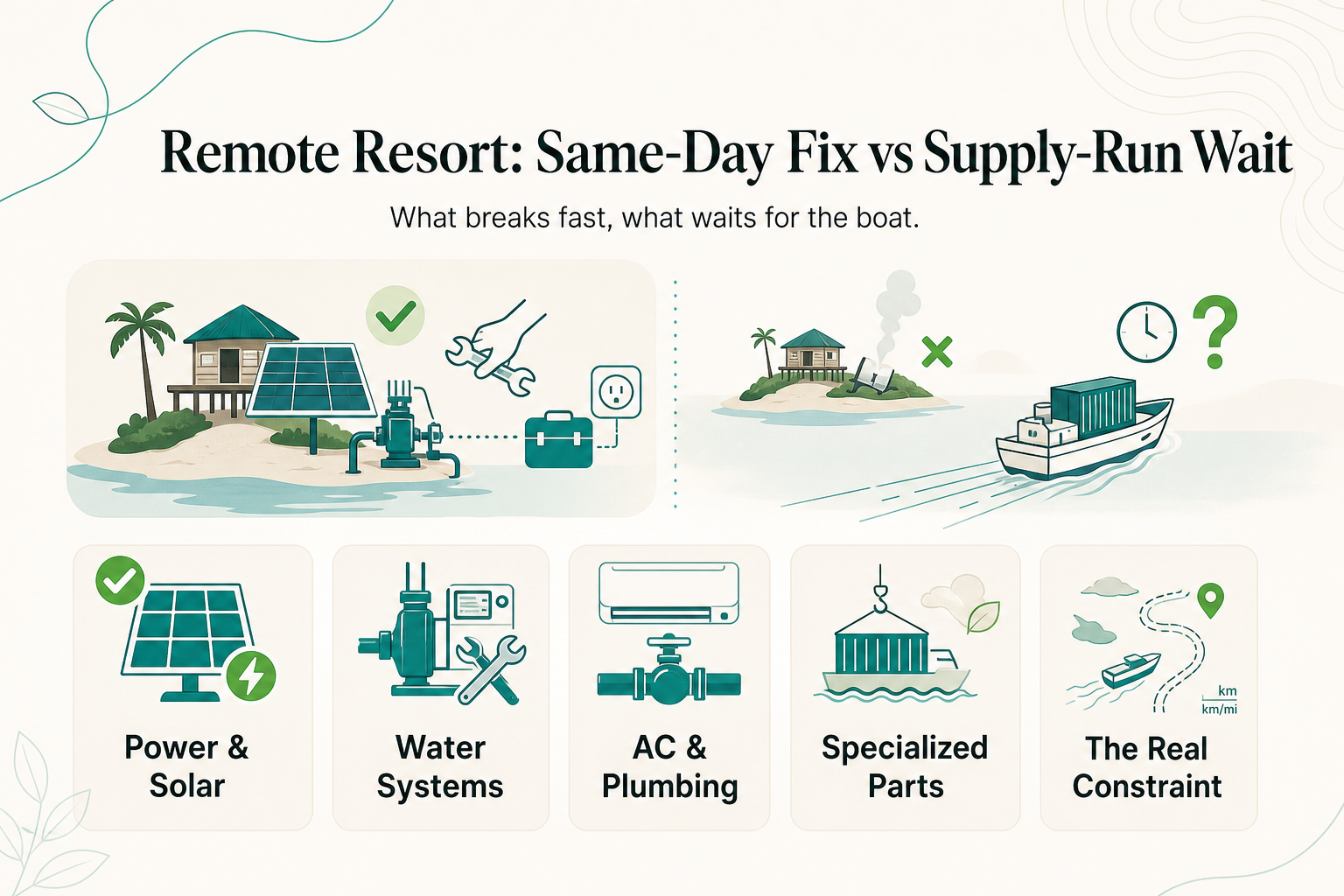
A 20-room island eco-resort with no municipal grid, no hardware store, and a 30-45 minute boat ride to the nearest port can fix most day-to-day mechanical and electrical faults on the same day, using on-site staff and spare parts kept in stock. What it cannot fix same-day is anything requiring a part not held in inventory, since the nearest supply town is a multi-hour transfer away and freight has to move by boat. The realistic standard isn't "everything works perfectly." It's "we know exactly what breaks, how fast we fix it, and what we tell the guest while we do."
TL;DR
- Same-day fixable: solar/battery faults, water pump and desalination issues, AC unit servicing, generator backup switching, minor plumbing and structural repairs.
- Not same-day fixable: specialized parts not in stock (compressor components, certain electronics), which require an Ampana or Luwuk supply run.
- Off-grid resorts stock spares proportional to what breaks most often: filters, pumps, batteries, inverters.
- A 20-room scale matters: fewer units to maintain per staff member than a 100+ room resort, but no backup supply chain either.
- Transparency with guests during a repair window builds more trust than pretending nothing ever breaks.
Why Does Remote Location Change the Maintenance Math?
A city hotel calls a vendor and gets a technician same-day. A remote island resort doesn't have that option. The nearest hardware supplier requires a multi-hour transfer from Buka Buka Island. That distance is the single biggest variable in how any remote resort plans maintenance, and it means the entire model has to shift from "call for help" to "hold your own parts and skills on-site."
On an island, the forecast that matters most is spare-parts consumption: how many pump seals, filter cartridges, and battery terminals get used per quarter, and whether the next resupply boat carries enough to cover it.
What Can a 20-Room Resort Fix the Same Day?
A trained on-site team, a stocked spares inventory, and systems designed to be serviced locally rather than sent out. At this scale, most electrical and mechanical failures fall into that category.
Power and Solar Systems
Reconnect runs on solar power for the large majority of its electricity, with generator capacity held in reserve only for backup. Inverter faults, panel connection issues, and battery bank imbalances are the most common failures in an off-grid solar system. These are fixable with in-house electrical staff and stocked replacement components. A tripped inverter or a loose connection almost always is same-day. A full battery bank replacement is not.
Water Production
Desalination and drinking water systems are sun-powered and run on-site rather than depending on municipal supply. Pump failures and filter clogs are the most frequent issues in any small-scale desalination unit. Both are serviced with parts kept on hand. A full membrane replacement depends on whether a spare membrane is already in stock.
Room Comfort: AC and Plumbing
Reconnect is one of the few resorts in the Togean Islands to offer air conditioning at all, in select room categories including the Beachfront Villa with AC. AC units in a marine, salt-air environment need more frequent coil cleaning and refrigerant checks than inland units. Most of that servicing happens same-day with an on-site technician. Plumbing leaks, valve replacements, and fixture repairs follow the same pattern: fixable fast if the part is standard, slower if it isn't.
Here's a quick reference for what typically falls into each bucket:
| Issue | Same-day fixable | Requires supply run |
|---|---|---|
| Inverter trip / loose solar connection | Yes | No |
| Full battery bank failure | No | Yes |
| Desal pump or filter clog | Yes | No |
| Desal membrane replacement | Sometimes | Depends on stock |
| AC coil cleaning, minor refrigerant top-up | Yes | No |
| AC compressor failure | No | Yes |
| Standard plumbing leak or valve | Yes | No |
| Structural or carpentry repair | Yes | No |
What Can't Be Fixed Same-Day, and Why?
Anything that needs a part not already on the island. That's not a Reconnect-specific limitation. It's physics and geography. A compressor component, a specialized electronic board, or a part that has to be sourced from a supplier in a larger city has to travel the same route guests do in reverse: boat to Ampana, then onward transport, before it even starts the return trip.
This is the tradeoff every remote island operation makes, whether it's a resort, a dive center, or a village clinic. You stock the parts tied to your highest-frequency failures, and you accept that the low-frequency ones will take days, not hours.
Think of the resort's spares inventory like a boat's toolkit rather than a full workshop. A toolkit carries what breaks on 95% of trips. It doesn't carry a spare engine block. The 5% of failures that need something bigger than the toolkit get handled at the next port, which is exactly how island maintenance works.
How Does Resort Size Affect What Gets Fixed and How Fast?
At 20 rooms, Reconnect has fewer units to monitor per staff member than a 100-plus-room property, and issues get spotted and reported faster in a smaller, more personal operation. That's a real advantage over larger resorts, where a maintenance ticket can sit in a queue.
A single-island resort with 20 rooms has no sister property next door. Everything it needs has to already be on Buka Buka Island or on its way there. No redundant systems elsewhere on the property exist to fall back on while a repair happens.
Guest-facing communication during a repair window matters more on a small remote resort than at scale. Issues addressed transparently and quickly, even mid-stay, drive far better guest sentiment than issues left unacknowledged. On an island where the "fix ETA" might genuinely be two days rather than two hours, telling a guest exactly what's happening and why beats vague reassurance every time.
Frequently Asked Questions
Does Starlink internet affect maintenance planning?
Yes, indirectly. Reliable connectivity means diagnostic calls with equipment manufacturers or remote troubleshooting support are possible even from a remote island, which speeds up decisions about whether a part can wait for the next supply run or needs an expedited trip.
What's the most common failure point on an off-grid island resort?
Based on our own logs, it's water pumps and solar connection points, both high-cycle components exposed to salt air and heavy daily use.
Is a five-hour transfer normal for reaching remote Togean resorts?
Transfer times vary by specific route and resort location within the Togean Islands; Reconnect coordinates the full Luwuk Airport to island journey directly with guests.
About Reconnect
Reconnect is an island eco-resort with an on-site SSI dive center in Indonesia's Togean Islands, Central Sulawesi. Across 20 rooms and 8 accommodation types, the resort runs fully off-grid with solar power, desalinated water, and Starlink connectivity. Get in touch at reconnect.id.