

A confined water session is a shallow, controlled pool or calm-lagoon practice dive where a student learns core scuba skills under direct instructor supervision before ever descending on a real reef. It covers mask clearing, regulator recovery, buoyancy control, and basic underwater breathing, typically lasting 30 to 50 minutes. For a traveler weighing whether to try diving in the Togean Islands, this session is the actual gatekeeper to the fun part: the first open-water dive.
TL;DR
- A confined session runs 30-50 minutes and happens in shallow, calm water with depth typically capped around 1.5-4 meters.
- Core skills practiced: regulator clearing, mask clearing, buoyancy control, and breathing technique.
- SSI's equivalent confined training (Try Scuba / Basic Diver) certifies students to a maximum depth of 12 meters with an SSI professional present.
- Full Open Water certification under SSI standards requires six confined water sessions and 16-32 hours total before independent open-water diving.
- At Reconnect, confined-style training dives happen at reef sites around Buka Buka Island, reached by a short boat ride, not in a swimming pool.
What Happens During a Beginner Confined Session?
A confined session is where an instructor walks a first-time diver through the physical mechanics of breathing underwater, in water shallow enough to stand up in in case something feels off.
SSI's equivalent taster experience is called Try Scuba for a single session, or the confined portion of the Basic Diver course. The skills taught are functionally the same across both instructional systems.
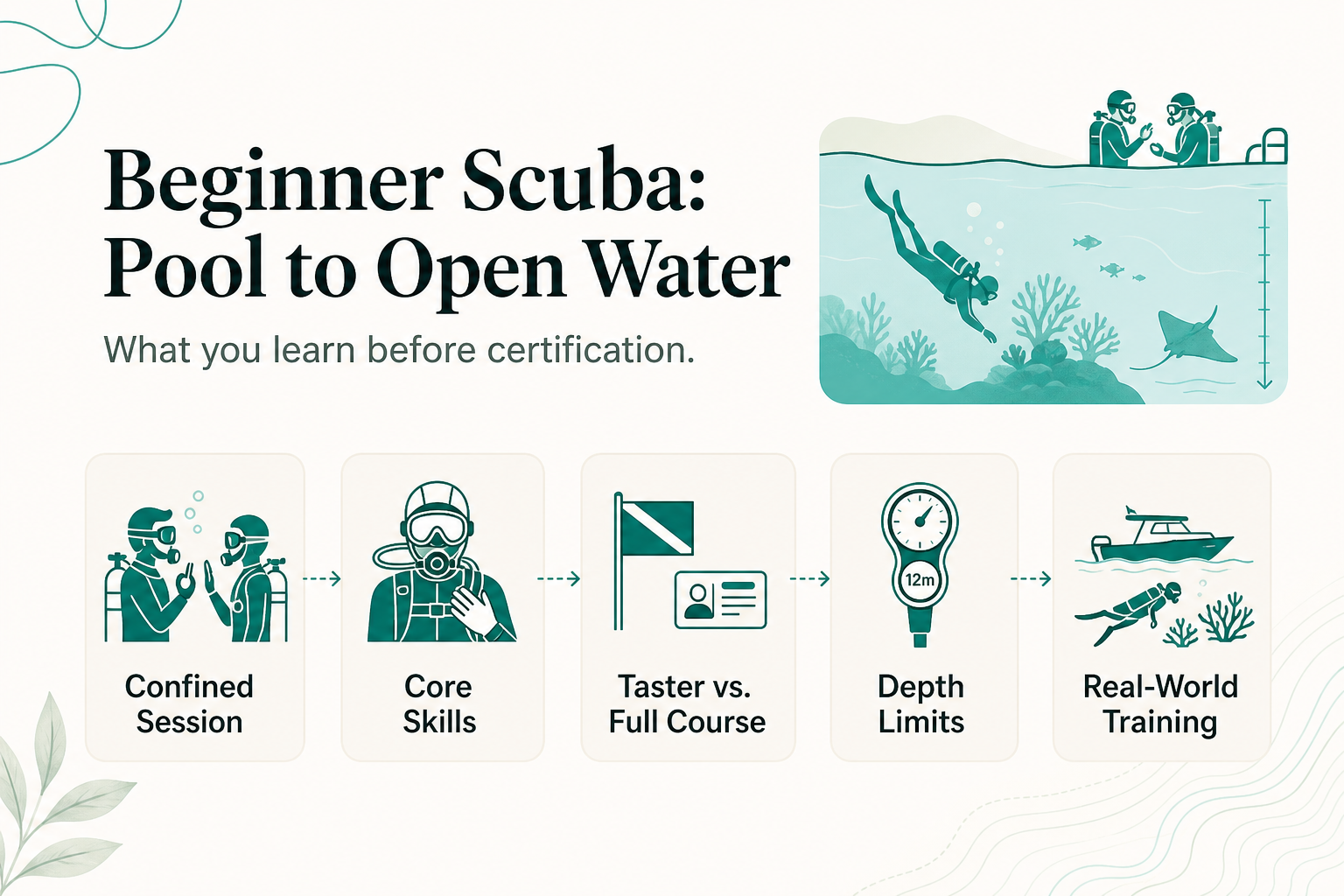
Expect the instructor to brief you on land first: how the regulator delivers air, what the gauges mean, and the hand signals you will use instead of talking. Then you get in the water. The session itself focuses on a short list of foundational skills:
- Regulator clearing - purging water from your mouthpiece if it floods
- Mask clearing - removing water from inside your mask without panicking or surfacing
- Buoyancy control - using your breath and a buoyancy compensator to hover, not sink or shoot upward
- Basic breathing technique - slow, continuous breathing through the regulator, since breath-holding underwater is the one real beginner mistake with safety consequences
Confined water training happens in consistent, shallow depth, typically 1.5 to 4 meters, with clear visibility and no current. A pool or a flat lagoon removes every variable except the skill itself, so an instructor can watch exactly how a new diver responds to water in their mask or a regulator pulled from their mouth, and correct it immediately.
How Is This Different From a Full SSI Open Water Course?
A beginner taster session is a single taste. An Open Water certification is the real qualification, and the two should not be confused when you are booking.
Depth and certification limits
SSI's Basic Diver certification allows a diver to descend to a maximum of 12 meters, always with an SSI professional present. That is meaningfully shallower than a certified Open Water diver's typical working limit, and it is intentional: a one-off taster dive is not meant to produce an independent diver, it is meant to show you what diving feels like with a professional managing every variable.
Structure and hours
SSI standards require six confined water sessions before a student can progress to open-water dives, with the full Open Water course running 16 to 32 hours depending on pace and group size. A single beginner taster session is a fraction of that, usually one pool-style or shallow-water session, sometimes followed by a single shallow open-water dive.
| Beginner taster | SSI Open Water Diver | |
|---|---|---|
| Confined sessions | 1 | 6 |
| Max certified depth | 12m (SSI professional required) | Standard open-water limits once certified |
| Total course hours | 1-3 hours typical | 16-32 hours |
| Outcome | Experience only, no certification | Full certification card |
Why this matters if you're choosing SSI
SSI and PADI are more alike than different at the beginner level. Both require confined water skills before open water, both cap beginner taster dives around 12 meters with a professional present, and both lead to internationally recognized scuba certification levels. The meaningful difference is usually which agency a given dive center is affiliated with, not the quality of instruction. Reconnect's dive center is SSI-affiliated and Blue Oceans certified, and instruction runs in English, French, and Indonesian, which matters more for an international guest than the agency logo on the certification card.
What Skills Carry Over Once You Start the Full Certification Path?
Every skill practiced in a confined session is a direct building block for Open Water certification, not a separate skill set you relearn later. Regulator clearing, mask clearing, and buoyancy control are the same three skills tested again, with more precision expected, during the six confined sessions of the full course.
The confined session proves you can do the mechanics; the open-water dives that follow prove you can do them when the water is not perfectly calm and predictable. Current, depth, visibility, other divers, and marine life change the equation-not the skills themselves.
This is also where a pre-dive buddy check becomes a habit rather than a formality. SSI mandates a full equipment check between dive partners before entering the water, covering the buoyancy compensator, weight system, releases, and air supply. Instructors introduce this in the confined session so it becomes automatic by the time a diver is doing it unsupervised.
Where This Training Happens at Reconnect
Most remote island dive centers train in shallow reef sites rather than pools. Reconnect's confined-style training dives take place at reef sites around Buka Buka Island, reached by a short boat ride, not in a swimming pool and not on the house reef (which is reserved for complimentary snorkeling).
Visibility at these training sites averages about 30 meters, which gives instructors a clear sightline to monitor skills like mask clearing and buoyancy control in real conditions.
Training on an actual Sulawesi reef from day one is a different experience than a hotel pool, calmer and shallower than the dive sites you progress to later, but real ocean, real fish, real light filtering down through the water column.
Guests who want to go beyond a taster session can continue toward Open Water, and from there toward the Advanced Adventurer course, SSI's five-dive progression that follows Open Water certification. Dive instruction and course fees are booked and paid for separately from the all-inclusive room rate; the stay itself covers meals, house-reef snorkeling, kayaking, and paddleboarding.
Frequently Asked Questions
Is a beginner taster session enough to dive again without a professional?
No. It qualifies you only for supervised diving to 12 meters with an SSI professional present, not independent diving.
How long before I can do an unsupervised open-water dive?
Under SSI standards, that requires completing the full Open Water Diver course: six confined sessions and 16-32 hours of training.
Do I need prior swimming experience for a confined session?
Instructors assess comfort in water during the pre-dive briefing; basic swimming ability is expected, but you do not need prior diving experience.
About Reconnect
Reconnect is a private island eco-resort and SSI-certified, Blue Oceans certified dive center on Buka Buka Island in the Togean Islands, Central Sulawesi. The resort runs fully off-grid on solar power, with desalinated water produced on site and zero single-use plastics. Beginner-to-advanced dive instruction in English, French, and Indonesian happens at reef sites a short boat ride from the resort. Get in touch at https://reconnect.id.
References
- SSI Training Standards (divessi.com)