


A resort's guest-to-staff ratio is the single number that predicts whether a remote island stay will feel personal or feel like triage. On islands without a backup supply chain, a nearby competitor to poach staff from, or a same-day replacement flight if someone quits, the ratio isn't a marketing statistic. It's the operational ceiling for everything from how fast your dinner arrives to whether a dive guide actually knows your name by day two.
TL;DR
- Guest-to-staff ratio measures how many staff members support each guest at any given time; lower ratios generally mean more attention per guest.
- Ultra-luxury resorts typically run 1:1 to 1:3 ratios; eco-resorts on remote islands often need similarly high staffing because off-grid systems and guided activities require more hands, not fewer.
- Some industry data suggests hotels holding a favorable guest-to-staff ratio during peak season see a meaningful lift in average guest spend and tend to top service rankings.
- On a remote island, the ratio also has to cover things a city hotel never staffs for: water desalination, solar system upkeep, and boat transfers.
- Reconnect's 20-room scale on Buka Buka Island, with locally hired staff and an on-site SSI dive center, is built around keeping that ratio favorable rather than maximizing room count.
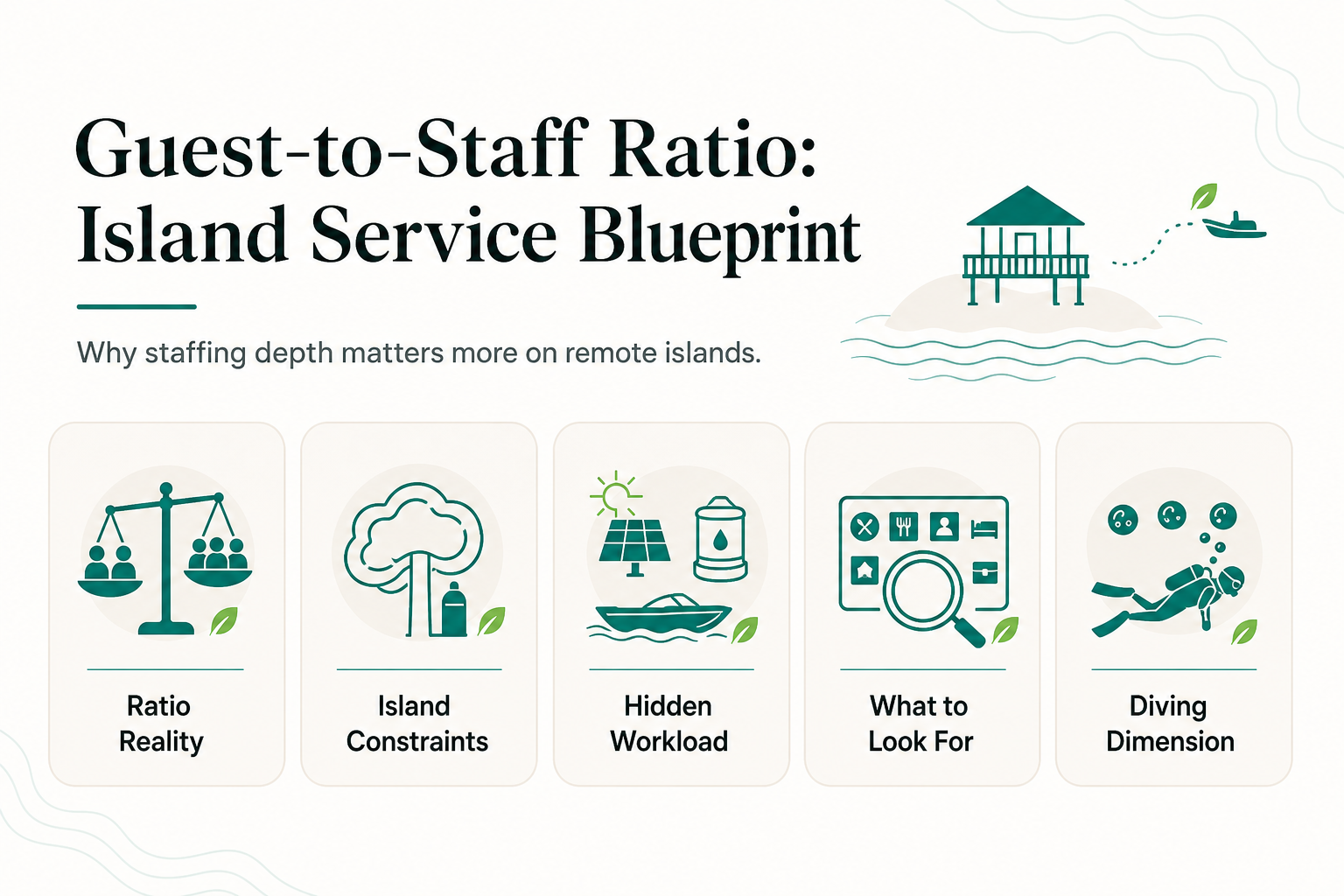
What Does Guest-to-Staff Ratio Actually Mean?
Guest-to-staff ratio is a headcount measure: how many staff members are on duty relative to how many guests are on property at a given time. A 1:3 ratio means three guests share the attention of one staff member across housekeeping, food service, guiding, and maintenance combined.
It is not the same as service quality, but it sets the outer limit on it. A property can have a favorable ratio and still deliver mediocre service through poor training. It cannot have an unfavorable ratio and deliver consistently attentive service, because there simply aren't enough hands.
- Ultra-luxury resorts: typically 1:1 to 1:3, prioritizing personalized service over occupancy.
- Mid-range luxury properties: run leaner ratios to balance comfort against affordability.
- Eco-resorts: frequently need high staff levels regardless of price tier, because off-grid power, water systems, and guided activities all require dedicated people.
That last category matters for anywhere in the Togean Islands. An eco-resort running its own solar array and desalination plant is staffing a small utility company alongside a hotel.
Why Does This Ratio Matter More on a Remote Island Than in a City Hotel?
A city hotel with a staffing gap can call a temp agency or shift a bellhop into housekeeping for the afternoon. An island resort reachable only by boat cannot do either. Every staff member on-site is the entire bench for that role until the next supply run or crew rotation.
This changes what "adequate staffing" has to cover:
- Guided activities. Diving, snorkeling boat trips, and village visits all need a guide physically present, not a phone call away.
- Off-grid infrastructure. Solar systems, battery banks, and water desalination units need someone monitoring and maintaining them daily.
- Transfer logistics. Airport pickups, road transfers, and speedboat crossings all require staff timed against flight schedules, not walk-in arrivals.
- No fallback labor pool. There's no nearby hotel to borrow a chef from during a busy week.
Some hospitality platform data points in the same direction: properties holding a favorable guest-to-staff ratio during peak season have reported a lift in average guest spend, and those same properties tend to score well on operational service rankings. On a remote island, that gap between "well-staffed" and "understaffed" is more visible to guests because there's nowhere else for the experience to happen. If the dive guide is stretched thin, there's no alternative reef trip down the road.
How Should a Traveler Actually Read a Resort's Staffing Claims?
Most resorts don't publish a raw guest-to-staff number, so the question becomes what to look for instead. A few practical signals travel better than the ratio itself.
Step 1: Check whether staff are named, not generic
Reviews and resort pages that reference specific guides, chefs, or dive instructors by name usually indicate a small enough team that guests build real relationships. Vague references to "our friendly staff" tell you nothing about headcount.
Step 2: Look at room count relative to activity offerings
A 20-room resort running its own SSI dive center, kayaking, paddleboarding, and boat excursions needs meaningfully more staff per room than a 20-room property offering only a restaurant and beach chairs. More offerings per room is a rough proxy for staffing depth, assuming the offerings are genuinely delivered rather than listed.
Step 3: Check who's hired
Locally hired staff with direct village supplier relationships tend to have lower turnover on remote islands, because the job doesn't require relocation and the surrounding community has a stake in the resort's reputation. High turnover is the fastest way to quietly worsen a resort's effective ratio, even if the org chart looks fine on paper.
Step 4: Read reviews for wait-time complaints specifically
Genuine understaffing shows up in reviews as recurring, specific complaints: slow meal service during peak hours, guides who seem rushed, or maintenance issues that sit unresolved for days. One complaint is an outlier. A pattern is data.
How Does This Play Out for Diving and Water Activities Specifically?
Diving adds a layer the ratio question that most hotel-focused guides miss entirely. SSI's own certification structure requires an Open Water Instructor to log at least 100 open water dives, complete a full Instructor Training Course, and pass a final evaluation before being qualified to teach independently. That's a meaningful bar, and it means a resort's dive staffing isn't just about headcount, it's about how many of those staff are actually qualified to run small groups safely.
Reconnect runs its SSI-certified dive center on Buka Buka Island in the Togean Islands with direct reef access by short boat ride rather than long transfers, and keeps training and guided dive groups deliberately small. Visibility in the Togean Islands averages around 30 meters during the dry season, which is well above the 5 to 15 meter range typical of many Southeast Asian diving destinations, and that clarity is wasted on a diver stuck in an oversized group with one overstretched instructor.
How Does Reconnect Approach Its Own Staffing Ratio?
Reconnect is a small-scale eco-resort by design: 20 rooms across eight accommodation types on Buka Buka Island, not a large-format property optimized for occupancy. All meals are included as part of every stay, kayaking and paddleboarding are included, and house-reef snorkeling is complimentary, each of which requires staff presence rather than a self-service kiosk.
The resort is also fully off-grid, running 93 percent on solar with on-site desalinated water production, which adds a technical staffing layer most beachfront properties don't carry at all. Staff are hired locally from communities near the resort, with supplier partnerships in neighboring villages, an approach that tends to support the lower-turnover, higher-continuity staffing pattern that keeps a favorable ratio intact season after season. None of this eliminates the tradeoffs of running an eco-resort in the Togean Islands, but it's a deliberate structural choice rather than a marketing line.
Frequently Asked Questions
Is a lower guest-to-staff ratio always better?
Generally yes for personalized attention, but only if the staff are well trained. A low ratio with undertrained staff still produces poor service; the ratio sets the ceiling, not the outcome.
Do all-inclusive resorts need more staff than a la carte properties?
Usually, since meals, activities, and guiding are all delivered rather than optional add-ons guests arrange themselves. An all-inclusive eco-resort model in particular needs enough qualified dive staff to keep groups small.
How can I tell if an island resort review reflects a genuine staffing issue?
Look for specifics: named delays, repeated mentions of rushed guides, or slow service during clearly identifiable peak periods, rather than a single vague one-star comment.
Does island resort staffing affect diving safety, not just comfort?
Yes. Instructor qualification requirements from SSI exist specifically so certified staff can safely manage groups; an overstretched instructor-to-diver ratio is a safety consideration, not just a service one.
Are remote island resorts in Indonesia typically well staffed?
It varies widely by property size and business model among the best eco-resorts Indonesia has to offer. Smaller, owner-founded properties tend to staff more conservatively per room than larger commercial operations.
About Reconnect
Reconnect is a Private Island Resort and SSI-certified dive center on Buka Buka Island in the Togean Islands, founded by Thomas Despin. Visit [reconnect.id] to explore how staffing and scale shape a stay in one of Indonesia's most remote island destinations.