


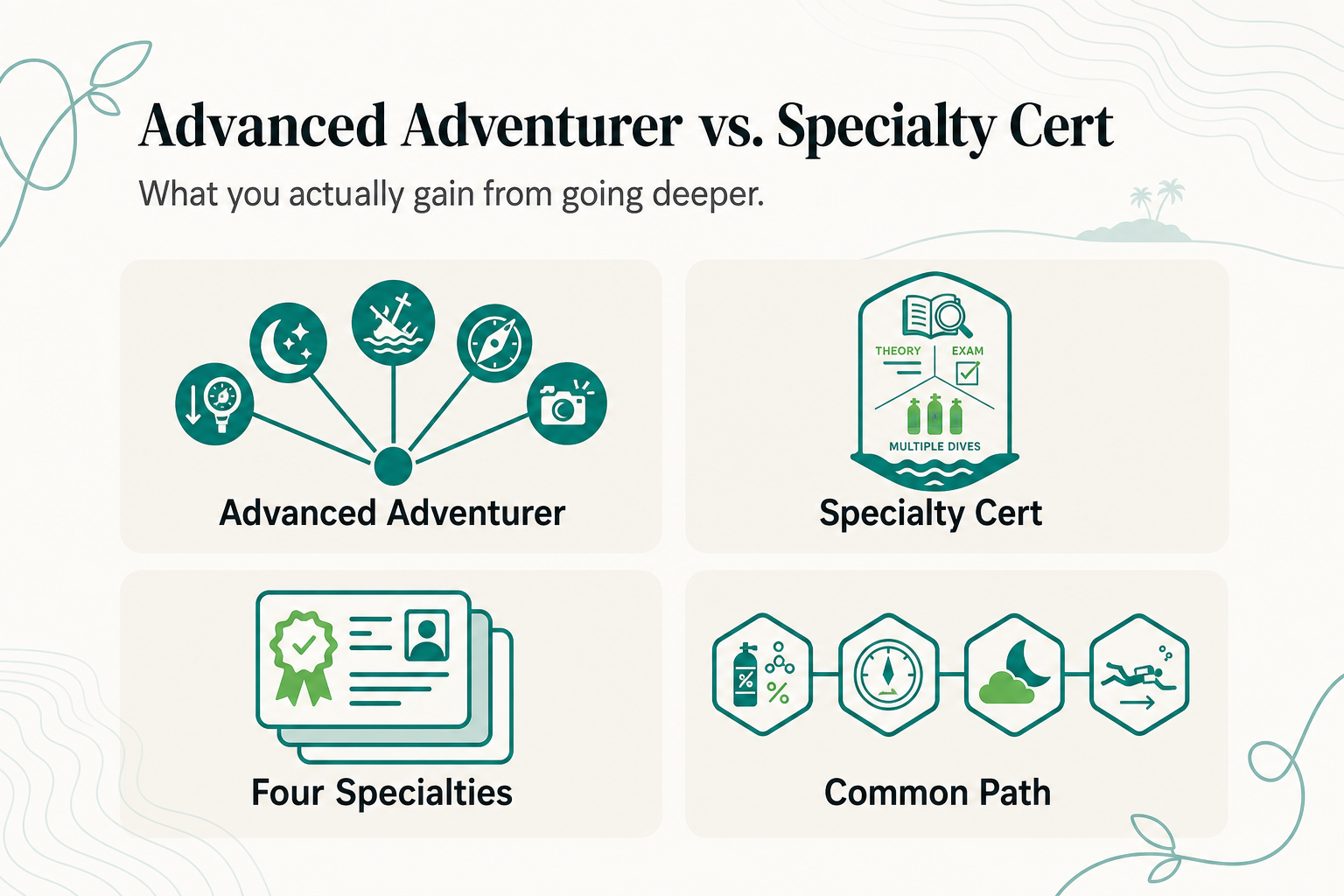
An SSI Advanced Adventurer certification gives you five short taster dives across five different specialties. An SSI specialty certification takes one of those tasters and turns it into a real, standalone skill: full academic sessions, an exam, and multiple dedicated open water dives until you have actually mastered that one area, not just sampled it. If you finished Advanced Adventurer and are wondering what to do next, that is the gap you are filling.
TL;DR
- Advanced Adventurer = five intro dives across five specialties; a specialty certification = one specialty, fully mastered.
- SSI offers over 20 specialty certifications, grouped into categories like Ecology, Diving Knowledge, and Equipment, including Deep Diving, Perfect Buoyancy, Enriched Air Nitrox, and Wreck Diving.
- Most specialty courses run 1 to 2 days, with 5 to 15 hours of instruction and 2 to 4 open water dives, and cost roughly $150 to $350 depending on location and program.
- The only formal prerequisite for most specialties is an Open Water Diver certification, with minimum ages usually between 10 and 15 depending on the specialty.
- Four completed specialties plus 24 logged dives earns you the Advanced Open Water Diver rating automatically. It is not a separate course or fee.
What's the Real Difference Between Advanced Adventurer and a Specialty Certification?
Advanced Adventurer is a sampler platter. You do one open water dive per specialty, guided by an instructor, across five specialties of your choosing [divessi.com]. It is designed to expose you to different environments and skills, not to certify you as competent in any one of them.
A specialty certification is the opposite. You pick one subject, sit through the full academic content, pass the knowledge review, and log multiple dedicated dives built specifically to develop that skill. The SSI Deep Diving specialty, for example, is one afternoon's worth of theory in Advanced Adventurer. As a standalone certification, it becomes a structured program covering gas management, narcosis recognition, and descent/ascent procedures across several dives at depth.
Think of Advanced Adventurer as a test drive and the specialty certification as owning the car. One tells you whether you like deep diving, night diving, or navigation. The other actually qualifies you to do it well, on your own judgment, without an instructor holding your hand through every step.
Which SSI Specialty Certifications Are Worth Taking First?
SSI groups its specialties into categories including Ecology, Diving Knowledge, and Equipment, with more than 20 programs available in total. Not all of them matter equally to a recreational diver who just wants to dive better and safer.
Here is how the most commonly chosen specialties stack up for someone coming straight off Advanced Adventurer:
| Specialty | What it actually teaches | Typical duration |
|---|---|---|
| Enriched Air Nitrox | Diving with enriched air mixes of up to 32% or 40% oxygen for longer bottom times and shorter surface intervals | 1 day, no dives required for some formats |
| Deep Diving | Gas narcosis management, dive planning below 18m, equipment checks for depth | 1-2 days, 3 dives |
| Night Diving | Navigation, communication, and hazard awareness in low visibility | 1 day, 2 dives |
| Perfect Buoyancy | Trim, weighting, and air consumption control | 1 day, 2 dives |
| Wreck Diving | Site orientation and awareness around shipwreck structures (non-penetration) | 1-2 days, 2 dives |
The SSI Nitrox certification is usually the first one divers take, because it changes something you use on every subsequent dive: your gas. The enriched air diver course requires no open water dives in some formats since the core skill is planning, not technique, which makes it the fastest specialty to add to your card.
Night diving certification and Deep Diving tend to come next, because they unlock access rather than refine a skill you already use daily. A lot of the best marine life activity around a reef, crustaceans, hunting behavior, bioluminescence, only shows up after dark, and you cannot see any of it without the certification and the right technique.
How Do Specialty Certifications Lead to Advanced Open Water Diver?
The rating comes automatically. Complete four full specialty programs and log 24 dives total, and you earn the Advanced Open Water Diver rating with no separate exam, course, or fee. It is a recognition of accumulated, verified skill, not a product on the price list.
That distinction matters for how you plan your next few certifications. Think about which four specialties will actually make you a better diver: Nitrox, Deep Diving, Night Diving, and Perfect Buoyancy is a common combination, because together they cover gas, depth, low light, and control-four skills that show up on almost every dive trip you will ever take.
What Does This Have to Do With Becoming a Dive Master?
If certification is starting to feel like a checklist rather than a hobby, that is a sign you might be heading toward professional-level diving, whether or not you plan to work in it. Dive master requirements vary by exact program, but they consistently sit on top of the same foundation: a verified, substantial number of logged dives, an Advanced Adventurer or equivalent rating, and, in most cases, a rescue-level certification before you can even enroll.
Specialty certifications count directly toward that dive count and toward the skill depth instructors expect a Dive Master candidate to already have. Someone who has done Nitrox, Deep, Night, and Wreck arrives at Dive Master training already comfortable with gas planning, depth management, and low-visibility navigation, rather than learning those basics for the first time under pressure.
Where Should You Actually Take These Courses?
The honest answer is: wherever the training dives happen in conditions similar to where you will use the skill. A Deep Diving specialty done in a quarry with 5 meters of visibility teaches you the theory but not much of the judgment.
Reconnect's on-site SSI dive center runs specialty training dives at reef sites around Buka Buka Island, reached by a short boat ride, in roughly 30 meters of visibility. Courses are taught in English, French, or Indonesian, in small groups, and are booked and paid separately from your stay, alongside guided dives available through the Dive-cation package. That combination-clear water and a genuine variety of depth and structure within a few minutes' boat ride-is what makes a Deep Diving or Night Diving specialty actually mean something once you are back diving somewhere else.
Frequently Asked Questions
Can I skip Advanced Adventurer and go straight to a specialty certification?
Yes, in most cases. The formal prerequisite for the majority of SSI specialties is an Open Water Diver certification, not Advanced Adventurer.
Do I need to do the specialty at the same dive center where I did Advanced Adventurer?
No. SSI certifications are recognized globally, and you can complete specialties at any SSI-affiliated dive center.
Is Enriched Air Nitrox worth it if I only dive occasionally?
It extends your bottom time and shortens surface intervals on every dive using nitrox afterward, so the benefit compounds even with infrequent diving.
What's the minimum age for specialty certifications?
It depends on the specialty, typically ranging from 10 to 15 years old.
About Reconnect
Reconnect is an island eco-resort with an on-site SSI dive center on Buka Buka Island in the Togean Islands, Central Sulawesi. All-inclusive full-board stays start from EUR 60 per night. If you are planning your next round of specialty certifications, get in touch through reconnect.id to check course availability and dates.