


"Beginner-friendly" gets stamped on dive marketing everywhere, but the term has an actual technical definition: minimal current, stable weather, visibility high enough for an instructor to see every student at once, and depths capped at 12 meters for supervised divers or 18 meters for certified Open Water divers. Tomini Bay, where the Togean Islands sit, meets that definition on most days of the year, with visibility around 30 meters and warm, current-sheltered water. That is a genuinely different environment from a beginner site with a 5-meter visibility minimum and choppy surface conditions.
TL;DR
- Beginner-friendly diving has measurable criteria: low current, stable weather, visibility sufficient for constant instructor eye contact, and depth caps of 12m (supervised) or 18m (Open Water certified).
- Industry minimum safe visibility for beginner instruction is about 5 meters; Sulawesi's Tomini Bay averages around 30 meters, well beyond that floor.
- Tomini Bay's calm, warm water lets new divers work on buoyancy and breathing without fighting current, a condition not every "tropical" dive destination actually offers.
- Reconnect runs SSI training dives at reef sites around Buka Buka Island, reached by short boat rides, with instruction in English, French, and Indonesian.
- House-reef snorkeling is complimentary for every guest and does not require any certification, course, or boat.
What Does "Beginner-Friendly" Actually Mean in Diving?
Certification agencies define it by a checklist, not a feeling. A site qualifies when current is minimal to absent, surge is low, weather is stable, and visibility is clear enough that an instructor can keep every student in view at all times. Shallow depth and easy, non-technical entry points matter too, since new divers are still learning to manage buoyancy and breathing without added stress.
Depth limits are set by the certification level, not the site. SSI and PADI both cap supervised Scuba Diver programs (like Discover Scuba Diving or SSI's Try Scuba) at 12 meters, and certified Open Water Divers at 18 meters. Try Scuba requires no prior experience at all. Open Water certification adds academic study, confined-water skills work, and open-water dives before a diver is cleared to that 18-meter ceiling.
Seeing clearly and not fighting the water around you: those two conditions make a beginner comfortable underwater. A murky, current-heavy site can technically be shallow and still be a bad place to learn, because the diver is task-loaded just staying oriented and stable.
Why Does Visibility Matter More Than Most Beginners Realize?
Visibility is a safety metric, not a scenic bonus. Industry standards set a minimum of about 5 meters for safe beginner diving, and instructor-to-student ratios get stricter if visibility drops below that line. Below the threshold, an instructor can lose visual contact with a student in seconds.
Sulawesi's reef water typically runs well past that floor. Tomini Bay conditions average around 30 meters of visibility, several times the minimum safety threshold. The practical effect: an instructor can watch an entire small group at once, at depth, without anyone drifting out of sight.
Think of it the way a driving instructor thinks about fog. The legal minimum stopping distance doesn't change, but a foggy road multiplies the workload and the risk of losing track of a hazard. Clear water does the same thing in reverse: it removes a whole category of things an instructor has to manage, leaving more attention for the student's actual skills.
That clarity is also why Sulawesi photographs well for beginners' first certification dives. But the visibility number matters operationally first, aesthetically second.
Why Do Calm, Current-Free Waters Change the Learning Curve?
Current is the other variable that separates an easy first dive from a stressful one. A new diver working on mask-clearing or buoyancy control in a strong current is doing two jobs at once: the skill, and staying in place while doing it.
The Togean Islands sit inside Tomini Bay, a body of water known for calm, warm conditions with limited current exposure. That combination lets a first-time diver isolate one skill at a time, which is exactly what the certification curriculum is built around. Shallow coral gardens and fringing reefs in this setting host sea turtles, bumphead parrotfish, and pygmy seahorses, so the calm conditions aren't a tradeoff against interesting marine life.
Compare that to open-water sites exposed to ocean swell or tidal channels, where even certified divers plan dives around slack tide. Not every reef destination marketed as tropical has Tomini Bay's combination of shelter and clarity. That's a real geographic distinction, not a marketing one.
How Does Reconnect Apply This Standard on Buka Buka Island?
Reconnect runs its SSI-certified training dives at reef sites around Buka Buka Island, reached by short boat rides rather than long transfers to distant dive sites. Instruction runs in English, French, and Indonesian, in small groups, which keeps instructor-to-student visibility manageable even before accounting for the water clarity itself.
Courses are booked and paid for separately from the room rate. The Try Scuba experience, Open Water certification, Advanced Adventurer, and specialty courses are structured this way. The Dive-cation package, by contrast, bundles guided dives, not training courses, for guests who are already certified.
House-reef snorkeling is different again, and it's worth separating clearly from the dive program:
| Activity | Certification needed | Cost | Where |
|---|---|---|---|
| House-reef snorkeling | None | Included in every stay | Buka Buka house reef |
| Try Scuba | None (supervised, 12m max) | Paid separately | Reef sites around Buka Buka, short boat ride |
| Open Water Diver course | None to start | Paid separately | Reef sites around Buka Buka, short boat ride |
| Dive-cation package (8 dives) | Existing certification | Bundled with full-board stay | Reef sites around Buka Buka |
Guests who never plan to dive still get full reef access. House reef snorkeling is complimentary for every guest, with masks, fins, and snorkels provided at no charge, and it needs no course, no boat, and no prior water experience. It's a genuinely separate track from the dive program, not a downgraded version of it.
What Should a Beginner Actually Check Before Booking a Dive Course in Sulawesi?
Skip the adjectives in the brochure and check the numbers instead:
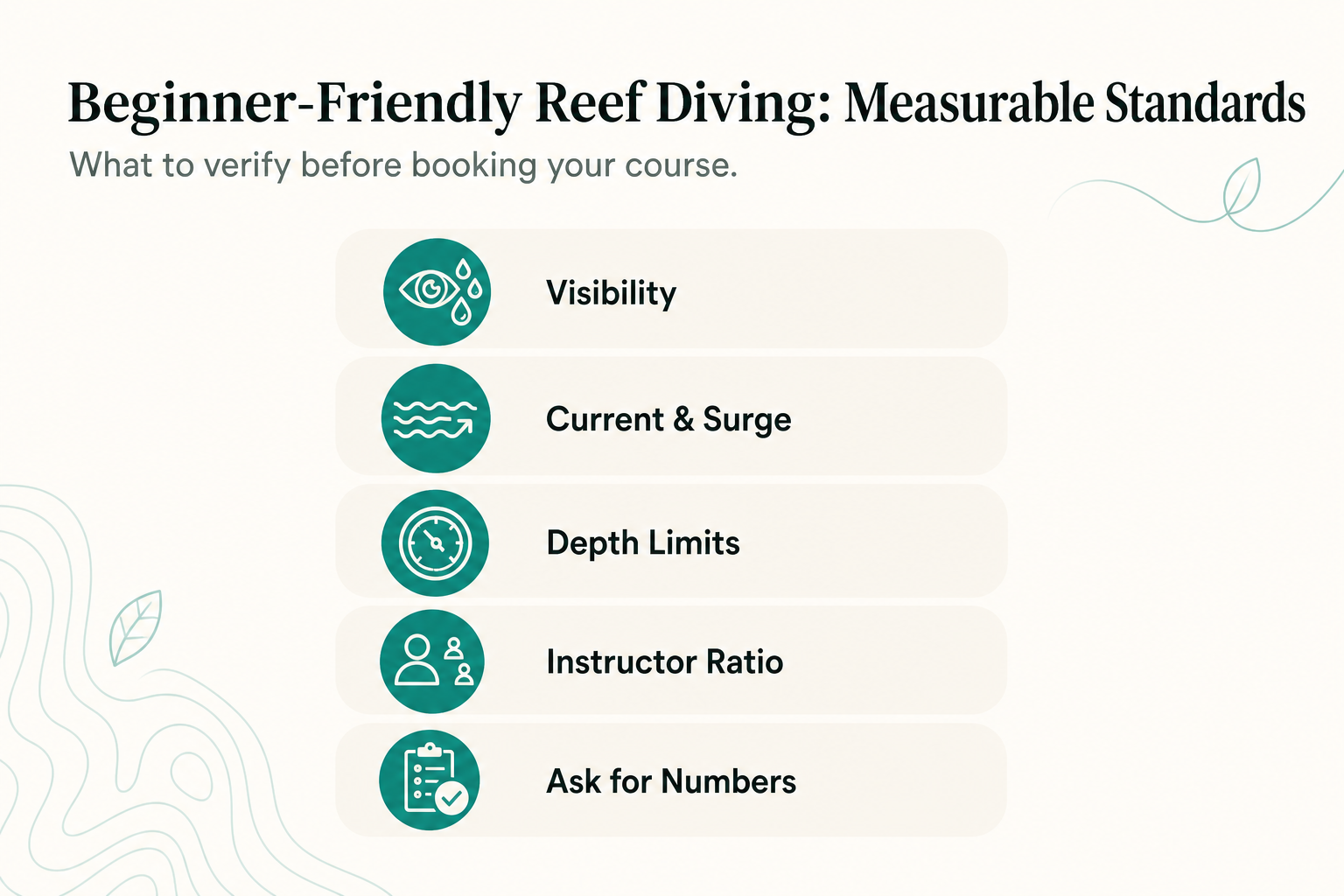
- Visibility on record for the season you're traveling. Ask for a figure, not a description. Around 30 meters is the Tomini Bay average.
- Current exposure at the actual training site, not the region in general. A calm bay ten minutes from a strong channel is still a calm bay.
- Instructor-to-student ratio, particularly for Try Scuba where supervision is direct and continuous.
- Depth limits stated by certification level, 12 meters supervised, 18 meters Open Water, and whether the operator holds to them.
- Language of instruction, if English isn't your first language, confirm the course runs in one you're fully comfortable with.
None of this is exotic information. Any operator confident in its site should hand it over without hedging.
Frequently Asked Questions
Is Sulawesi generally considered good for beginner divers?
Tomini Bay's calm, current-sheltered water and visibility around 30 meters meet the technical criteria certification agencies use to define beginner-friendly conditions: stable weather, minimal current, and clear sightlines for instructors.
What depth will I actually reach as a first-time diver?
Supervised programs like Try Scuba cap at 12 meters. Certified Open Water Divers are cleared to 18 meters. Advanced Adventurer, a five-dive course, extends depth and skill range further but isn't required to start.
Do I need to be certified to snorkel the house reef?
No. House-reef snorkeling requires no certification, no course, and no boat, and it's included with every stay.
How does current affect a first Open Water dive?
Strong current forces a new diver to manage position and skill practice simultaneously, which raises stress and slows skill acquisition. Calm water like Tomini Bay's removes that variable so students isolate one skill at a time.
About Reconnect
Reconnect is a Private Island Resort with an on-site SSI-certified dive center on Buka Buka Island in the Togean Islands, Central Sulawesi. The resort is 93% solar-powered, produces its own desalinated water on-site, and runs on an all-inclusive full-board rate from EUR 60/night. Its dive center holds Blue Oceans certification and trains in reef sites around Buka Buka reached by short boat rides, alongside complimentary house-reef snorkeling, kayaking, and paddleboarding for every guest. Get in touch through reconnect.id to plan a stay or ask about course scheduling.