


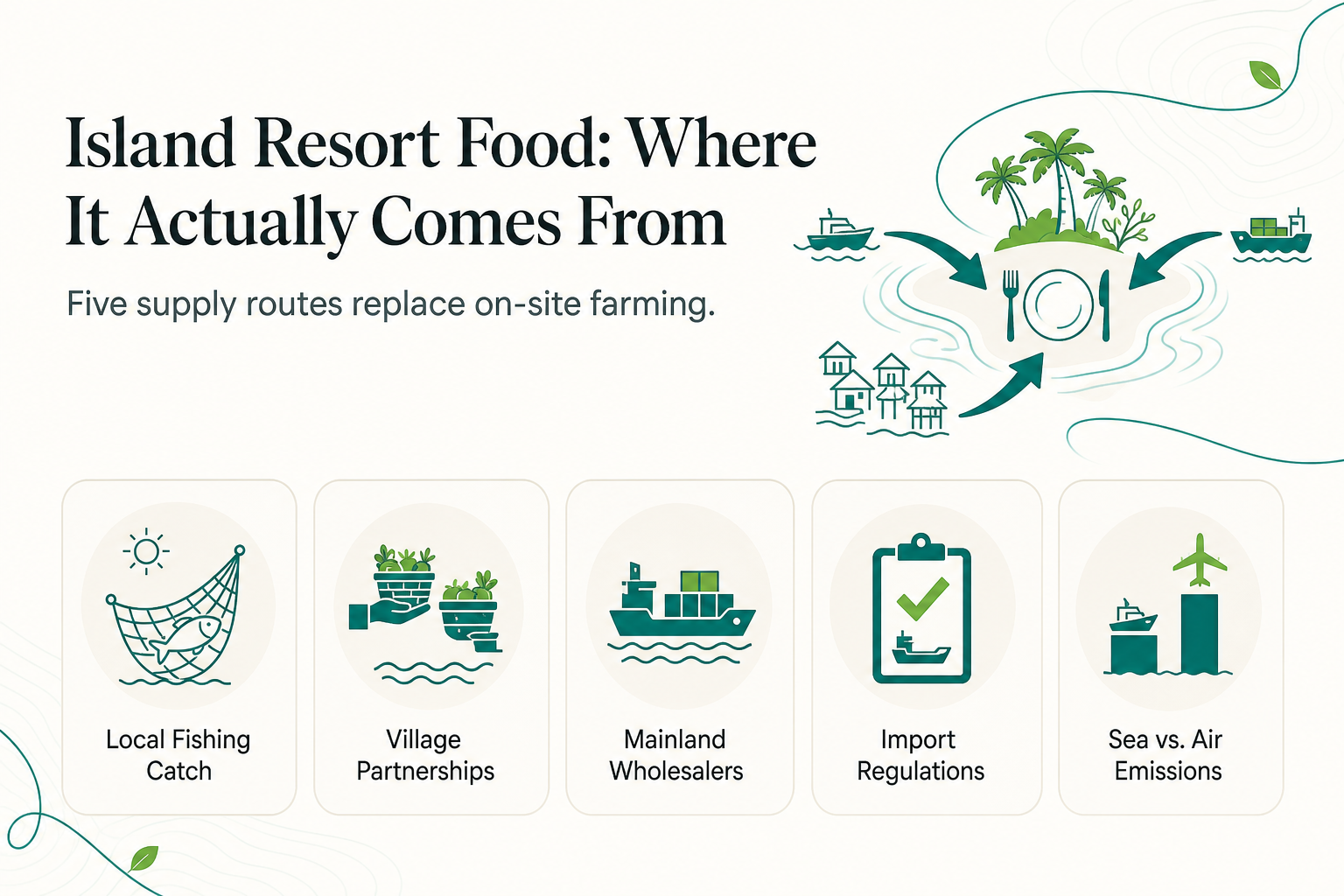
A remote island resort with no farmland, no cattle, and no municipal supply chain still has to put three meals a day in front of every guest. The honest answer is that almost nothing is grown on-site in the Togean Islands; food arrives by boat, by air, and increasingly from partnerships with the nearest fishing villages, and the real sustainability question is not whether food travels, but how far, how often, and from whom.
TL;DR
- Most Togean Islands resorts source food through a mix of local fishing catch, village produce partnerships, and boat-freighted goods from Ampana or Gorontalo, since there is no large-scale farming on most small islands.
- Sea freight emits 10 to 40 grams of CO2 per metric ton per kilometer versus roughly 500 grams for air freight, making boat-based supply chains the lower-carbon option by a wide margin.
- Perishable imports into Indonesia require BPOM Import Certificates, Foreign Food Registration Numbers, Halal certification, and customs clearance through the INSW system, which shapes what can realistically arrive fast.
- "Farm to table" in this region usually means "sea to table" plus village-grown produce, not on-site agriculture.
- Reconnect sources through local staff and neighboring village supplier partnerships, cutting the distance between catch and plate rather than eliminating food miles entirely.
Why Doesn't a Remote Island Resort Just Grow Its Own Food?
Soil, water, and scale are the limiting factors. Most small Togean islands are coral-based with thin, salt-affected topsoil unsuited to intensive vegetable farming, and fresh water has to be desalinated or shipped in rather than pulled from a well or reservoir.
Even where small kitchen gardens exist, they cannot produce at the volume or variety a full-board kitchen serving three meals a day needs. A resort menu spanning breakfast pastries, grilled fish, rice, vegetables, and afternoon tea draws on dozens of ingredient categories, most of which simply cannot be grown on a coral island regardless of effort.
This is why the term "farm to table resort" gets used loosely in the tropics. In practice it almost always means a shortened supply chain, not a closed one: fish caught that morning, vegetables grown in a nearby village garden, but rice, oil, flour, and dairy still arriving from the mainland by boat.
How Does Food Actually Travel to a Remote Island Kitchen?
Three supply routes cover almost everything eaten on a Togean island: the sea, the reef, and the village market. Each has a different distance, cost, and carbon profile.
Route 1: Local fishing catch. Fresh fish, squid, and reef species are the shortest supply chain available; catch can go from boat to kitchen the same day, with essentially zero food miles for this category.
Route 2: Village and market produce. Vegetables, fruit, eggs, and some staples come from nearby settlements such as Bajo villages or the Ampana market, typically a short boat trip rather than a long haul.
Route 3: Bulk and packaged goods. Rice, cooking oil, flour, canned goods, and imported items travel further, usually via Ampana or Gorontalo, then onward to the island by boat.
| Supply route | Typical source | Distance profile | Carbon profile |
|---|---|---|---|
| Fresh catch | Local reef and open water | Same-day, minimal | Near-zero food miles |
| Fruit, vegetables, eggs | Nearby villages, Ampana market | Short boat trip | Low, sea-based |
| Rice, oil, packaged goods | Ampana or Gorontalo wholesalers | Longer boat or truck leg | Low per ton-km if by sea, higher if trucked then flown |
The mode of transport matters more than the raw distance. A crate of vegetables moved 200 kilometers by boat can have a smaller carbon footprint than the same crate moved 50 kilometers by small plane.
Why Do Food Import Rules Matter More Than Distance?
Regulation, not geography, often decides what shows up on a remote menu. Any packaged or perishable item entering Indonesia from abroad has to clear a specific set of checks before it reaches a kitchen at all.
Perishable imports must carry a BPOM Import Certificate (SKI) and a Foreign Food Registration Number (ML), obtain Halal certification, and pass customs and quarantine review through the Indonesia National Single Window system. The paperwork alone makes imported perishables a slower, costlier option than a fish caught that morning.
This regulatory layer shapes a broader food systems idea: nearly 40 percent of the entire US food supply is wasted annually, in large part because complex, long supply chains create more points where food spoils or gets discarded [rts.com]. A short, simple chain from reef to kitchen has fewer of those failure points by design, not by branding.
What Does "Sustainable" Actually Mean for an Island Kitchen?
Sustainable sourcing here means minimizing the distance and steps between catch or harvest and plate, while keeping supplier relationships direct and local.
For a remote island, that raises the stakes on sourcing decisions, because there is no fallback supermarket down the road if a shipment is delayed. Reconnect hires staff locally and works through supplier partnerships with neighboring villages for fish and produce, rather than routing everything through a distant wholesale import chain.
This is not full farm-to-table. Rice, oil, and packaged goods still arrive from Ampana or the wider Sulawesi supply network, the same as at any other island resort. What changes is the balance: more of the plate comes from a short sea or village route, less depends on long, regulation-heavy import chains.
An all-inclusive resort serving three meals a day plus afternoon tea needs supply reliability more than sourcing purity. A shorter chain with a trusted village partner is more resilient to weather delays and rough crossings than a longer chain built on imported specialty goods.
What Should Travelers Expect From Food at a Remote Indonesian Resort?
Expect variety built around what the sea and nearby villages actually produce that week, not a fixed international menu. Fresh fish, rice, and seasonal vegetables form the backbone; imported extras are the exception, not the rule.
A guest expecting daily imported cheese and out-of-season produce will find a different reality than one expecting fresh reef fish and village-grown greens. The latter is both the more accurate expectation and, per the freight numbers, the lower-carbon one.
Frequently Asked Questions
Does Reconnect grow its own food on Buka Buka Island?
No. Reconnect sources through local staff and neighboring village partnerships for fish and produce, supplemented by boat-freighted staples from the wider Sulawesi supply network.
Is boat freight really lower-carbon than flying food in?
Yes, by a wide margin. Sea freight emits 10 to 40 grams of CO2 per metric ton per kilometer compared to roughly 500 grams for air freight, making sea-based supply routes the clear lower-carbon choice.
Why can't more Togean resorts do full farm-to-table dining?
Thin coral-based soil and no fresh groundwater on most small islands rule out large-scale agriculture, which is why sourcing focuses on fishing and village partnerships instead.
Does an all-inclusive eco resort still rely on outside food?
Nearly all of it does. "All-inclusive" describes what is bundled into the room rate, not where the ingredients originate.
About Reconnect
Reconnect is an island eco-resort with an on-site SSI dive center on Buka Buka Island in the Togean Islands, Central Sulawesi. The resort runs fully off-grid on solar power, produces its own desalinated drinking water on-site, and maintains a zero single-use plastic policy throughout. All-inclusive full-board stays start from EUR 60 per night, and the kitchen sources through locally hired staff and partnerships with neighboring villages. Learn more at Reconnect.