


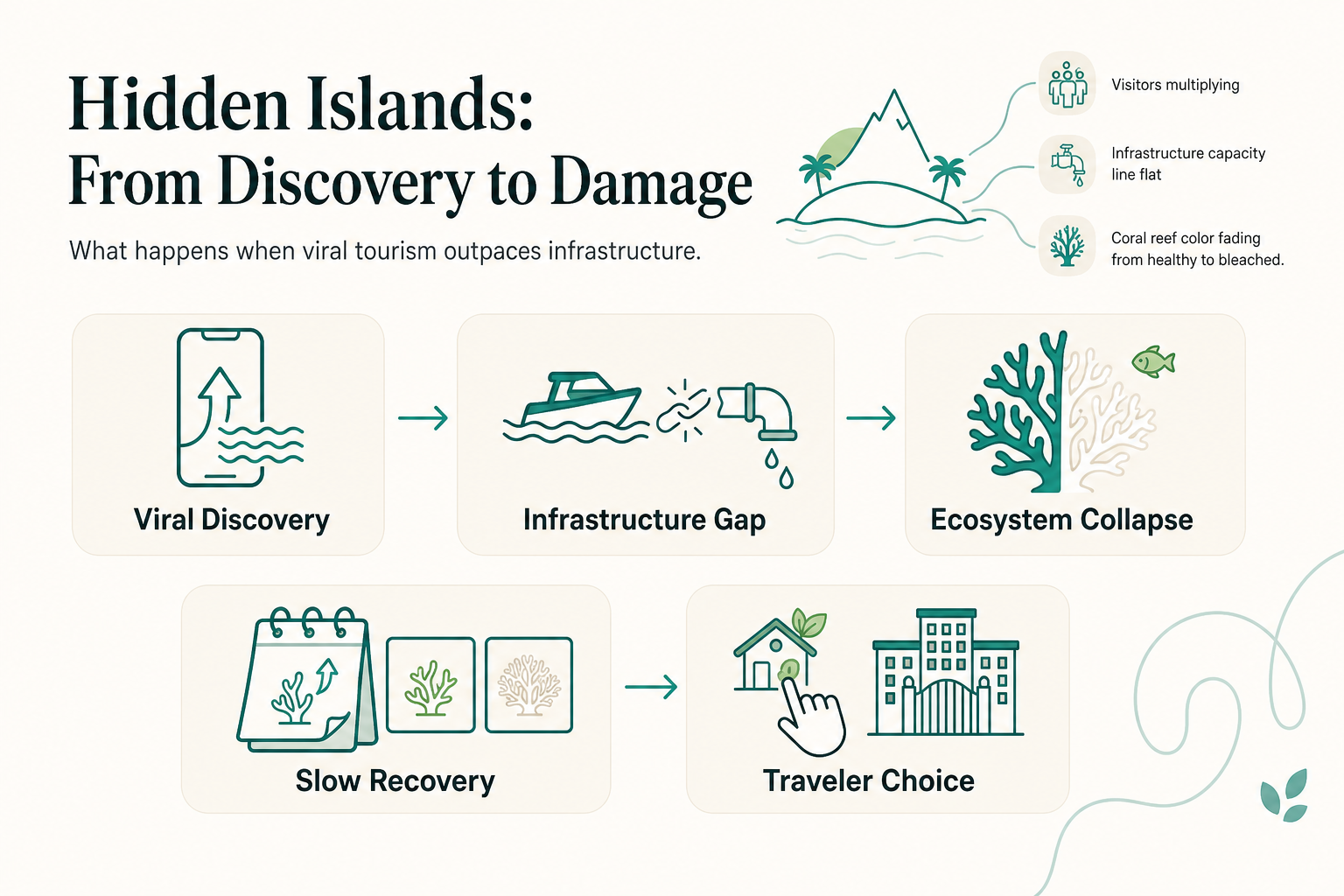
When a remote island gets discovered, the sand and water usually look the same for a year or two. What changes first is invisible: booking volume, boat traffic, wastewater load. By the time the coral damage is visible, the destination that made people want to go there is already gone. Thailand's Maya Bay saw daily visitors climb from 170 in 2008 to more than 5,000 by 2018, and lost roughly half its coral reef in the process. Boracay lost 70 percent of its coral cover between 1988 and 2011. Both are case studies in what tourism researchers call carrying capacity failure, and both are cautionary tales for anyone planning a trip to a place still described as "undiscovered."
TL;DR
- Viral discovery (driven heavily by TikTok and Instagram) can push visitor numbers past an island's ecological limit in a few years, sometimes faster.
- Maya Bay and Boracay both lost roughly half or more of their coral cover once tourism outpaced infrastructure and regulation.
- Water clarity and marine life can recover within about seven months of reduced pressure, but coral structure needs at least five years to mature, and severely damaged reefs can take decades.
- The Global Sustainable Tourism Council's four-pillar framework (management, local benefit, cultural protection, environmental impact) is the closest thing to an industry standard for avoiding this outcome.
- Slow travel to small-scale, capacity-limited destinations is the practical way for individual travelers to avoid contributing to the next Maya Bay.
What Actually Happens When a Hidden Island Goes Viral?
A destination going viral means a specific platform mechanism, not vague popularity. TikTok's short-form video algorithm and Instagram's Reels are the documented drivers of most modern destination surges, rewarding visually striking, easily replicable content. Dubai has passed 81 billion TikTok views; London has over 150 million tagged Instagram photos. The mechanism is straightforward: one clip performs well, the algorithm pushes it to more feeds, and thousands of travelers arrive within a booking cycle or two, aiming to recreate the same shot.
Small islands are structurally unprepared for this. A destination built for 200 daily visitors has no fast way to add wastewater treatment capacity, boat mooring and dive-site rotation systems, trained local staff for hospitality and conservation, or waste collection and disposal infrastructure. Demand can scale in months. Infrastructure takes years. That gap is where the damage happens.
Why Does Environmental Damage Happen So Fast Once Tourism Scales?
Coral reefs and small marine ecosystems operate on tight ecological margins. Damage compounds quickly once a threshold is crossed, and the relationship between visitor numbers and harm is not linear. A reef can absorb a certain amount of foot traffic, anchor damage, and runoff and still function. Past that point, stress accumulates faster than the ecosystem can process it.
Boracay's decline followed this pattern: unregulated construction and inadequate wastewater systems fed nutrient pollution directly into reef zones, compounding boat and swimmer pressure. Nearly three-quarters of the coral cover was gone.
Maya Bay's damage came from a narrower but more concentrated cause: thousands of daily visitors in a small, enclosed bay, with boat anchors and foot traffic doing direct physical damage to coral that had no time to recover between waves of tourists. Neither collapse was sudden. Both were the visible result of years of demand outpacing any planning for it.
What Does Recovery Actually Look Like, and How Long Does It Take?
Recovery timelines differ sharply depending on what exactly needs to heal. Water clarity and marine wildlife can rebound within about seven months once tourism pressure drops, based on documented closures. That is the part visitors notice first, and it can create a false impression that a destination has fully recovered.
Coral structure is different. Corals need at least five years to mature and reproduce even under ideal conditions, and severely degraded reefs can take decades to regenerate fully. Maya Bay's 2018 to 2021 closure restored visible water clarity and brought sharks back to the bay within months, but the underlying coral structure is still years from maturity.
A destination that looks recovered on Instagram may still be ecologically fragile, and reopening too soon or too fully risks repeating the original damage cycle.
Is There a Standard for How Many Visitors an Island Can Handle?
There is no single universal visitor cap that applies across destinations. Instead, the framework calculates three carrying capacities specific to each location: Physical Carrying Capacity (the hard infrastructure limit), Real Carrying Capacity (adjusted for environmental and social factors), and Effective Carrying Capacity (the number actually manageable given local staffing and management).
The Global Sustainable Tourism Council's certification framework operationalizes this across four pillars:
| Pillar | What It Covers |
|---|---|
| Sustainable management | Planning, monitoring, and limiting visitor impact over time |
| Local socio-economic benefit | Whether tourism revenue reaches the surrounding community |
| Cultural heritage protection | Respecting and preserving local traditions and sites |
| Environmental impact minimization | Waste, water, energy, and habitat protection |
A destination without an answer to "what is our effective carrying capacity" is a destination without a plan for what happens if it goes viral.
How Can Travelers Choose Destinations That Won't Repeat This Cycle?
Individual travelers cannot fix carrying capacity policy, but they can choose where their visit adds pressure and where it doesn't.
Step 1: Check if room count is a real limit, not a marketing line.
A property with no expansion plan behaves differently than a resort chain with phase two already permitted.
Step 2: Look for infrastructure that matches the location's actual capacity.
Off-grid solar power, on-site desalinated water, and zero single-use plastic policies indicate a property built for its site rather than one straining local utilities.
Step 3: Ask what happens to marine environments the property depends on.
A dive center that publishes real visibility numbers and works with a marine conservation certification is giving you verifiable information, not a slogan.
Reconnect, an eco-resort with an on-site SSI dive center on Buka Buka Island in the Togean Islands, operates under this exact model. The resort is deliberately capped at 20 rooms, 93 percent solar-powered, produces its own desalinated water on-site, and runs a zero single-use plastic policy. These choices exist because there is no municipal grid or water system to fall back on if visitor numbers spike. The SSI-affiliated, Blue Oceans certified dive center here offers visibility averaging about 30 meters on reefs and walls close to the island.
Guests can also visit nearby Bajau sea nomad communities, a cultural encounter that depends entirely on the area staying small enough that those villages remain functioning communities rather than photo stops.
Frequently Asked Questions
How fast can a hidden destination become overtouristed?
Based on documented cases like Maya Bay, the shift from low-impact to ecologically damaged can happen within roughly a decade, and viral social media exposure can compress that timeline further.
Is scuba diving in Sulawesi affected by overtourism the way Southeast Asian dive spots elsewhere are?
Parts of the Coral Triangle remain lightly visited precisely because they lack the infrastructure and access that drove volume elsewhere; that is also why capacity planning matters before, not after, visibility increases.
What can one traveler realistically do to avoid contributing to overtourism?
Choose properties with a fixed, stated room cap, ask about power and water sourcing before booking, and favor longer stays in fewer places over rapid multi-stop itineraries.
Reconnect is a Private Island Resort and eco-resort with an on-site SSI dive center on Buka Buka Island in Indonesia's Togean Islands. To plan a visit or ask about capacity, transfers, or the dive center, get in touch through reconnect.id.