


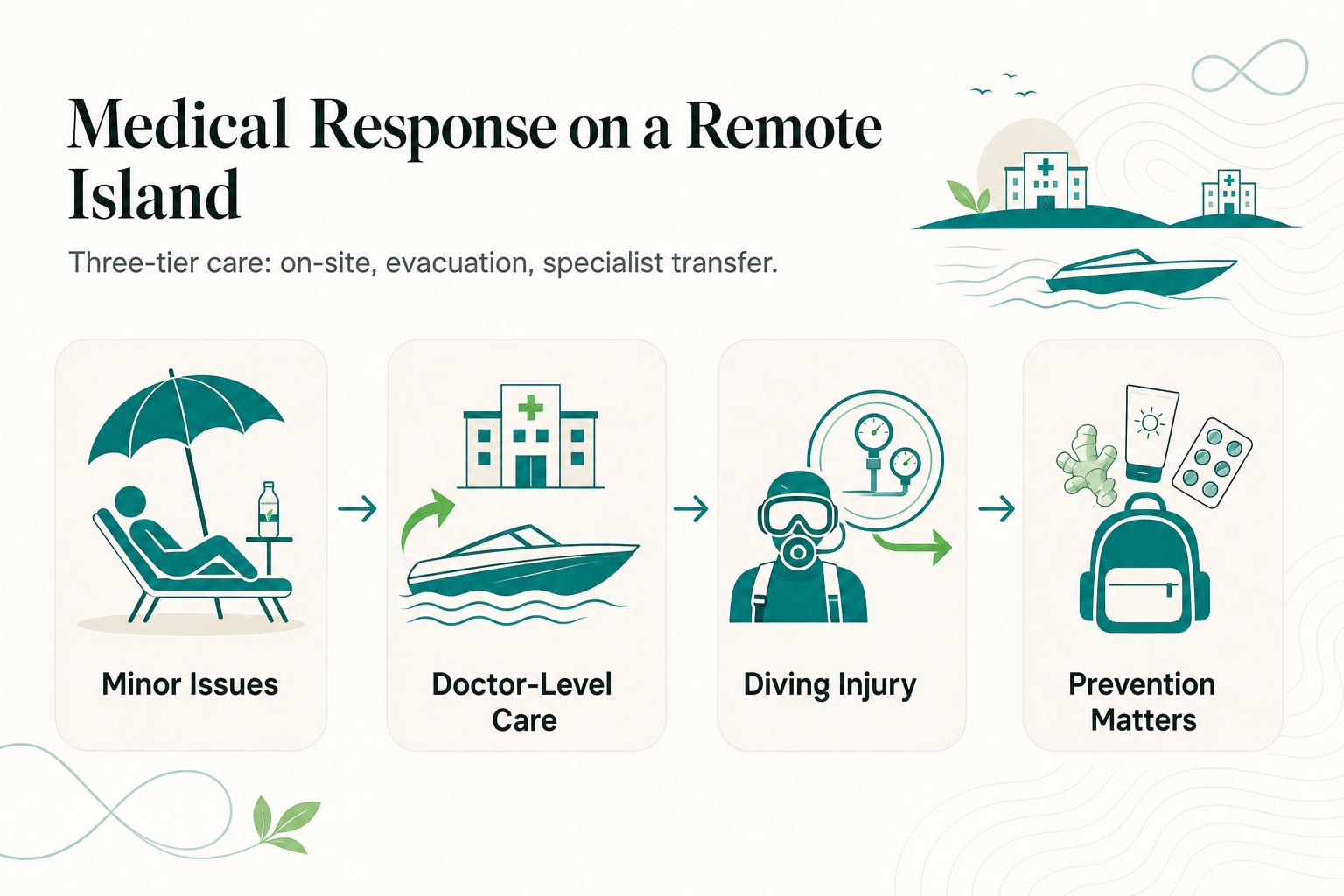
If you get seasick, sunburned, or unwell while staying at Reconnect, the response is layered: on-site first aid and rest for minor cases, a coordinated speedboat and car evacuation to Ampana for anything needing a hospital, and a further transfer to Palu for diving injuries requiring a decompression chamber. Remote islands cannot offer emergency-room medicine on demand. What they can offer is a clear plan, and knowing that plan before you book is what actually reduces risk.
TL;DR
- Minor issues (seasickness, sunburn, mild stomach upset) are handled on-site with rest, hydration, shade, and basic first aid.
- Anything requiring a doctor means evacuation to Ampana by speedboat and car.
- Decompression sickness from diving requires a further transfer to the nearest chamber in Palu, coordinated through specialized emergency medical assistance.
- SSI's medical questionnaire does not disqualify divers for seasickness or sun sensitivity, but it does require a doctor's clearance if you flag certain conditions.
- Prevention (ginger, hydration, reef-safe sunscreen, staying on deck) matters more here than it would somewhere with a hospital twenty minutes away.
What Counts as a Minor Issue Versus an Emergency on a Remote Island?
Minor issues are things rest, hydration, and basic supplies resolve within hours: seasickness during the boat transfer, sunburn from a day on the water, a mild headache or stomach upset. Emergencies are anything that needs a doctor, imaging, or medication beyond a first aid kit, think suspected fractures, high fever that doesn't break, or diving injuries. The distinction matters because the response is completely different.
Remote island resorts in Indonesia typically maintain limited medical response capabilities. That means basic first aid supplies, emergency oxygen, and a defined evacuation plan to mainland hospitals, not an on-site emergency room. Most small island resorts, including Reconnect, are built around this first model: strong first-response capability paired with a fast, well-rehearsed evacuation route, not a standing clinic.
Reconnect's day-to-day approach:
- First aid kits and emergency oxygen on-site, staffed by team members trained in basic response.
- A pre-planned evacuation route to Ampana for anything beyond first aid.
- Direct coordination with emergency medical assistance providers for diving-specific injuries.
How Do You Handle Seasickness on the Way to a Remote Island?
Seasickness comes from a sensory mismatch: your inner ear registers motion, but your eyes, especially if fixed on a phone or the boat's interior, tell your brain you're still [oceanservice.noaa.gov]. That conflict is what triggers nausea, not the waves themselves. Understanding the mechanism explains why the fixes all point toward realigning what your eyes and ears are telling you.
Seasickness prevention tips that actually work on this route:
- Stay on deck and fix your eyes on the horizon rather than the boat interior [oceanservice.noaa.gov] [konasnorkeltrips.com].
- Keep moving air across your face; closed, stuffy cabins make nausea worse [victoriawhalewatching.com].
- Stay hydrated before and during the crossing; dehydration amplifies symptoms [oceanservice.noaa.gov] [getmyboat.com].
- Take motion-sickness medication (like dimenhydrinate) before symptoms start, not after [getmyboat.com] [gogetlost.com].
- Ginger, in capsule, candy, or tea form, is a commonly used natural option worth packing [getmyboat.com] [gogetlost.com].
None of this is unique to the Togeans, but the stakes are higher here than on a short ferry ride: there's no pulling over, and the nearest pharmacy is hours away. Pack what you need before you leave Luwuk. The Luwuk to Ampana journey takes 5 hours by car, then a 30-45 minute speedboat crossing to reach Buka Buka Island; the speedboat leg is where seasickness risk peaks.
What About Sunburn, Heat, and Everyday Illness?
Sun exposure near the equator at low latitude is intense, and reef glare off the water adds to it even on overcast days. Reef-safe sunscreen (mineral-based, reapplied every two hours in and out of the water), a hat, and a rash guard for snorkeling or diving handle most of it. If sunburn happens anyway, Reconnect's staff can provide aloe, hydration, and shade. Severe sunburn with blistering or fever moves into the same evacuation conversation as any other flagged medical issue.
Everyday illness, stomach upset, mild fever, headaches, is handled the same way: rest, fluids, over-the-counter medication from the first aid kit. Travelers on prescription medication should bring a full supply for the trip; there is no pharmacy on Buka Buka Island.
What Happens If a Diver Needs Medical Evacuation?
This is the scenario every serious dive traveler should understand before booking anywhere remote, not just at Reconnect. SSI requires all divers to complete a Diver Medical Participant Questionnaire before diving. Seasickness and sun sensitivity are not disqualifiers, they're treated as environmental hazards divers accept by signing the standard liability release. But certain flagged conditions (cardiac history, recent surgery, some respiratory issues) require a physician's written clearance before you're allowed in the water.
If something does go wrong underwater, the standard protocol for suspected decompression sickness is immediate 100% oxygen, isotonic fluid hydration, and rapid evacuation to a hyperbaric chamber. When evacuation is delayed, moderate cases are sometimes managed on-site with portable hyperbaric equipment or carefully planned in-water recompression.
For the Togean Islands, that means:
| Step | Destination | Transport | Purpose |
|---|---|---|---|
| 1 | Ampana | Speedboat + car | Nearest basic hospital, general medical care |
| 2 | Palu | Coordinated evacuation | Nearest decompression chamber, diving injuries only |
This is a longer chain than divers from Europe or Australia are used to, and it's exactly why Reconnect's dive team runs a Blue Oceans certified operation with conservative dive planning: staying well within no-decompression limits, briefing every diver on ascent rates, and keeping guided groups small. Prevention through disciplined dive practice matters more here than in destinations with a chamber an hour away.
Frequently Asked Questions
Is travel insurance required to dive or stay at Reconnect?
Reconnect does not mandate a specific insurer, but given the evacuation distances involved, travel insurance covering medical evacuation and diving injuries specifically is strongly recommended before you arrive.
Can I get diving-specific travel insurance for a trip like this?
Yes, dive-specific policies covering hyperbaric treatment and evacuation are widely available and worth checking against the Ampana-to-Palu evacuation chain described above.
Are there other island resorts in Indonesia with similar remote-medicine considerations?
Most remote island destinations across Indonesia, including well-regarded properties in Raja Ampat and Wakatobi, share this same limited-on-site, evacuation-plan model rather than full clinics, because of the same permit and staffing requirements.
Reconnect
Reconnect is an eco-resort with an on-site SSI dive center on Buka Buka Island in Indonesia's Togean Islands. Learn more at https://reconnect.id.
References
- What causes seasickness? (oceanservice.noaa.gov)
- How to Prevent & Cure Seasickness: The Complete Guide (getmyboat.com)
- How To Not Get Seasick On A Boat: A Kona Guide | Kona Snorkel Trips (konasnorkeltrips.com)
- Sea Sickness Prevention | Go Get Lost® Worldwide Adventures (gogetlost.com)
- Preventing Sea Sickness: The Whale Watcher's Guide! - Springtide Whale Watching (victoriawhalewatching.com)