


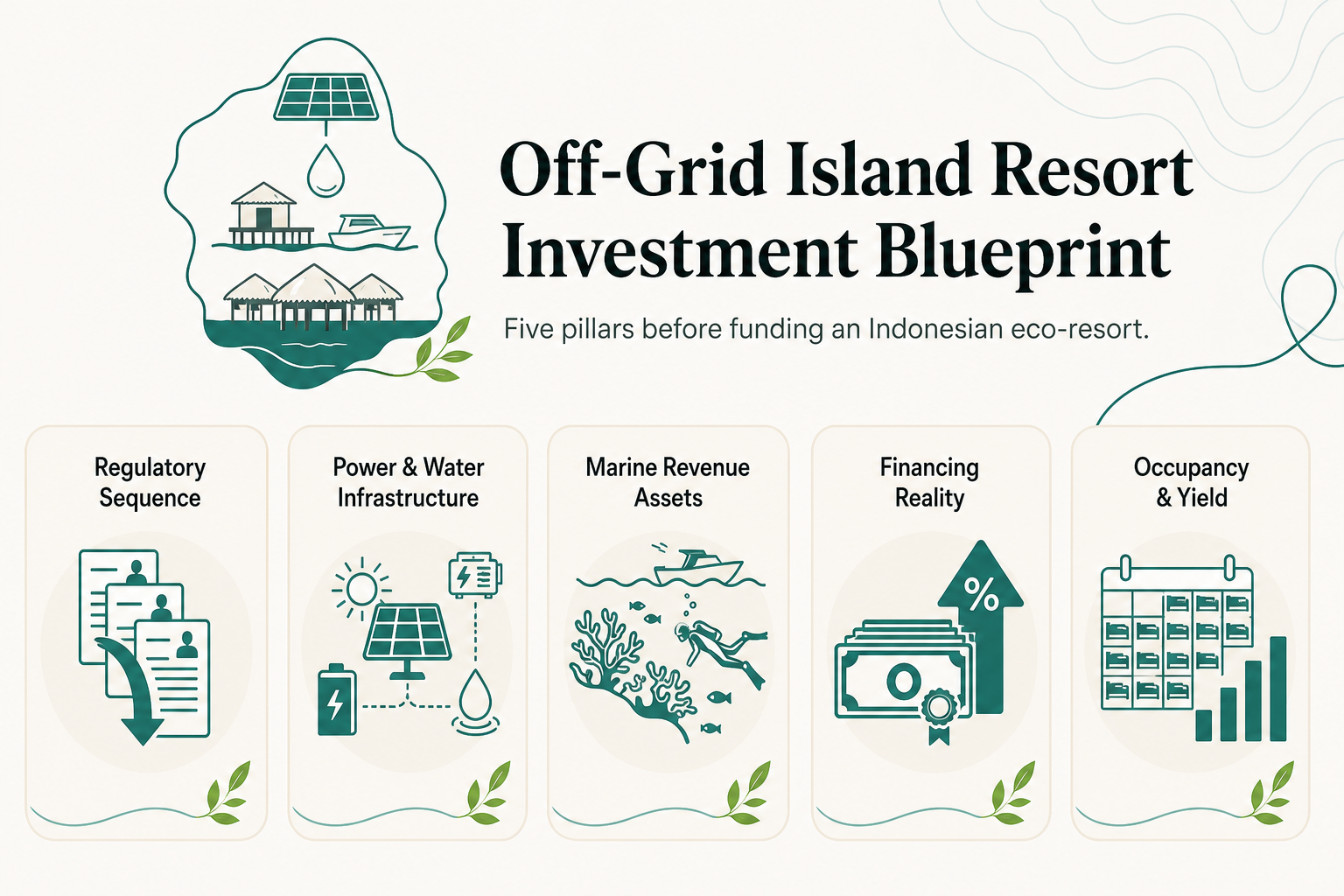
Funding an off-grid island resort in Indonesia means underwriting three separate risks at once: power generation, water production, and marine logistics, each in a location with no grid to fall back on. Get the technical specifications wrong and the resort cannot open. Get the regulatory sequence wrong and it cannot legally operate. The Indonesian ecotourism market is projected to grow at a 10.53% CAGR, reaching over $8 billion by 2034, and well-run island eco-resorts are producing net annual rental yields of 8% to 15% at occupancy rates of 70% to 85%. Those returns depend entirely on getting the off-grid engineering and licensing right before the first guest arrives.
TL;DR
- A 20-room off-grid resort needs a 50-100 kWp solar array with 100-200 kWh of LiFePO4 battery storage to hit 98% power availability.
- Licensing requires a Tourism Business License (TDUP), a PT or PMA legal entity, an NPWP tax number, environmental permits (UKL-UPL or AMDAL), building approvals (PBG), and Port Authority vessel registration.
- Indonesian ecotourism is growing at a 10.53% CAGR toward $8 billion by 2034, with island properties yielding 8-15% net annually at 70-85% occupancy.
- Marine visibility in the Togean Islands averages 20-40 meters, a genuine asset for dive tourism revenue but not one that offsets weak infrastructure.
- Generator backup is a compliance requirement, not a business model; investors should treat solar-first design as the baseline, not a premium option.
About the Author: Reconnect operates a 20-room off-grid eco-resort and SSI dive center on Buka Buka Island in the Togean Islands, running on 93% solar power with on-site desalination since construction. This article draws on that build-and-operate experience, not secondhand research.
What Regulatory Steps Come Before Any Construction Begins?
Indonesian resort licensing follows a fixed sequence, and skipping a step stalls the whole project. Operating an off-grid resort in the Togean Islands requires a Tourism Business License (SIUP Pariwisata or TDUP), a registered legal entity such as a PT (local) or PMA (foreign-owned), and a taxpayer identification number (NPWP) [landlimited.com].
Beyond the business license, three further approvals apply specifically to remote island sites:
- Environmental permits (UKL-UPL for smaller projects, AMDAL for larger ones) assessing impact on reef and coastal ecosystems [landlimited.com]
- Building approvals (PBG), replacing the old IMB system, covering structural safety for tropical construction [landlimited.com]
- Port Authority (Syahbandar) registration for any resort-operated boats, covering safety equipment and crew certification [landlimited.com]
An island site adds a wrinkle a mainland hotel never faces: every guest and every kilogram of building material arrives by boat, so vessel compliance is not administrative overhead. It is the only way materials, staff, and revenue-paying guests reach the property at all.
What Are the Real Technical Requirements for Off-Grid Power and Water?
Off-grid does not mean improvised. A 20-room resort in a tropical climate typically needs a 50 to 100 kWp solar array paired with 100 to 200 kWh of lithium iron phosphate (LiFePO4) battery storage. LiFePO4 is specified over cheaper lead-acid chemistry because it tolerates the daily full-discharge cycles a resort load profile creates, without the capacity fade that would otherwise force a battery replacement within a few years.
Marine and tropical conditions demand hardware most mainland solar installers never spec:
| Requirement | Why it matters |
|---|---|
| High wind-load rating | Cyclone and storm resilience for panel mounting |
| IP54/IP65 waterproofing | Salt spray and monsoon rain exposure |
| IEC 61701 salt-mist resistance | Prevents corrosion of electrical contacts near seawater |
| Automated diesel backup | Maintains 98% power availability when batteries drop below 20% |
That last line item is the one investors most often misread. A backup generator is a regulatory and reliability necessity, not evidence the resort is "mostly solar with a diesel crutch." At Reconnect, solar supplies 93% of total power, with the generator running only when battery reserves are genuinely low. The 7% gap is the cost of guaranteeing power on a cloudy week in a location with zero grid connection to fall back on.
Desalination and drinking water production follow the same logic: sun-powered units producing water on-site remove dependence on barged-in bottled water or municipal supply that does not exist on a remote island in the first place.
How Should Investors Size the Marine and Dive Tourism Opportunity?
The reef itself is a revenue asset, and its condition is measurable. Average marine visibility in the Togean Islands ranges from 20 to 40 meters, peaking in the dry season between April and November [practicalselfreliance.com]. Reconnect's own dive operation, running guided dives on reefs around Buka Buka Island, documents visibility averaging 30 meters, consistent with that regional range.
The Togeans combine atolls, barrier reefs, and fringing reefs with steep walls and drop-offs, plus named draws like the volcanic pinnacles of Una Una, a WWII B-24 Liberator wreck, and a marine lake of stingless jellyfish [practicalselfreliance.com]. That variety matters commercially: a resort selling only house-reef snorkeling has one product, while a resort with an SSI-certified dive center and boat access to multiple site types can sell certification courses, guided dive packages, and day excursions as separate revenue lines. Course fees, in particular, should be modeled separately from full-board room revenue since they are typically sold and paid for independently of the accommodation rate.
Where Do Off-Grid Island Resort Budgets Actually Break Down?
Financing an off-grid property is structurally different from financing a conventional hotel, and lenders treat it that way. Off-grid homes generally cannot qualify for a traditional mortgage, since standard lending products assume connection to municipal utilities [practicalselfreliance.com]. Off-grid land purchases carry their own diligence burden too: investors need to verify the land legally permits residential and commercial construction before committing capital [landlimited.com].
Budget planning for an island eco-resort typically spans four categories:
- Land and entity setup: island acquisition or lease, PT/PMA formation, initial permits
- Power and water infrastructure: solar array, battery bank, desalination units, generator backup
- Marine infrastructure: jetty, vessels, Port Authority compliance, dive center equipment
- Build-out: accommodation units, kitchen and staff facilities, connectivity (satellite internet where no cellular network reaches)
Financing options that work outside traditional mortgages include specialized off-grid lenders, seller financing, and cash-plus-phased-development models where early revenue funds later room additions [spintheglobeproject.com][practicalselfreliance.com]. Investors should also budget conservatively on the interest side: off-grid properties often carry a rate penalty of roughly 1 percentage point above standard mortgage rates when lenders will finance them at all [spintheglobeproject.com].
What Makes an Off-Grid Resort Investable Rather Than Just Sustainable?
Sustainability credentials do not by themselves produce yield. What does: occupancy discipline, a diversified revenue mix beyond room nights, and infrastructure sized correctly from day one rather than retrofitted under guest pressure. A resort that undersizes its solar array to save capital will spend the next five years running the generator as primary power, quietly becoming the "generator-powered resort" no eco-conscious traveler wants to book.
The eco-resort case study worth studying closely is one where power, water, and marine access were engineered together before construction, not layered on after. Reconnect's build, an SSI dive center with direct reef access, 93% solar power, and on-site desalination running on 20 rooms, reflects that sequencing: infrastructure first, guest experience and revenue lines built on top of a system that does not fail when a resupply boat is late.
Frequently Asked Questions
Does an off-grid resort need internet connectivity to be commercially viable?
Increasingly yes, for both guest experience and operations. Satellite systems like Starlink now make reliable internet possible in locations with no cellular tower for many kilometers, a combination that was rare in remote Indonesian archipelagos until recently.
Can a PMA (foreign-owned entity) structure own island resort land directly?
Land ownership rules for foreign investors in Indonesia are specific to entity type and location; this requires direct legal counsel rather than a general answer, since structures vary by island and provincial regulation.
How long does the full licensing process typically take?
Timelines depend on which permits apply (UKL-UPL versus full AMDAL, for instance) and provincial processing speed, so investors should budget for variable timelines rather than a fixed number.
Is diesel generator backup a sign of poor off-grid design?
No. Regulatory and reliability standards call for backup generation to maintain 98% power availability when batteries run low. The question investors should ask is what percentage of total power comes from solar versus generator, not whether a generator exists at all.
What occupancy rate should investors underwrite for a new island eco-resort?
Established prime-area island properties run 70-85% occupancy. New properties should model a ramp-up period below that range rather than assuming mature-market occupancy in year one.
About Reconnect
Reconnect is a private island eco-resort and SSI-certified dive center on Buka Buka Island in Indonesia's Togean Islands, founded by Thomas Despin. The resort runs on 93% solar power with on-site desalinated water and zero single-use plastics, offering 20 rooms across full-board all-inclusive stays from EUR 60/night. Its dive center provides direct reef access to sites averaging 30 meters visibility, without long boat transfers.
To see how this infrastructure model works in practice, visit Reconnect.
References
- How much does a private island cost? Complete guide - Wise (wise.com)
- How to Finance an Off-Grid House — Spin the Globe Project (spintheglobeproject.com)
- What You Should Know Before Buying Off-Grid Land - Land Limited (landlimited.com)
- Financing Off Grid Property ~ Things to Know (practicalselfreliance.com)