


Travel sites can tell you the ferry schedule, the average temperature, and the name of the national park. What they cannot tell you is which channel floods too fast to cross at low tide, which reef recovered from the 2016 bleaching event and which did not, or which Bajau family still builds boats the way their grandfather did. That knowledge lives with people who never wrote a blog post about it, because they were too busy living the answer.
TL;DR
- Local guides in remote Indonesia hold operational knowledge (tides, weather patterns, reef conditions, village customs) that is too hyperlocal and fast-changing for travel sites to document.
- This knowledge gap is largest in places like the Togean Islands, where infrastructure, internet, and even basic mapping lag far behind Bali or Lombok.
- Bajau sea nomad communities carry generations of marine knowledge that shapes real-time decisions about where to snorkel, dive, or anchor.
- Resorts with locally hired staff function as a knowledge bridge, translating that expertise into a usable guest experience.
- The best way to access this knowledge is to stay somewhere the guides live, not somewhere they are flown in to work.
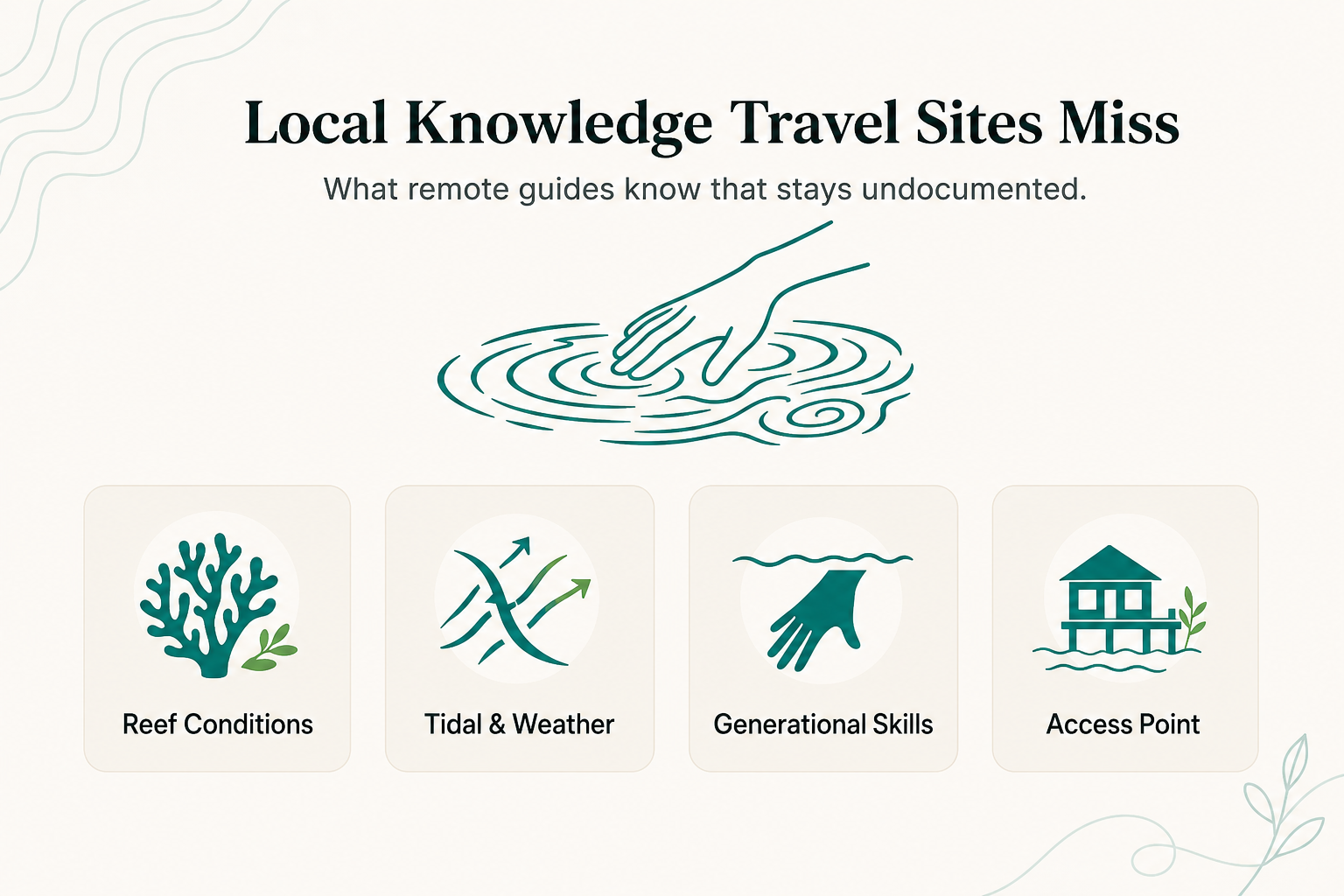
Why Doesn't This Knowledge Show Up on Travel Sites?
Travel sites are built for scale. They index places with enough search volume, enough reviews, and enough repeat traffic to justify the content. The Togean Islands, an archipelago in the Gulf of Tomini administratively part of Tojo Una-Una Regency in Central Sulawesi, sit well outside that volume.
A travel site can describe a region in a paragraph. It cannot track that the east channel near a specific reef silts up after heavy rain, or that a particular dive site is only calm before 10am. That kind of detail changes week to week, sometimes day to day. It is maintained by observation, not by publishing.
This is the structural reason hidden gems in Indonesia stay hidden even as digital travel content multiplies. The information exists. It is just not the kind of information that scales into an article.
What Do Bajau Guides Actually Know That Isn't Written Down?
The Bajau, often called sea nomads, are an ethnic group historically living aboard boats across the Sulawesi and Sulu seas, with many communities now settled in stilt villages across the Togean Islands and nearby waters. Their knowledge is built from generations spent reading water, not studying it.
What this looks like in practice:
- Reading surface texture to judge current strength before a boat crossing, without checking a tide table.
- Knowing which reef sections host juvenile fish nurseries and should be approached slowly, if at all.
- Tracking seasonal fish movements tied to monsoon shifts, information that determines where a snorkeling trip will actually be worthwhile that week.
- Free-diving techniques passed down for generations, originally developed for spearfishing, now also useful for showing guests how to equalize and dive down efficiently.
None of this is secret. It is simply undocumented, because documenting it was never the point. It was the point of staying alive and fed on the water.
Why Does This Matter More in a Place Like the Togean Islands?
A related but distinct question is why the gap matters more here than in, say, the Gili Islands, where local guide networks are better documented through tour platforms. The answer is infrastructure density. The Gilis have enough visitor volume to support formal guide listings and reviews. The Togeans do not, yet the marine environment rewards exactly the kind of guide knowledge that goes undocumented.
The archipelago sits inside the Coral Triangle, and a 1998 rapid marine assessment by the Center for Applied Biodiversity Science at Conservation International recorded 819 fish species here, a figure that signals genuine reef complexity, not marketing shorthand. Visibility commonly averages around 30 meters. That combination, high species density plus very good visibility, is part of why the Togeans are mentioned alongside other underrated Sulawesi destinations in broader guides to adventure travel in Indonesia [travelovin.com].
High biodiversity does not automatically mean easy access to it. Knowing which reef section is worth the boat ride on a given day still depends on someone who was out there yesterday.
How Do You Actually Access This Knowledge as a Traveler?
You cannot search for it, because it was never indexed. You access it by proximity: staying somewhere the people holding the knowledge actually work, live nearby, or are related to someone who does.
Option 1: Independent local guide hire
In destinations with formalized guide networks, travelers can hire independent local guides directly. This works well where those networks exist, though in remote regions without established platforms, it depends on arriving already knowing who to ask, which defeats the purpose for a first-time visitor.
Option 2: Small group tours with local operators
Multi-day group trips through Sulawesi and other underrepresented islands increasingly build in local guiding as a core feature rather than an add-on [gadventures.com][responsiblevacation.com]. This gets you expertise without needing contacts ahead of time, though the knowledge arrives filtered through a tour itinerary rather than in real time.
Option 3: Stay where the staff are from the place
The most direct route is a resort or lodge where guides and staff are hired from the surrounding villages, not flown in. At Reconnect, all staff are hired locally, with supplier partnerships extending into neighboring Bajau communities. Guests get access to reef knowledge and local history as a byproduct of daily operations, not as a scheduled excursion.
This is also why a dedicated village visit excursion to nearby Bajau communities carries more weight when the people running it already have a working relationship with the village, rather than a one-off arranged tour.
How Should Travelers Evaluate Whether a Resort Actually Has This Knowledge?
Before booking, the honest signal is not marketing copy. It is whether the operation is staffed by people from the region.
| Signal | What it indicates |
|---|---|
| Staff hired from surrounding villages | Day-to-day access to current reef, weather, and tide knowledge |
| Dive center with named local instructors | Site-specific knowledge, not generic certification |
| Direct supplier relationships with villages | Ongoing relationship, not a single staged visit |
| Independently verified reviews (TripAdvisor, Google, Booking.com) | Confirms guest experience matches the claim |
Reconnect's dive center is SSI-affiliated and Blue Oceans certified, and the resort carries a 4.9 rating on TripAdvisor, 4.8 on Google, and 9.2 on Booking.com across 981 verified reviews. These are the kind of island resort reviews worth checking before trusting any claim about local expertise, including ours.
Frequently Asked Questions
Is local guide knowledge in Indonesia only relevant for diving and snorkeling?
No. It extends to weather reading, village etiquette, boat safety, and timing for land excursions. Diving and snorkeling are simply where the knowledge gap is most measurable, since reef conditions change often and travel sites rarely update that fast.
Are Bajau sea nomads still living a nomadic lifestyle today?
Most Bajau communities in the Togean Islands now live in permanent stilt villages rather than aboard boats full time, though boat-based fishing knowledge and free-diving skills remain central to daily life and are passed down within families.
Does staying at a resort with local staff cost more than a standard hotel?
Not necessarily. Reconnect's all-inclusive full-board rates start from EUR 60 per night, covering meals, house-reef snorkeling, kayaking, and paddleboarding, comparable to or below many mass-market beach properties elsewhere in Indonesia.
Can I hire a local guide independently without going through a resort?
In destinations with established guide platforms, yes. In more remote regions like the Togeans, independent access is harder without existing contacts, which is why staying somewhere with local staff is often more practical for a first visit.
What is considered the best snorkeling in Indonesia if I want a quieter alternative to Bali or the Gilis?
The Togean Islands, with roughly 30-meter average visibility and documented high fish biodiversity within the Coral Triangle, are a strong option for travelers seeking strong reef conditions without the Gili Islands' crowd density.
About Reconnect
Reconnect is a Private Island Resort in Indonesia's Togean Islands with an on-site SSI dive center, built off-grid and solar-powered. All staff are hired locally, with supplier ties to neighboring Bajau villages. Rooms start from EUR 60 per night, all-inclusive. Learn more at reconnect.id.
References
- North Sumatra: Indonesia's Most Underrated Adventure Destination | Travel Guide | Travelovin (travelovin.com)
- Indonesia Tours & Small Group Trips 2026 | G Adventures (gadventures.com)
- Indonesia vacations & tours in 2026 & 2027 | Responsible Travel (responsiblevacation.com)