


An advanced diver is not defined by a number in a logbook. It is defined by specific, demonstrable skills: gas management under load, precise buoyancy in current, underwater navigation without surfacing to check a map, and calm decision-making at depths beyond 18 meters. A diver with 15 logged dives who has trained these competencies is genuinely more capable than one with 100 dives who has only repeated the same shallow reef dive each time.
TL;DR
- "Advanced" in diving refers to a skill set, not a dive count: the bookable course is Advanced Adventurer, five dives, zero prerequisites.
- The core technical gap is two mandatory skills: Deep Diving (gas management, no-decompression limits) and Navigation.
- Open Water divers train to a maximum recommended depth of 18 meters; Advanced Adventurer divers extend that to 30 meters.
- Intermediate divers often have high dive counts but weak buoyancy and air-consumption control; the course targets exactly those gaps.
- SSI's Advanced Adventurer is the structured five-dive course you actually book and train for, with no minimum logged dives required.
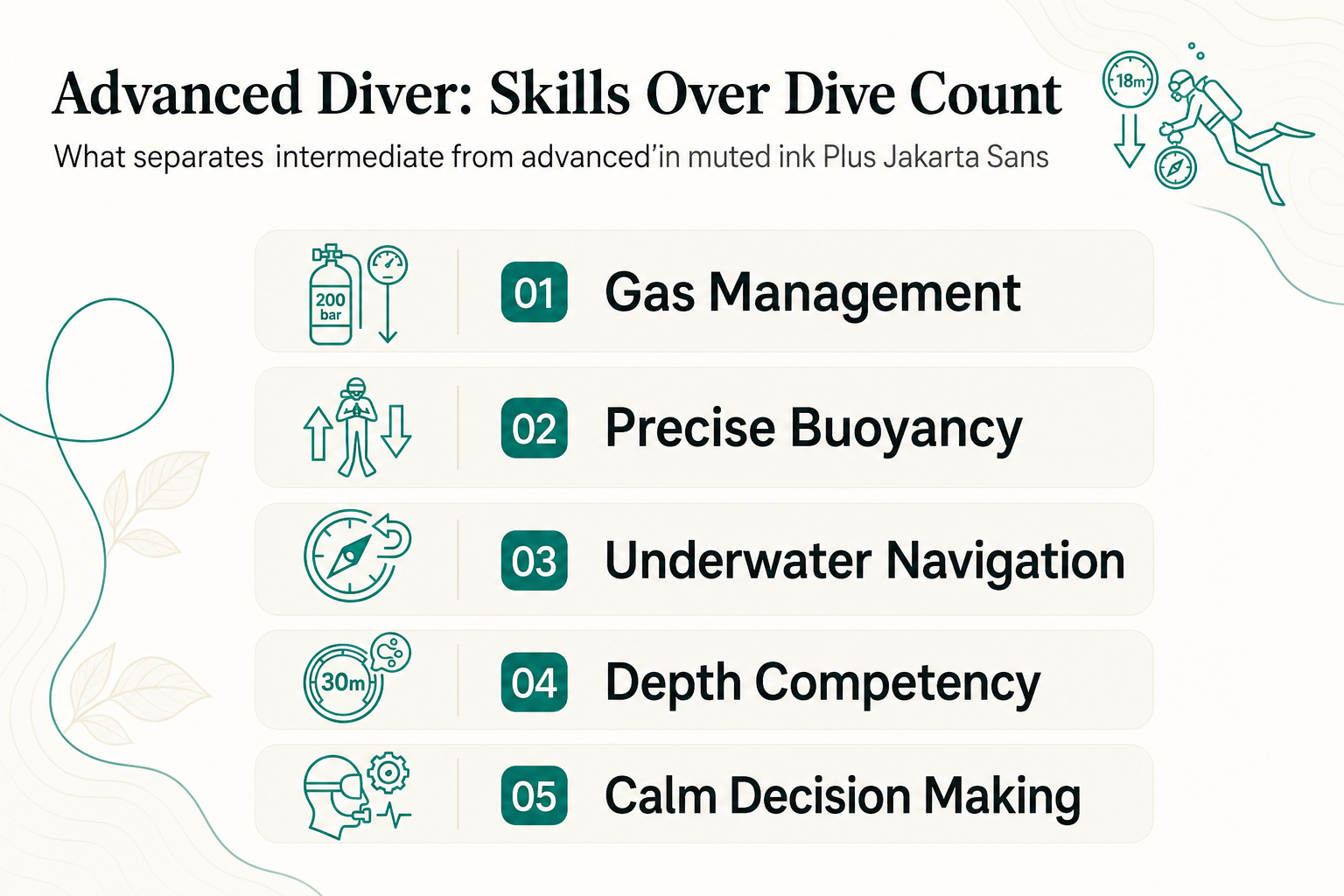
What Actually Makes a Diver "Advanced"?
Advanced scuba diving is not technical diving, and it is not extreme diving. It is a refinement of core skills every diver already started learning in Open Water: buoyancy control, navigation, depth awareness, and situational judgment.
The confusion comes from how divers self-assess. Someone who has done 50 dives on the same shallow house reef has repetition, not range. Range comes from deliberately training in conditions that demand new skills: current, depth, low visibility, night diving, or navigation without a guide leading the way [divessi.com].
This is why certification agencies do not gate advanced training behind a dive count. SSI's Advanced Adventurer course requires zero minimum logged dives to enroll. A diver can move directly from Open Water into advanced training. What the course requires instead is demonstrated competence in two specific skill areas, which is a very different bar than simply logging hours underwater.
What Does the Advanced Adventurer Course Actually Require?
SSI's Advanced Adventurer certification is five open water training dives, two of which are mandatory: Deep Diving and Navigation. The remaining three dives are chosen from an elective list, letting divers tailor the course toward wreck, drift, or night diving depending on where they plan to dive next.
The two mandatory dives target the exact gaps that separate a comfortable intermediate diver from a genuinely advanced one.
Deep Diving requires mastering gas management and understanding no-decompression limits, skills that become critical past 18 meters. Think of it the way a driver handles a car differently on a highway than in a parking lot: the margin for error shrinks as speed and distance increase. At depth, air consumption accelerates, narcosis risk increases, and ascent rates matter more. A diver who has never trained this has no practiced framework for managing it when it happens for real.
Navigation requires the diver to read a compass, track distance and direction underwater, and return to a start point without surfacing to reorient. This is the skill that turns a diver from someone who follows a guide into someone who can plan and lead a dive.
| Skill Area | Open Water Diver | Advanced Adventurer Diver |
|---|---|---|
| Max recommended depth | 18 meters | 30 meters |
| Mandatory training dives | Foundational skills only | 5 dives, Deep + Navigation mandatory |
| Minimum logged dives to enroll | N/A | 0 |
| Gas management under load | Not required | Required |
| Independent navigation | Not required | Required |
Why Does Course Naming Confuse So Many Divers?
SSI's bookable course is called Advanced Adventurer, and it consists of five open water training dives. You sign up, train, and get certified.
A separate thing entirely is a recognition rating that SSI awards automatically once a diver hits a combination of logged dives and completed specialties, without requiring a standalone purchase or additional training dives. The two credentials use similar language but function very differently. If you want the skills, specifically gas management, depth discipline, and navigation, you book the structured course. It is the training that changes your diving, not a title that accumulates in the background.
How Do You Know If You're Ready to Move Past Intermediate?
A related but distinct question from what the course requires is whether a given diver is actually ready to benefit from it. Dive count is a poor predictor here, but a few honest self-checks are useful.
- Air consumption: Can you complete a 40-minute dive at 12-15 meters without being the first in your group to signal low air?
- Buoyancy: Do you ascend and descend without using your hands, and hold a safety stop within a meter of target depth without fin kicks to correct?
- Stress response: Have you handled an unexpected situation, a mask flood, a minor current shift, without your breathing rate spiking?
- Navigation instinct: Could you point back toward the boat right now without looking at a guide?
If the honest answer to two or more of these is no, more dive count alone will not fix it. Structured training will, because it isolates the skill and drills it deliberately rather than leaving it to chance repetition.
Where Does This Training Actually Happen?
Indonesia sits inside the Coral Triangle, and scuba diving trips routinely combine the exact conditions advanced training calls for: depth, current, and varied topography within a short boat ride of each other. At Reconnect, on Buka Buka Island in the Togean Islands, Advanced Adventurer training dives happen at reef sites around the island, reached by a short boat ride rather than a long transfer. Visibility averages about 30 meters, which matters directly for navigation training since compass work is far harder to learn when you cannot see your own fin tips.
Instruction runs in English, French, and Indonesian, in small groups, through our SSI-affiliated, Blue Oceans certified dive center. The dive course itself is booked and paid for separately from your stay. Our all-inclusive full-board rate, from EUR 60 per night, covers meals, house-reef snorkeling, kayaking, and paddleboarding, not certification training. If you want guided dives without a course, the Dive-cation package offers 8 guided dives over 5 days instead.
Reconnect's dive center sits on-site, so training dives do not require a long boat transfer to reach sites with the depth and current variation the Advanced Adventurer course needs.
Frequently Asked Questions
Do I need a minimum number of logged dives before taking an advanced course?
No. SSI's Advanced Adventurer course requires zero logged dives to enroll, though most divers complete it after their Open Water course and a handful of fun dives.
How long does the Advanced Adventurer course take?
It consists of five open water training dives, typically completed over two to three days depending on surface interval requirements and site access.
What is the difference between Deep Diving and Navigation as mandatory dives?
Deep Diving trains gas management and no-decompression limits at depths up to 30 meters; Navigation trains compass use and underwater route-finding without surface reference. Both are required; the other three dives are elective.
Can I choose which elective dives to take?
Yes. Common electives include night diving, wreck diving, and drift diving, chosen based on where and how you plan to dive afterward.
Is advanced certification required to dive at 30 meters?
Practically, yes. Open Water training caps recommended depth at 18 meters; going deeper without the Deep Diving training dive means diving outside your certified limits.
About Reconnect
Reconnect is a private island eco-resort on Buka Buka Island in the Togean Islands of Central Sulawesi, built around an SSI-certified, Blue Oceans certified dive center with direct reef access. The resort is 93% solar-powered, produces its own desalinated water on-site, and keeps dive groups small with 20 rooms. Stays start from EUR 60 per night, full-board, with complete transfer coordination from Luwuk Airport. Get in touch at reconnect.id.
References
- Which Advanced Diver Course Should You Take First? (divessi.com)