


Bali and the Gili Islands near Lombok dominate Indonesia's SSI open water course rankings for one simple reason: volume. There are 72 SSI-certified dive centers in Bali and 18 in the Gili Islands, compared to just 2 in the remote Togean Islands of Central Sulawesi. Rankings built on review counts and course throughput favor the places with the most instructors, the most daily departures, and the most students cycling through, not necessarily the best in-water teaching or the healthiest reef.
TL;DR
- Bali (72 centers) and the Gili Islands (18 centers) dominate SSI rankings on volume, not teaching quality.
- The Togean Islands run only 2 SSI-certified centers, so rankings built on review density will always favor Bali and Lombok.
- Remote centers must prove small class sizes, direct reef access, and instructor language coverage instead of competing on quantity.
- A center's SSI affiliation and Blue Oceans certification matter more than its ranking position when you're choosing where to actually learn.
What Actually Drives SSI Course Rankings in Indonesia?
SSI rankings aggregate review counts, course completions, and center density. Bali's 72 centers and the Gili Islands' 18 generate enormous review volume simply by processing more students every month than most other regions in the country combined.
A center certifying 50 Open Water divers a month will outrank a center certifying 8, even if the smaller center's instructor-to-student ratio is better and its reef access is shorter. Ranking algorithms reward activity, not pedagogy. That's not a flaw in SSI's system; it's how review aggregation works everywhere.
A high ranking tells you a center is busy. It doesn't tell you whether your open water dives happen in a group of 4 or a group of 12.
Why Does Center Density Matter for a Beginner Diver?
Center density means how many dive operators sit within a short radius of each other, competing for the same students. Bali's Padangbai and the Gili Islands pack dozens of operators into a few square kilometers.
High density cuts both ways.
- Competitive pricing. More operators means course prices stay comparable across the board.
- Scheduling flexibility. You can usually start a course the next morning if one center is full.
- Crowded training sites. Popular check-out dive spots see multiple schools running sessions simultaneously.
- Variable group sizes. Some operators keep ratios tight, others fill boats to capacity during peak season.
Low density, like the Togean Islands' 2 centers, works in reverse. Fewer scheduling options, but training dives happen at reef sites with far fewer other groups in the water at the same time.
What Must a Remote Dive Center Prove?
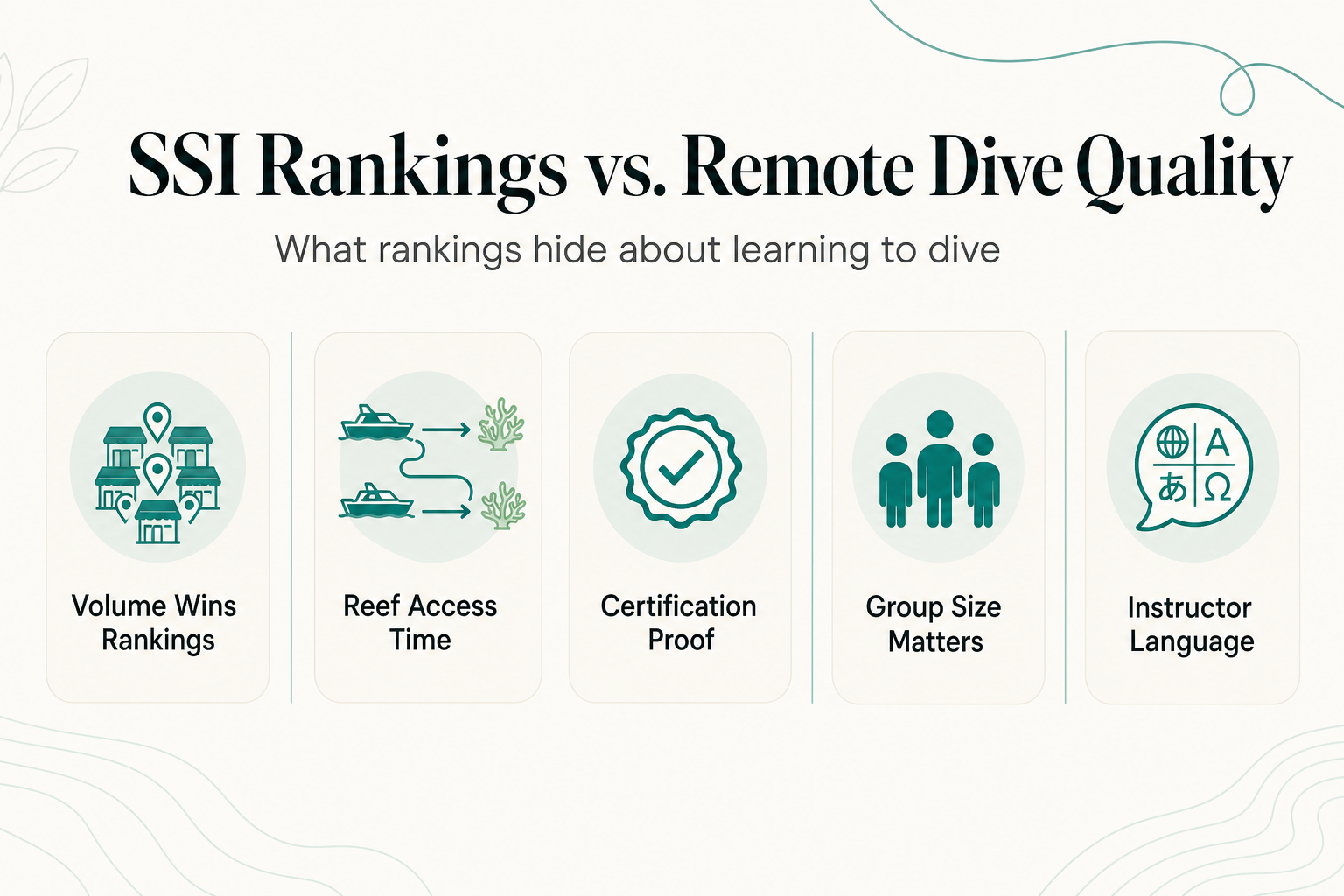
A remote center without review volume must substitute proof for popularity. Four things matter most.
Proof Point 1: Certification and Operational Standards
SSI affiliation confirms an instructor teaches the current curriculum under SSI's quality framework. Blue Oceans certification signals the center follows documented environmental practices in diving operations. Reconnect holds both.
Proof Point 2: Direct Reef Access
This saves the most time. Training dives at reef sites around Buka Buka Island are reached by short boat ride, not long transfers across straits. This removes commute time that eats into every dive day at a congested hub.
Proof Point 3: Group Size
Ask directly: how many students per instructor, per boat, per day? A remote center must prove it keeps ratios small on discipline, not market pressure alone.
Proof Point 4: Instructor Language Coverage
Confirm the instructor teaches in your language before booking. Reconnect's dive center instructs in English, French, and Indonesian, which matters for learning buoyancy control and emergency procedures in your first language.
How Does Togean Diving Compare to Bali and Lombok on Water Conditions?
Visibility and marine life are where the comparison gets genuinely interesting. The Togean Islands feature schooling barracuda, pygmy seahorses, and blacktip reef sharks on sheltered wall dives and volcanic seamounts.
Bali and Lombok are known for pelagic-heavy sites: mola mola at certain times of year off Nusa Penida and strong currents through the Lombok Strait. The Togeans run a different profile: sheltered walls, volcanic seamounts, and a stingless jellyfish lake that doesn't exist near Bali.
| Factor | Bali / Gili Islands | Togean Islands |
|---|---|---|
| SSI-certified centers | 72 (Bali) + 18 (Gili) | 2 |
| Typical conditions | Pelagic-heavy, stronger currents | Sheltered walls, volcanic seamounts |
| Signature marine life | Reef fish diversity, seasonal pelagics | Barracuda schools, pygmy seahorses, blacktip reef sharks |
| Unique feature | High center density, flexible scheduling | Stingless jellyfish lake |
Both locations offer different diving experiences. The comparison is about what kind of diving you want this trip, not which location ranks higher.
How Should You Actually Choose Between a High-Ranked Hub and a Remote Center?
Use a short framework instead of a star rating.
- Best option: match the center to the diving you want. Pelagic encounters and schedule flexibility favor Bali or the Gili Islands. Fewer divers per reef and direct boat access to training sites favor a verified remote center with small groups.
- Alternative: check instructor language coverage before anything else if English isn't your first language.
- Weaker option, stated honestly: choosing purely by star rating or review volume tells you a center is busy, nothing more about group size, boat time, or instructor language.
Frequently Asked Questions
Is an SSI Open Water certification earned in a remote location recognized the same way as one from Bali?
Yes. SSI certification standards are identical regardless of location. The curriculum, the required skills, and the certification card don't vary by region.
Does a lower-ranked dive center mean lower teaching quality?
Not necessarily. Rankings reflect review volume and course throughput, not instructor skill or reef access. A center with fewer reviews can still run tighter group sizes and shorter transit to dive sites.
Why do only 2 SSI centers operate in the Togean Islands compared to 72 in Bali?
Remoteness. The Togeans require a flight to Luwuk or Gorontalo followed by boat transfers, which limits the number of operators willing to establish there compared to Bali's direct international airport access.
Should group size matter more than certification when choosing a course?
Both matter, but for different reasons. Certification confirms the curriculum is standardized. Group size determines how much individual attention you get during skill practice.
Reconnect is a Private Island Resort on Buka Buka Island in the Togean Islands, operating one of only 2 on-site SSI-certified dive centers in the archipelago. The resort is fully off-grid, 93% solar-powered, with on-site desalinated water and Starlink connectivity. Dive instruction runs in small groups with training dives at reef sites directly around the island. Learn more at reconnect.id.