


A remote island with no roads, no chain hotels, and no crowds sounds like an escape from modern life. It is, except for one detail: your body and your plans still depend on reliable power, clean water, and a way to reach medical help if something goes wrong. The islands that get this right combine genuine remoteness with a short list of non-negotiable infrastructure. This checklist covers exactly what that list should contain, and why cutting corners on it undermines the very experience travelers are seeking.
TL;DR
- Remote islands avoid overtourism damage by staying small-scale, but "small-scale" is not the same as "underprepared."
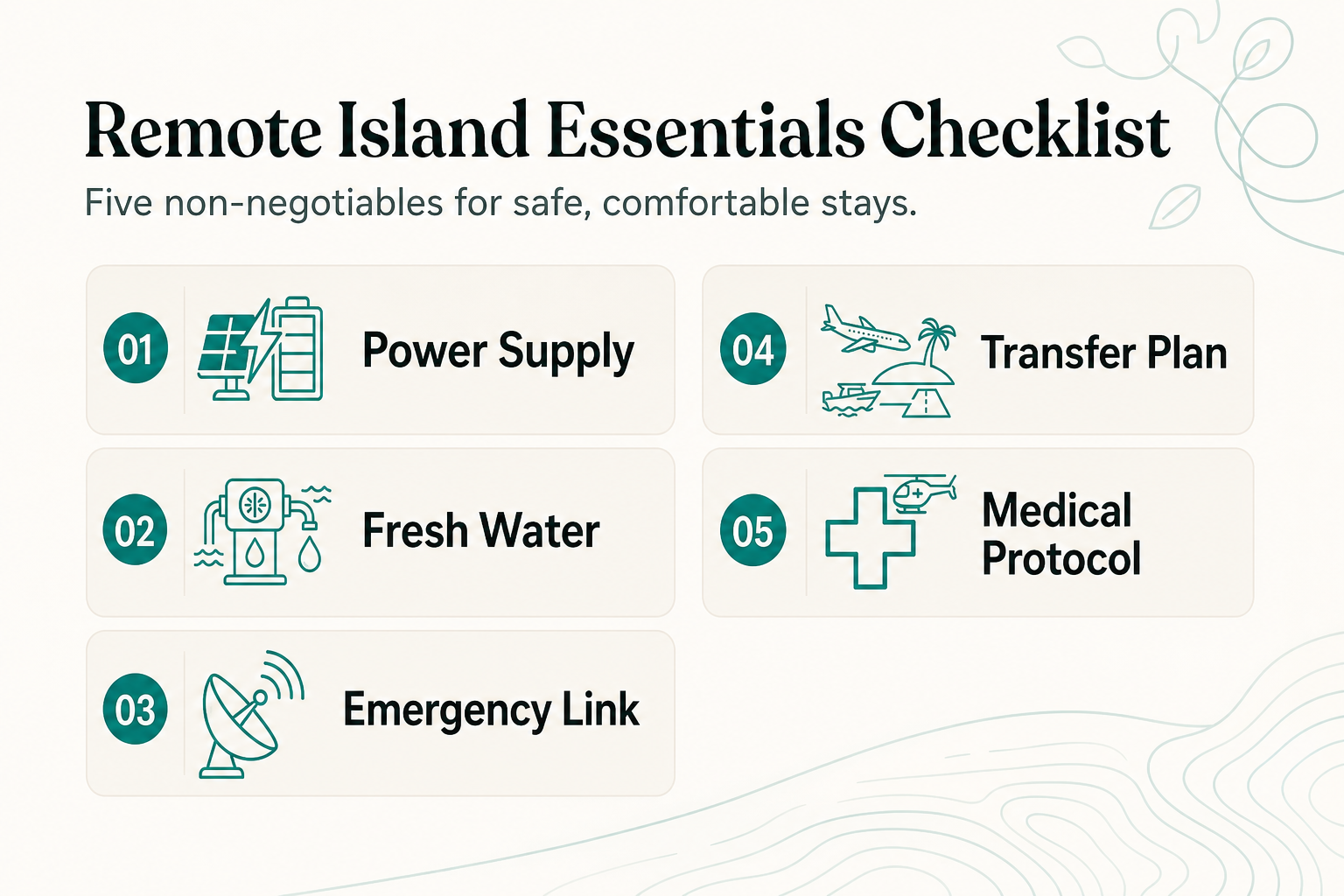
- The non-negotiables are power, water, connectivity for emergencies, and a coordinated transfer plan; everything else is comfort layered on top.
- Off-grid solar with battery backup and on-site desalination remove the two biggest failure points of remote island stays: power cuts and unsafe water.
- Air conditioning, Starlink internet, and full-board meals are reasonable expectations at a remote island eco-resort, not luxuries incompatible with authenticity.
- Reconnect on Buka Buka Island in the Togean Islands runs on 93% solar power, on-site desalinated water, and Starlink, while keeping to 20 rooms.
Reconnect operates a 20-room island eco-resort in the Togean Islands, Central Sulawesi, built off-grid from the ground up rather than retrofitted after the fact. That experience, running solar, desalination, and dive operations on a remote island daily, forms the basis for this checklist.
What Makes an Island "Remote" Without Mass Tourism Infrastructure?
A remote island in this context has no municipal grid, no piped water system, and no scheduled public transport connecting it to the mainland. Getting there usually means a flight, a long road transfer, and a boat crossing, in that order. That isolation is precisely what keeps visitor numbers low and ecosystems intact.
Islands with heavy infrastructure investment tend to draw heavy footfall, and heavy footfall is the documented driver of reef damage from careless snorkeling and boating, plus beach erosion from over-development [seagoinggreen.org]. Islands are also more prone to congestion than mainland destinations simply because they have less land to absorb visitors [sustainabletravel.org]. Public infrastructure in popular island destinations frequently lags behind demand during peak season [courier.unesco.org]. Remote islands sidestep this by never building the infrastructure that invites the crowd in the first place.
That tradeoff only works for travelers if the island still handles the basics. Isolation without a power plan, a water plan, and a way to call for help is not a remote island experience. It's a risk.
Why Do Off-Grid Islands Still Need Reliable Power and Water?
Reliable power on a remote island is not about running air conditioning around the clock. It is about refrigeration for food and medicine, lighting after dark, charging phones and dive computers, and running the pumps that produce drinking water in the first place. Lose power on an island with no backup generator and no fuel resupply schedule, and you lose water production within hours.
Off-grid tropical solar systems built to standards like IEC 62458 use high-efficiency monocrystalline panels paired with lithium-ion battery storage, with moisture-resistant sealing and IP65-rated junction boxes to survive salt air and humidity. This setup is materially different from a generator that runs a few hours a night.
Reconnect runs on 93% solar power, with a generator kept strictly as backup, never as the primary source. Desalinated water is produced entirely on-site, sun-powered, so there is no dependency on bottled water shipped in by boat. The resort also runs a zero single-use plastic policy, using a water dispenser, liquid soap, and cloth bags in place of disposables.
Checklist: power and water essentials for a remote island stay
- Solar capacity sized for 24-hour use, not just daytime
- Battery storage rated for at least one full night without sun
- Generator present only as backup, not the main source
- On-site water production (desalination or filtration), not shipped-in bottled water
- Clear plastic-reduction policy, since remote islands have no waste collection infrastructure
Does Staying Connected Undermine the Point of Going Remote?
Connectivity on a remote island is not about scrolling social media on a beach. It is about being reachable during a medical situation, a weather change, or a missed transfer, none of which pause because the island is scenic.
Satellite internet, specifically Starlink, has changed what is possible in remote island settings in the past few years. A resort can now sit hours from the nearest town by road and boat and still have functioning internet, without the fiber infrastructure that mass tourism destinations depend on. Reconnect runs Starlink throughout the resort alongside its solar system, a combination still uncommon in this part of Indonesia.
The tradeoff to be honest about: connectivity does not mean speed comparable to a city hotel, and it does not replace a coordinated transfer plan. A traveler booking a remote island stay should still confirm, before departure, exactly how the resort gets guests from the nearest airport to the property, step by step.
What Belongs on a Remote Island Traveler's Checklist?
Group the essentials by category rather than treating them as one long list. Some are safety-critical, some are comfort, and confusing the two leads to disappointment or worse.
| Category | Non-negotiable | Reasonable comfort expectation |
|---|---|---|
| Power | 24/7 electricity, solar with battery backup | Air conditioning in select rooms |
| Water | On-site desalinated or filtered water | Hot water for showers |
| Connectivity | Some form of emergency communication | Starlink or equivalent for daily use |
| Transfers | A single coordinated plan from airport to island | Private car and speedboat rather than shared transport |
| Food | Safe, consistent meal supply | Full-board, gourmet-standard meals |
| Medical | Basic first aid on-site, a clear evacuation plan | Not a hospital, but a real protocol |
On air conditioning specifically: it remains genuinely rare across Togean Islands resorts, most of which rely entirely on natural ventilation. Reconnect is one of the few in the region offering AC at all, and it is available in select room categories such as the Beachfront Villa, rather than across the entire property.
Reconnect's own room lineup illustrates the comfort-without-compromise principle: eight accommodation types from EUR 60/night for a Beachfront Glamping Hut or Pyramid, up to EUR 175/night for Villa Athena, all on all-inclusive full-board terms covering three meals daily, afternoon tea, and unlimited coffee, tea, and water.
How Does This Apply to Diving and Marine Access?
Diving adds a second layer of infrastructure demands on top of general remoteness: equipment, trained staff, and direct reef access around the island, since a long boat ride to a dive site adds real risk where rescue options are limited.
Visibility in the Togean Islands averages about 30 meters. Reconnect's location gives divers direct access to reefs, walls, and pinnacles around Buka Buka Island by short boat ride, rather than a long transfer from the resort.
SSI's certification path runs from Level 1 Open Water Diver (18-meter depth limit) through Level 2 Specialty Diver, Level 3 Advanced Open Water Diver (a recognition earned at four completed specialties plus 24 logged dives, not a bookable course), up to Level 4 Master Diver. Reconnect's on-site dive center is Blue Oceans certified and teaches in English, French, and Indonesian.
Bookable courses and dive packages
Its bookable five-dive course beyond Open Water is the Advanced Adventurer. Dive courses are paid separately from accommodation. The all-inclusive Dive-cation package bundles guided dives with full-board stay, covering meals and non-motorized activities like kayaking and snorkeling, plus guided dives-but not certification training.
Marine regulations and site access
Marine tourism operators in Indonesian protected waters work within national conservation frameworks, including coastal setback rules requiring at least 100 meters from the high tide line. This shapes where any dive center or eco-resort can legally build and contributes to reef preservation.
Frequently Asked Questions
How do I check if a remote island resort's power and water claims are real before booking?
Ask specifically what percentage is solar versus generator, how water is produced on-site, and whether backup power has ever failed to cover a full night.
Can you get a remote island eco-resort experience in Indonesia without giving up comfort?
Yes. The Togean Islands host several properties offering full-board meals, guided diving, and select air-conditioned rooms, while remaining small-scale and off-grid.
Why does coastal setback distance matter to travelers, not just regulators?
A 100-meter setback from the high tide line, required under Indonesian coastal law, keeps construction back from the shoreline, which is part of why well-regulated island resorts preserve their beach and reef frontage.
About Reconnect
Reconnect is an island eco-resort with an on-site SSI dive center on Buka Buka Island in the Togean Islands, Central Sulawesi. Founded by Thomas Despin, it operates with 93% solar power, on-site desalinated water, and zero single-use plastics across 20 rooms, all-inclusive full-board from EUR 60/night. Get in touch through reconnect.id to plan a stay.
References
- Can Small Islands Survive Mass Tourism? — Sea Going Green (seagoinggreen.org)
- What is Overtourism and Why is It a Problem? (sustainabletravel.org)
- Travel without leaving a trace - how to tackle overtourism I ... (courier.unesco.org)