


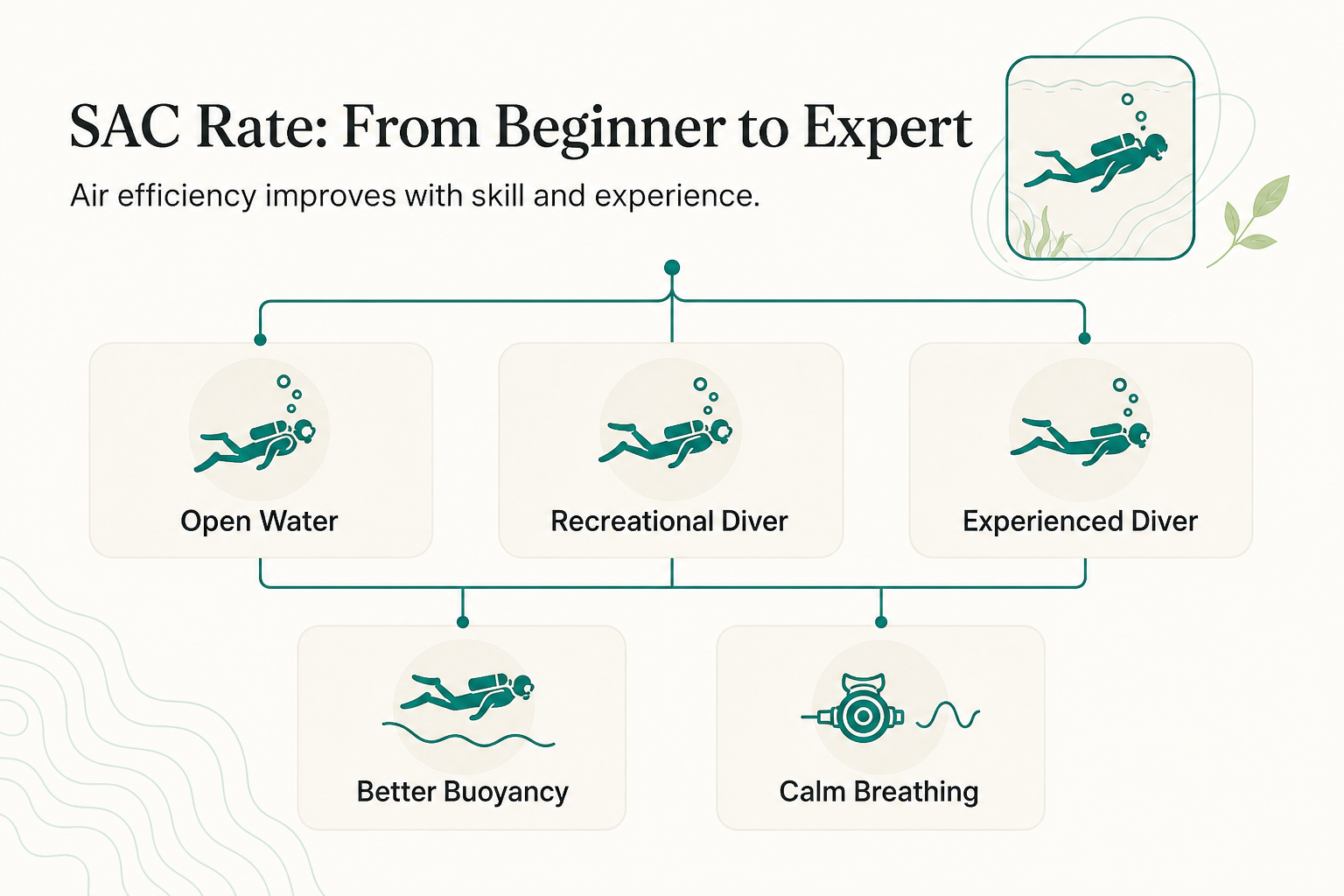
A diver's SAC rate, surface air consumption measured in cubic feet or liters per minute, is the single clearest number for tracking skill progress underwater. New Open Water divers typically burn through 0.8 to 1.2+ cubic feet per minute (cfm), while experienced divers and professionals often settle at 0.2 to 0.45 cfm, roughly half to a third the air for the same dive. That gap is not about lung capacity. It is about buoyancy control, trim, and a calmer breathing pattern that comes with logged dives.
TL;DR
- SAC rate (surface air consumption) measures how much air you use per minute at the surface, adjusted for depth to estimate real consumption.
- Beginners average 0.8-1.2+ cfm, recreational divers 0.4-0.7 cfm, experienced divers 0.2-0.45 cfm, according to PADI training benchmarks.
- Better buoyancy control and trim cut physical exertion; calmer breathing lowers oxygen demand. Both drop your SAC rate.
- Bottom time is usable gas volume divided by (SAC rate x ambient pressure at depth), so a lower SAC rate directly buys longer dives.
- SSI caps Open Water divers at 18 meters and Advanced Adventurer divers at 30 meters after the Deep Dive specialty, with no fixed bottom-time limit beyond no-decompression limits.
What Exactly Is a SAC Rate and Why Does It Matter?
SAC rate stands for surface air consumption, the volume of air you would use per minute if you were at the surface (1 atmosphere of pressure). It is the standard unit divers use to compare air efficiency across different depths and tank sizes. The number matters because it is the single best predictor of how long your air will actually last, more useful than tank size alone.
A diver with a low SAC rate on a small tank will often outlast a diver with a high SAC rate on a bigger one.
Think of SAC rate as miles-per-gallon for scuba diving. The tank is your fuel tank, but the rate at which you burn fuel determines your range, not the tank's size.
Two divers can start with identical tanks and finish wildly different dives.
How Do You Calculate SAC Rate and Dive Time?
Standard dive time calculations start with usable gas volume: your starting tank pressure minus a reserve pressure you want to keep in hand for ascent and safety stops. That usable volume is then divided by your SAC rate multiplied by the ambient pressure at your target depth. Ambient pressure at depth is depth in meters divided by 10, plus 1.
At 20 meters, that is (20/10) + 1 = 3 atmospheres. A diver breathing 20 liters per minute at the surface will breathe roughly 60 liters per minute at 20 meters, three times the surface rate.
Quick example:
| Variable | Value |
|---|---|
| Starting tank pressure | 200 bar |
| Reserve pressure (kept in reserve) | 50 bar |
| Usable pressure | 150 bar |
| SAC rate | 18 L/min |
| Depth | 20 m (3 atm) |
| Consumption at depth | 54 L/min |
Divide usable gas volume by consumption at depth and you get estimated bottom time. This is the logic behind every sac rate calculator and dive time calculator app on the market: same formula, just automated.
Why Does SAC Rate Improve From Open Water to Advanced Diver?
The improvement is physiological and biomechanical, not a matter of willpower. As divers log more dives, two things change at once, and each compounds the other.
Biomechanical: buoyancy control and trim. A diver who is constantly finning to stay off the bottom, or arching to avoid silting out a reef, burns oxygen on wasted movement. Scuba diving buoyancy control that is genuinely neutral, weight distributed so the diver hovers flat and horizontal, removes that drag entirely.
Streamlined trim means less water resistance with every kick.
Physiological: breathing pattern and stress. New divers tend to breathe shallow and fast, partly from excitement, partly from the unfamiliar sensation of breathing through a regulator. Experienced divers shift to slow, deep breaths and carry less background stress, which lowers both oxygen demand and respiratory rate.
The two reinforce each other. A diver who is not working hard to stay in position is, by definition, calmer, which slows the breathing further. Controlled breathing, extended exhales, and unhurried inhales interrupt the fast, shallow pattern that drives up consumption before buoyancy skills have time to mature.
What Role Does the Advanced Adventurer Course Play in This?
SSI's Advanced Adventurer course, the five-dive course that follows Open Water, is where most divers see their SAC rate drop fastest. It is not a coincidence. The course adds depth, navigation, and often a Deep Dive specialty dive to 30 meters, conditions that force better buoyancy habits because there is less margin for error.
SSI sets a maximum depth of 18 meters for Open Water divers. Advanced Adventurer divers who complete the Deep Dive component can go to 30 meters. Neither certification defines a fixed bottom-time limit: your actual time underwater is governed by no-decompression limits and your own air consumption.
SAC rate becomes the practical ceiling on a dive, not the certification card. This is also where task loading starts to matter. Current-heavy sites, navigation exercises, and greater depth all increase breathing rate independent of skill, so even a diver with a strong SAC rate in calm, shallow water will see it climb on a harder dive.
Recognizing that pattern, rather than being surprised by it, is itself a mark of an advancing diver.
How Can Divers Actively Lower Their SAC Rate?
Buoyancy work delivers the fastest, most durable gains. Perfecting fundamental skills-hovering, fin pivots, controlled ascents and descents-removes the physical exertion that drives up air use more reliably than any breathing exercise alone.
- Dial in weighting first. Overweighted divers fight to stay off the bottom; underweighted divers fight to stay down. Both waste air.
- Practice slow, deliberate breathing. Extend the exhale, do not hold the breath, let the inhale be unhurried.
- Log every dive's SAC rate. Patterns across dive sites, currents, and depths tell you where your technique still breaks down.
- Dive more often. Comfort compounds. A diver with 50 logged dives is calmer by default, independent of any specific drill.
For divers training in a real-world setting rather than a pool, site choice matters too. Guided dives on walls and pinnacles with strong but navigable currents teach buoyancy and trim far faster than flat, current-free sand patches, simply because the environment punishes poor technique immediately.
Frequently Asked Questions
Is a lower SAC rate always better?
Generally yes for dive time, but an unusually low rate during a stressful dive can indicate shallow breath-holding, which carries its own risk. Consistency across different conditions matters more than a single low number.
Does tank size affect my SAC rate?
No. SAC rate is a measure of your consumption per minute, independent of tank size. Tank size affects how long your usable gas volume lasts, not your rate of using it.
Can scuba diving for beginners target SAC rate improvement specifically?
Yes. Most of the gain in early courses comes from buoyancy and weighting work rather than deliberate breathing drills, since poor trim is the larger inefficiency for new divers.
Does SAC rate keep improving after Advanced Adventurer?
Yes, though the gains taper. The steepest curve is between Open Water and roughly 20-30 logged dives; specialty courses and more dive time refine it further but in smaller increments.
Do colder water or stronger currents change SAC rate expectations?
Yes. Current-heavy sites and task loading increase breathing rate regardless of experience level, so divers should expect a higher SAC rate on a challenging site than on a calm, shallow one.
About Reconnect
Reconnect is a Private Island Resort on Buka Buka Island in Indonesia's Togean Islands, built around an on-site SSI-certified dive center with direct reef access and visibility averaging about 30 meters. Courses run from Discover Scuba Diving through Advanced Adventurer and specialties, taught in English, French, and Indonesian in small groups. The resort is 93% solar-powered, fully off-grid, and all-inclusive full-board from EUR 60/night. Get in touch at reconnect.id to plan a course or guided dive package.