


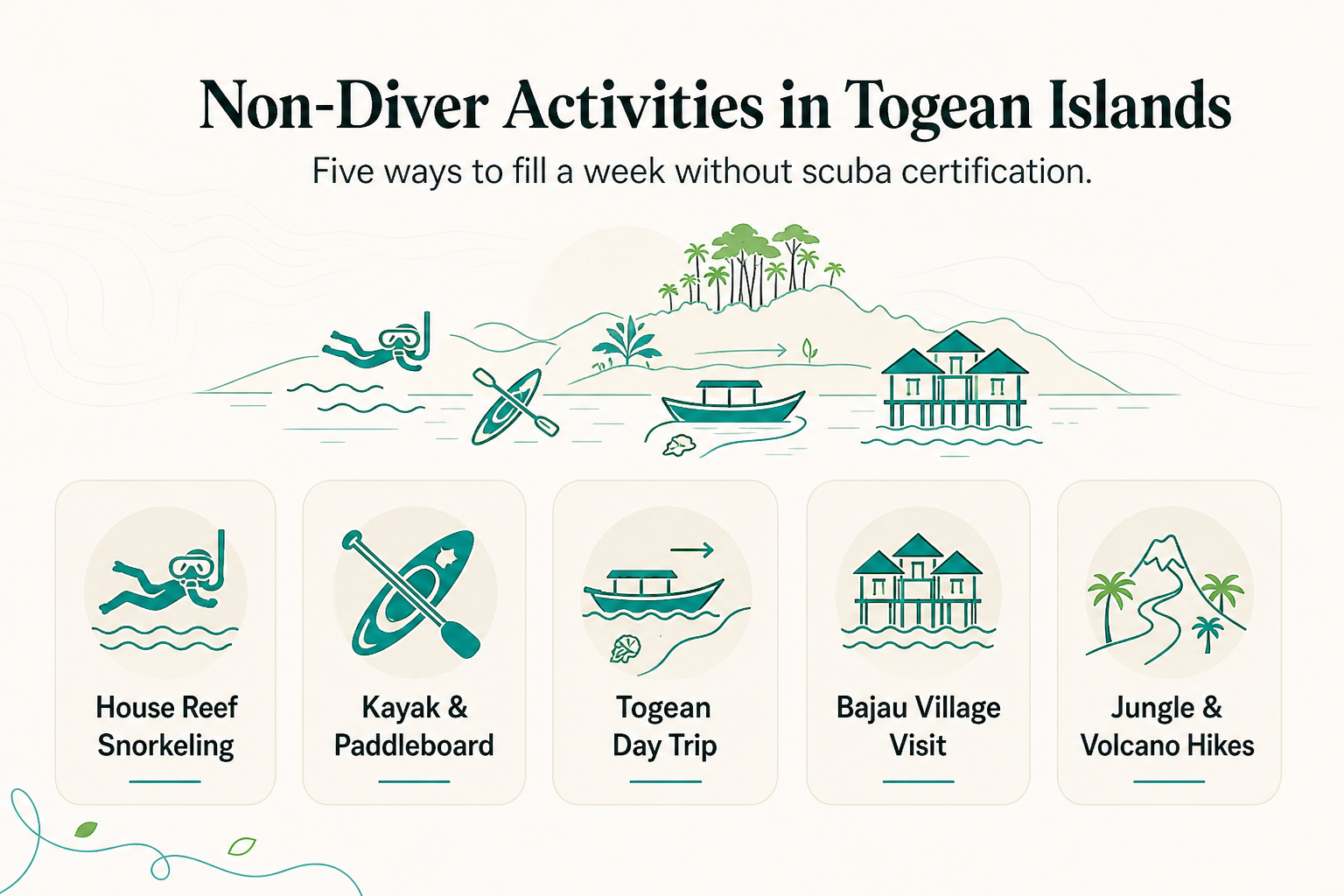
No. The Togean Islands reward non-divers as much as divers, just through a different set of activities: house-reef snorkeling, kayaking, paddleboarding, village visits, jungle hikes, and boat excursions into a national park that most visitors never fully explore. Diving gets the marketing attention because the reefs are genuinely exceptional, but a multi-day stay built entirely around snorkeling, paddling, and island exploring is a complete trip on its own, not a consolation plan for people who skip scuba.
TL;DR
- Snorkeling is the main non-diving draw: house-reef access is complimentary, and guided boat trips reach additional reef sites around Buka Buka Island.
- Kayaking and stand-up paddleboarding are included with every stay at Reconnect, no extra booking needed.
- The Togean Day Trip excursion reaches Togean Islands National Park sites non-divers can enjoy from the surface or the shore.
- Village visits to Bajau sea nomad communities and jungle or volcano hikes on nearby islands fill out a week without a single tank fill.
- Togean Islands accommodation built around full-board meals and no-car logistics matters more for non-divers, since they are not structuring their day around dive boat schedules.
Reconnect operates an SSI-certified dive center on Buka Buka Island, but a meaningful share of our guests book a multi-day stay without diving once. This gives us a direct, repeated view of what non-divers actually do and enjoy over three, five, or seven nights on the water.
What Can Non-Divers Actually Do Day to Day?
Snorkeling is the backbone of a non-diving stay, and it does not require a boat. A house reef reachable by wading or a short swim from shore is standard at most Togean properties, and at Reconnect it is complimentary for every guest, with masks, fins, and snorkels provided at no charge.
Visibility in the Togeans averages around 30 meters, calm and current-light compared to destinations like Raja Ampat, which makes snorkeling here relaxed rather than physically demanding. Beyond the house reef, guided snorkeling boat trips reach additional sites around the island, giving non-divers access to the same reef structures divers use, just from the surface.
Two more activities round out a typical day:
- Kayaking between nearby islets, included with every stay, no booking or extra fee.
- Stand-up paddleboarding along the shoreline, same inclusion terms as kayaking.
None of these require advance scheduling around dive boat departures. On a mixed-group trip, non-divers are not waiting around for the divers to surface before the day starts.
What Is the Togean Day Trip and Is It Worth It for Non-Divers?
The Togean Day Trip is a paid excursion by private boat into Togean Islands National Park, booked separately from the room rate. It is not included in a standard stay, so non-divers weighing whether to add it should know what the park actually offers from the surface.
Mariona Lake is one of the park's signature stops, a marine lake where stingless jellyfish drift just below the surface and snorkeling among them requires no scuba certification at all. Beaches like Karina and Kadidiri give a straightforward sand-and-swim stop between boat legs. For travelers who want a single day that captures the park's variety without any diving, the Togean Day Trip is the most efficient way to do it.
Permits are required for certain activities inside the park, and the standard park entrance fee is around IDR 150,000 (about USD 10) per person, with additional fees for specific permits such as diving or snorkeling in designated zones [togeanindonesia.com]. Build that into the day's budget separately from the excursion cost itself.
Can You Visit Bajau Villages and Explore the Islands on Foot?
Yes, and this is where the Togeans differ most from a standard beach destination. The Bajau, often called sea nomads, live in stilt villages built directly over the water, with Pulau Papan near Malenge being one of the most visited. A guided village visit gives non-divers a cultural dimension that no reef can provide, and it works as a half-day addition to any multi-day itinerary.
For travelers who want to stay on land, the islands themselves have terrain worth walking:
- Jungle trails on Malenge, through dense forest with a reasonable chance of spotting endemic wildlife.
- A trek up Mount Colo on Una Una, a more serious volcano hike for travelers wanting real elevation gain.
- Wildlife spotting for Togean macaques, coconut crabs, and hornbills, all endemic or near-endemic to the archipelago.
These are not polished, signposted trails in the way a national park trailhead in Europe or North America might be. Expect a guide, variable terrain, and a genuinely remote feel, which is the point for most people who choose the Togeans over more developed Indonesian destinations.
How Should Non-Divers Choose Togean Islands Accommodation?
Togean Islands accommodation matters more for non-divers than for divers, not less. A diver's day is structured by the dive center's boat schedule regardless of where they sleep. A non-diver's day depends entirely on what the resort itself offers on-site.
Three things to check before booking as a non-diver:
| Priority | Why it matters for non-divers |
|---|---|
| Full-board meal inclusion | No driving or boat trip needed to find dinner each night |
| Included water activities | Kayaking, paddleboarding, and house-reef snorkeling fill the day without extra bookings |
| Transfer coordination | Removes the logistics burden of independently arranging Ampana-to-island boats |
Reconnect's rooms run from EUR 60 per night for a Beachfront Glamping Hut or Pyramid tent, up to EUR 175 for Villa Athena, which sleeps up to four. All eight room types include the same full-board meals, afternoon tea, and unlimited coffee, tea, and water. Air conditioning is only available in select categories like the Beachfront Villa, worth flagging since many Togean properties do not offer AC in any room at all.
Is a Non-Diving Stay in the Togeans Worth the Travel Effort?
Getting here takes effort regardless of why you are coming. The typical route runs through Luwuk Airport, then a 5-hour private car transfer to Ampana, followed by a 30 to 45 minute speedboat crossing to the island.
That is a full day of transit before a non-diver even touches the water. The honest tradeoff is this: the Togeans ask for more logistics than a direct-access beach destination, but the payoff is a reef and island environment with far fewer visitors than better-known Indonesian spots. For a non-diver deciding whether that tradeoff is worth it, the deciding factor should be whether snorkeling, paddling, village visits, and hiking sound like a real week, not a backup plan.
Frequently Asked Questions
Do I need a national park permit just to snorkel from the beach?
No. Permits and park fees apply to activities inside Togean Islands National Park itself, reached via a paid excursion, not to house-reef snorkeling at a resort.
Will I see sharks or rays while snorkeling?
Possible but less reliable than diving. White-tip reef sharks and eagle rays are more commonly reported by divers at depth.
Is the jungle hiking safe without a guide?
Not recommended. Trails on Malenge and the Mount Colo trek on Una Una are best done with a local guide given the lack of signage.
About Reconnect
Reconnect is a private island eco-resort on Buka Buka Island in the Togean Islands, with an on-site SSI dive center. Learn more at reconnect.id.
References
- Permits, park fees and local rules in Togean Marine Park... (togeanindonesia.com)