


Every bookable SSI certification level, from a half-day Discover Scuba Diving experience through the professional Divemaster rating, is available on-site at Reconnect's dive center on Buka Buka Island, Central Sulawesi. Training dives happen at reef sites around the island, reached by short boat rides, with instruction offered in English, French and Indonesian. This guide maps each level in order, what it requires, and how long it realistically takes.
TL;DR
- SSI's recreational path runs Open Water Diver, then Specialty Diver (2 specialties, 12 logged dives), Advanced Adventurer (4 specialties, 24 dives, a recognition rating rather than a bookable course), then Master Diver (4 specialties plus Stress and Rescue, 50 dives).
- The professional track starts with Dive Guide (50 logged dives plus specific specialties) and advances to Divemaster, which adds the Science of Diving program and 60 logged dives total.
- Reconnect's on-site SSI dive center runs the full sequence, with training dives at reef sites around Buka Buka Island and visibility averaging about 30 meters.
- Dive courses are booked and paid for separately from the all-inclusive stay rate.
- Reconnect is a Blue Oceans certified dive center with small-group instruction in three languages.
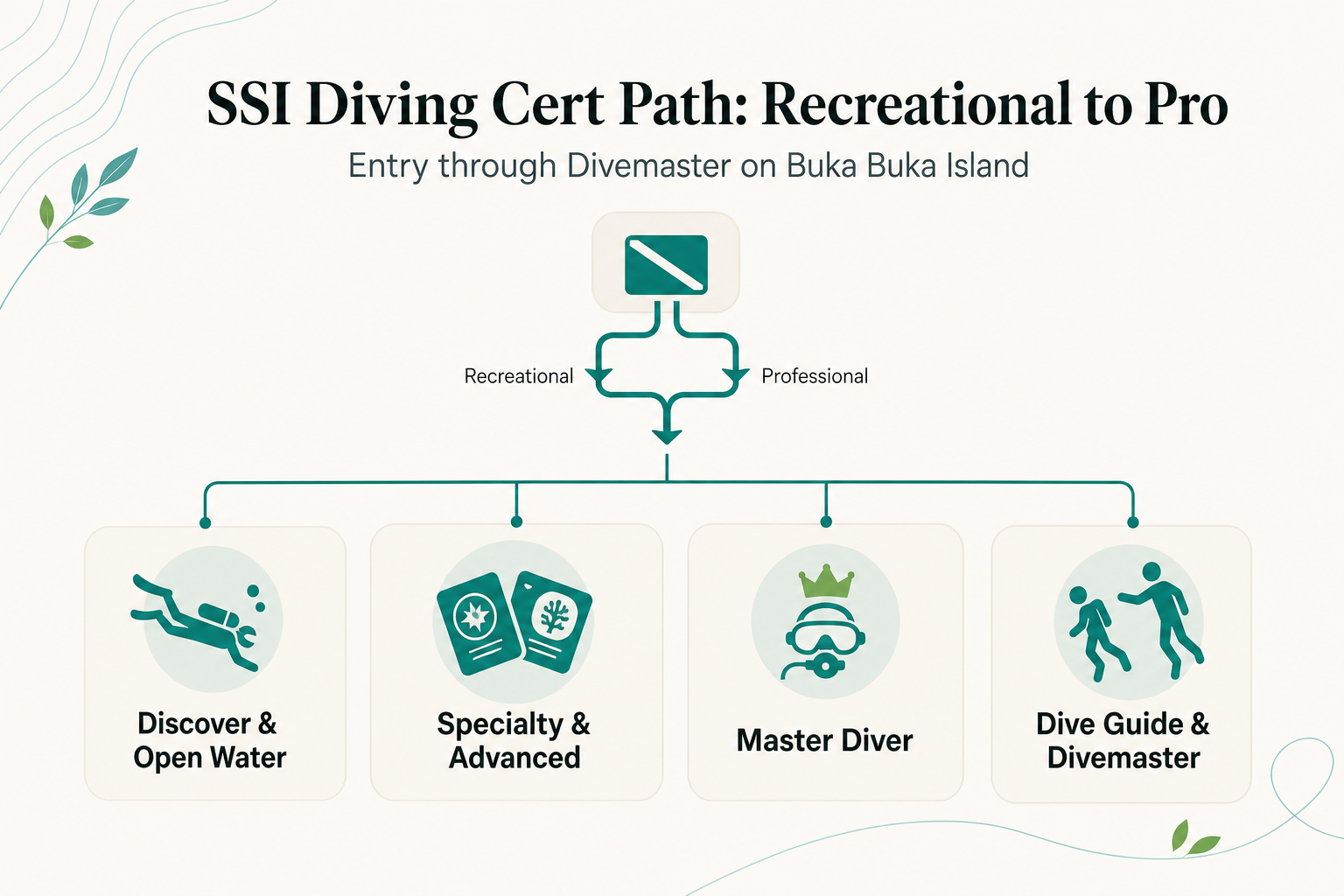
What Certification Levels Does SSI Actually Offer?
Scuba Schools International is a global, business-based training and certification agency founded in 1970, headquartered in Wendelstein, Germany under parent company HEAD NV. It is ISO-certified against ISO 24801 and 24802 standards for recreational diving and is a founding member of the Recreational Scuba Training Council.
The common "ssi vs padi" question comes down to structure more than substance. Both are RSTC founding members teaching equivalent core skills. SSI's point of difference is a digital learning platform and a slightly different specialty-count structure for its advanced ratings, which matters once you reach the levels below.
SSI's recreational progression has four stages:
- Open Water Diver: entry-level certification, no prior experience needed.
- Specialty Diver: requires 2 specialty courses and 12 logged dives.
- Advanced Adventurer: a recognition rating, not a separate bookable course. It is awarded automatically once a diver has completed 4 specialties and logged 24 dives.
- Master Diver: requires 4 specialties plus the Stress and Rescue course, and 50 logged dives.
The professional track begins with Dive Guide, requiring 50 logged dives and specific specialties, then advances to Divemaster, which adds the Science of Diving program and brings the total to 60 logged dives.
How Do You Start: Discover Scuba Diving or Straight to Open Water?
Discover Scuba Diving is a single supervised dive for anyone who has never used scuba gear, run in shallow water with an instructor the whole time. It answers one question cheaply: do you like breathing underwater before you commit to a full course.
For scuba diving for beginners who already know they want certification, skipping straight to the Open Water Diver course is the faster route. At Reconnect, both options run from the same jetty, with training dives at reef sites around Buka Buka Island rather than the house reef.
Step 1: Discover Scuba Diving
One confined or shallow open-water dive with an instructor. No certification issued. Typically completed in a few hours.
Step 2: Open Water Diver Course
The SSI open water certification is earned through:
- Academic study (SSI's digital platform, completed at your own pace)
- Confined water skill sessions
- Open water training dives at reef sites around the island
This is the foundation certification every other level builds on. Reconnect's open water diver course runs in small groups with more individual correction time on buoyancy and weighting, the two skills most beginners actually struggle with.
What Comes After Open Water: Specialty Courses and Advanced Adventurer?
Advanced Adventurer is not something you book. It is a rating SSI awards once your logbook and certification record show 4 completed specialties and 24 logged dives.
SSI specialty courses are the building blocks that get you there. Common choices include:
| Specialty | Typical Focus |
|---|---|
| Navigation | Compass and natural navigation underwater |
| Deep Diving | Diving beyond 18 meters safely |
| Night/Low Visibility | Diving after dark or in reduced visibility |
| Perfect Buoyancy | Trim, weighting, air consumption |
| Wreck or Boat Diving | Site-specific procedures |
Reach 12 logged dives with 2 specialties and you hold Specialty Diver. Reach 24 dives with 4 specialties and SSI automatically recognizes you as Advanced Adventurer, no separate exam required. Push to 50 dives with 4 specialties plus Stress and Rescue, and you qualify for Master Diver, the top recreational rating before the professional track begins.
What Does the Professional Track Look Like: Dive Guide to Divemaster?
The professional track asks for more logged dives and a different kind of competence: the ability to supervise other divers, not just yourself.
Dive Guide is the entry point. It requires 50 logged dives and specific specialty certifications, and it shifts the training focus toward site knowledge, group management, and problem-solving for other divers rather than your own skills.
Divemaster builds directly on Dive Guide. It requires completing both the Dive Guide and Science of Diving programs, along with 60 logged dives total. The Science of Diving component covers the physics and physiology behind the recreational limits you have been diving within all along, decompression theory, gas absorption, the actual mechanics of why dive tables and computers say what they say.
A Divemaster candidate is expected to demonstrate sound, independent judgment in dive planning and execution. During the course, instructors break down every skill learned since Open Water and expect precision performance, not just a passing standard. That is the real difference between diving as a recreational skill and diving as the first rung of a profession: precision becomes the product, not a nice-to-have.
Reconnect's instructors and divemasters work with well-maintained, modern equipment, and the center has been featured in Dive Magazine for its approach to training in a remote island setting [divemagazine.com].
FAQ
Is the SSI Open Water course included in Reconnect's all-inclusive rate?
No. All-inclusive full-board rates cover meals, house-reef snorkeling, kayaking and paddleboarding. Dive courses, including Open Water, are booked and paid for separately.
Can I do Discover Scuba Diving if I have never snorkeled before?
Yes. It requires no prior experience and is run entirely with an instructor present in shallow water.
Does Reconnect run training dives on the house reef?
No. Course training dives happen at reef sites around Buka Buka Island, reached by a short boat ride. The house reef is reserved for complimentary snorkeling.
How many logged dives do I need before starting Divemaster?
You need to have completed Dive Guide and the Science of Diving program, reaching 60 logged dives total, before certifying as Divemaster.
About Reconnect
Reconnect is a Private Island Resort on Buka Buka Island in the Togean Islands, built around an on-site SSI dive center that is Blue Oceans certified. The resort is 93% solar-powered, produces its own desalinated water, and runs on a zero single-use plastic policy. Full-board stays start from EUR 60 per night, with dive courses booked separately and transfers coordinated from Luwuk Airport. Get in touch at reconnect.id.