


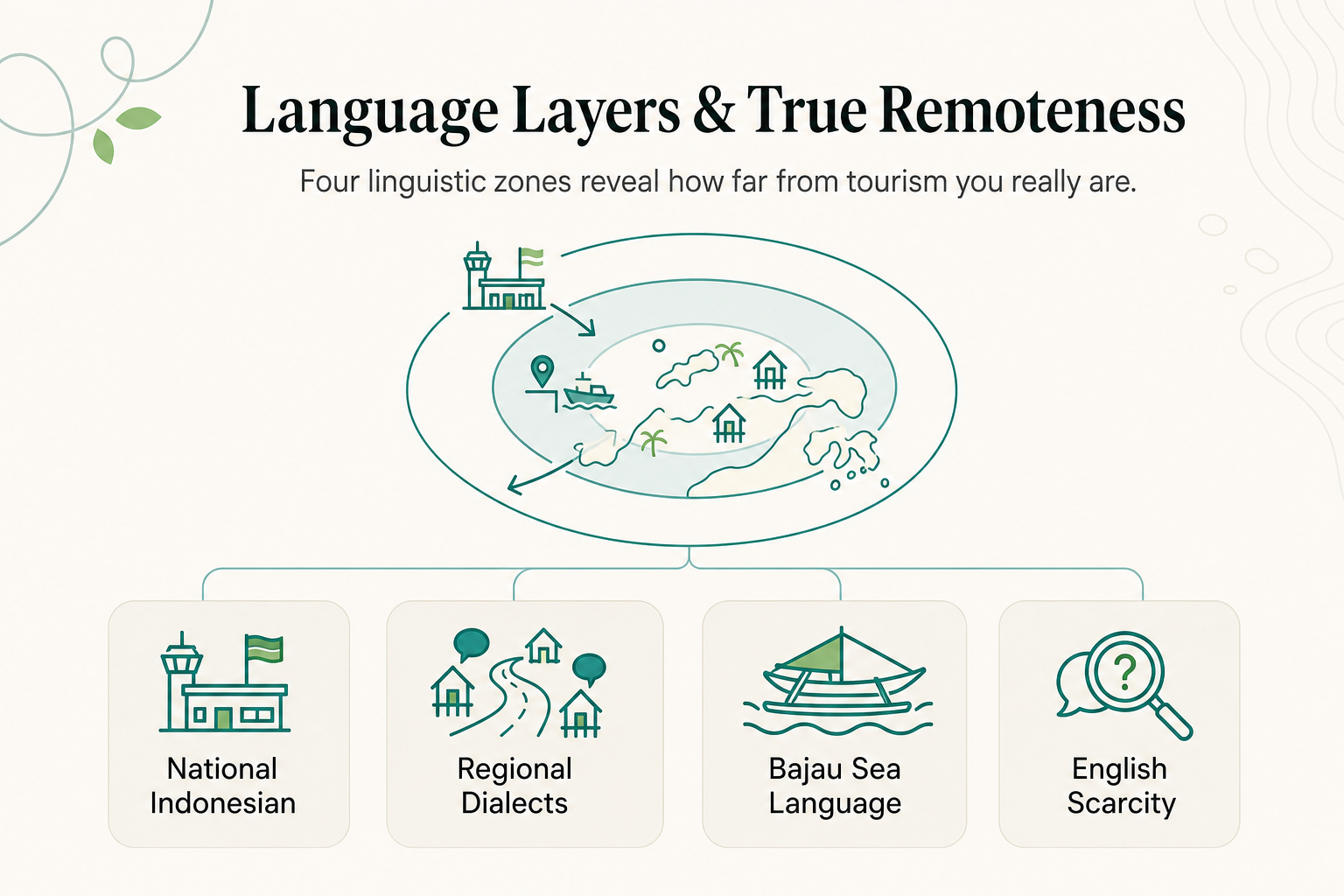
The number of languages a traveler needs to get by is a more honest measure of remoteness than any distance on a map. In the Togean Islands of Central Sulawesi, reaching the archipelago means moving through Indonesian-speaking airport staff, Bajau sea nomad communities with their own spoken dialect, and village interactions where English simply is not the default. That layering of languages, not the hours of travel, is what actually signals how far off the beaten path you have gone.
TL;DR
- Remoteness shows up in how many language transitions a trip requires, not just travel time or distance.
- The Togean Islands involve at least three linguistic layers: national Indonesian, regional Sulawesi dialects, and the distinct spoken language of Bajau sea nomad communities.
- Fewer English speakers at each step (airport, port, village, boat crew) is a reliable proxy for how untouched a destination remains.
- Resorts that bridge these gaps without erasing local culture offer a more authentic travel experience than destinations that have standardized around English.
- Reconnect operates as a Private Island Resort in this exact linguistic environment, running dive instruction in English, French, and Indonesian so guests get both immersion and clarity.
Why Do Language Barriers Track Remoteness So Closely?
A language barrier is simply the point where a traveler's assumptions about communication stop working. In heavily touristed parts of Indonesia, such as Bali, English has become a working second language for most people in hospitality. In the Togean Islands, it has not, and that gap is not an inconvenience to route around. It is data.
Every destination sits somewhere on a spectrum between "standardized for international visitors" and "operating on its own terms." Where airports, menus, and signage remain primarily in Indonesian and regional languages, you are closer to the lived reality of the region, not a curated version of it.
Recognizing that linguistic layers signal population density, tourism infrastructure, and how recently outsiders have arrived in number changes how you prepare for the journey.
How Many Language Layers Does Reaching the Togean Islands Actually Involve?
Getting to the Togean Islands is not a single border crossing. It is a sequence of distinct linguistic zones, each with its own level of English fluency.
Layer 1: National Indonesian (Bahasa Indonesia)
At Luwuk Airport, Bahasa Indonesia is the working language. Airport staff, drivers, and officials function in Indonesian first, with English available in pockets but not guaranteed. This is standard for a regional gateway serving a remote island destination rather than a major international hub.
Layer 2: Regional Sulawesi Dialects
The overland transfer from Luwuk to Ampana moves through communities where local Sulawesi dialects sit alongside standard Indonesian. Menus, roadside signage, and casual conversation shift register the further you travel from the airport.
Layer 3: Bajau Sea Nomad Communities
The most distinct linguistic layer belongs to the Bajau sea nomads, communities who have historically lived on boats and stilt villages across the Coral Triangle. Their spoken language is separate from standard Indonesian, and a village visit to a nearby Bajau community is as much a linguistic encounter as a cultural one.
Each layer strips away a bit more of the assumption that English, or even standard Indonesian, will carry you through. That progressive loss of a common language is the clearest marker that you have left mass tourism behind and entered a genuinely remote travel destination.
What Does This Mean for Trip Planning in Remote Indonesia?
Recognizing language layering changes how you prepare, not whether you go. A traveler with no Indonesian can still reach the Togeans and have a smooth trip. The planning simply shifts toward bridging gaps rather than avoiding them.
Practical approaches that work well in this kind of setting:
- Learn a handful of functional phrases. Greetings, numbers, and food-related words solve most daily friction.
- Treat translation tools as a backup, not a crutch. Connectivity in genuinely remote regions is inconsistent, so apps that require constant data access can fail exactly when needed most.
- Book through an operator that handles the handoffs. Coordinated transfers remove the moments where a language gap would otherwise become a logistics problem. Reconnect coordinates the full route from Luwuk Airport through Ampana to the island, bridging each linguistic layer rather than leaving guests to negotiate each leg independently.
Unresolved language barriers do not just slow things down, they measurably affect outcomes when no bridging mechanism exists. The fix is not to eliminate the barrier. It is to have a reliable bridge across it.
Why Does This Make the Togean Islands a Genuine Case Study in Remoteness?
Stepping back from the logistics, the deeper point is that the Togean Islands pass a test that many "remote" destinations do not. A place marketed as off-the-beaten-path but staffed entirely in English has usually already been absorbed into the tourism economy. The Togeans have not reached that point, and the language layering above is the evidence.
Reefs that sit outside heavy tourist traffic tend to correlate with reefs that have seen less diver pressure overall. Visibility around Buka Buka Island averages about 30 meters, reflecting water that has not been degraded by mass-tourism infrastructure.
An island experience built around this kind of remoteness looks different from a standardized resort stay. At Reconnect, that means:
| Element | How it addresses remoteness |
|---|---|
| Dive instruction | Offered in English, French, and Indonesian, bridging the main languages guests and local staff actually speak |
| Local staffing | All staff hired locally, keeping the resort embedded in the surrounding linguistic and cultural environment rather than imported from outside |
| Village visits | Structured excursions to Bajau sea nomad communities, framed as cultural exchange rather than a staged photo stop |
| Connectivity | Starlink internet available resort-wide, so guests can use translation tools when needed without relying on patchy local signal |
None of this erases the language layering described above. It makes the layering navigable without flattening it into something generic, which is the difference between an authentic travel experience and a manufactured one.
Frequently Asked Questions
Do I need to speak Indonesian to visit the Togean Islands?
No. Basic English works at the airport level and at resorts with international staff, but functional Indonesian phrases help significantly in villages and smaller ports.
What language do Bajau sea nomad communities speak?
Bajau communities speak their own distinct language, separate from standard Bahasa Indonesia, reflecting their long history as a semi-nomadic seafaring people across the Coral Triangle.
Is the Togean Islands good for snorkeling as well as diving?
Yes. Reefs in this region support both snorkeling and diving, with house-reef snorkeling available directly off the beach at resorts like Reconnect.
Are there other reliable routes into the Togean Islands besides Luwuk?
Luwuk is the main reliable gateway, with Gorontalo as the other reliable route. Ampana functions as a port leg on the Luwuk route, not a separate gateway.
About Reconnect
Reconnect is a Private Island Resort and SSI dive center on Buka Buka Island in the Togean Islands. Get in touch at reconnect.id to plan a stay that treats remoteness as the point, not the obstacle.
References
- Implications of Language Barriers for Healthcare: A Systematic Review - PMC (pmc.ncbi.nlm.nih.gov)